Hej! Välkommen tillbaka.
In our last two lessons, we established the fundamental blueprint for Swedish main clauses: the V2 word order rule, which places the verb in the second position, and the cast of "actors" – the subject pronouns (jag, du, hon, etc.) that perform the action.
Today, we give those actors their scripts. Our learning outcome is to conjugate regular and common irregular verbs in the present tense. This is the V in our SVO (Subject-Verb-Object) structure. You'll learn the systematic patterns Swedes use to talk about what is happening right now.
For someone with your background in tutoring and language analysis, you'll appreciate that Swedish verbs present a fascinating trade-off: one aspect is dramatically simpler than in English or French, while another introduces a new layer of categorization.
The Golden Rule of Swedish Verbs
Let's start with the simplification. Unlike French or even English (with its third-person "-s"), Swedish present tense verbs do not change form based on the person or number. The verb for "I speak" is the same as for "she speaks" or "they speak."
Take a look at the following image. It lists 25 common verbs. Pick any verb and look down its column. You'll see the same form repeated for Jag, Du, Han/Hon, Vi, Ni, and De. This is a core principle.
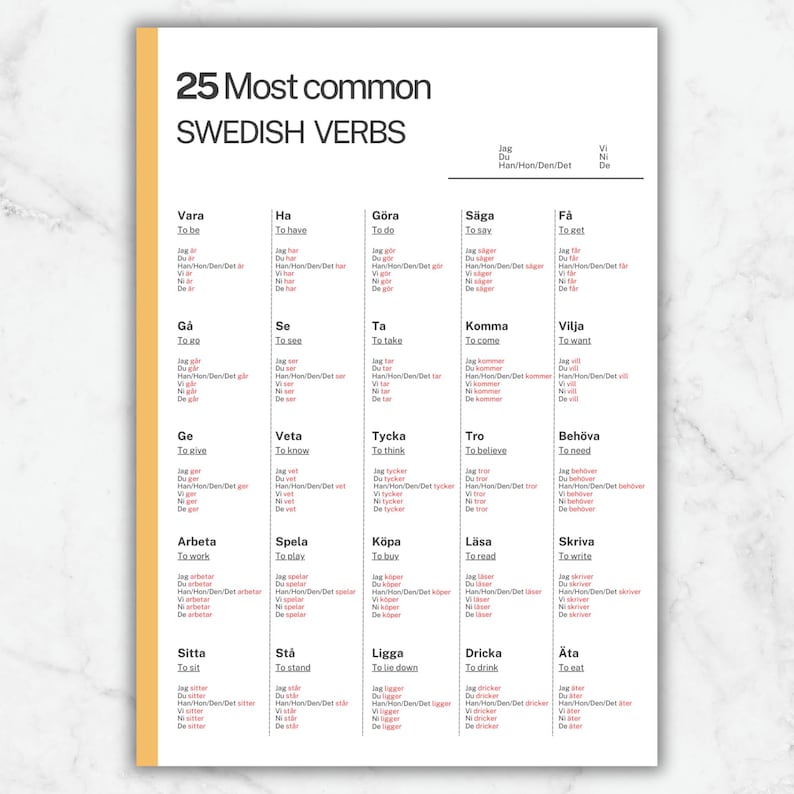
This means your main task isn't memorizing different endings for each pronoun, but rather learning which single present tense form a verb takes. This is determined by which "verb group" it belongs to.
The Verb Groups: A System of Patterns
Swedish verbs are traditionally sorted into four main groups, plus a smaller set of completely irregular verbs. Think of these groups as sets of conjugation rules. Knowing a verb's group tells you how to form its tenses. For today, we only care about the present tense.
The following video provides a fantastic, comprehensive overview of the entire system. We'll watch it in segments to break down each group.
EVERYTHING About SWEDISH Verbs
The video 'EVERYTHING About SWEDISH Verbs' from the channel Say It In Swedish gives a complete tour of the verb conjugations. It's perfect for getting the full, un-simplified picture you prefer. We'll focus on the present tense formations for each group.
Watch the following segments, paying close attention to how the present tense is formed for each group: Group 1: Start at 01:18 and watch until 02:47. Note the '-ar' ending. Group 2: Continue from 02:47 to 05:34. Note the '-er' ending. Group 3: Continue from 05:34 to 06:22. Note the '-r' ending. Group 4 (Strong Verbs): Continue from 06:22 to 08:41. Note that these also typically use '-er' in the present tense.
To complement the video, here is a visual "cheat sheet" that summarizes the verb groups. This can be a very useful reference as you work through the patterns.
Present Tense Formation by Group
Let's synthesize what you've just seen and heard. The infinitive is the base form of the verb, usually preceded by att (to), e.g., att tala (to speak). The stem is the verb's core, often found by removing the -a from the infinitive.
-
Grupp 1: The
-arverbs- These verbs have a stem ending in a consonant, and their infinitive ends in
-a. - Rule: Add
-arto the stem. - Example:
att arbeta(to work) →arbet+ar→arbetar. - Jag arbetar. Du arbetar. Vi arbetar.
- These verbs have a stem ending in a consonant, and their infinitive ends in
-
Grupp 2: The
-erverbs- This is a large group. The stem often ends in a consonant.
- Rule: Add
-erto the stem. - Example:
att ringa(to call) →ring+er→ringer. - Hon ringer. Ni ringer. De ringer.
-
Grupp 3: The
-rverbs- These are typically short, monosyllabic verbs whose stem ends in a vowel.
- Rule: Add
-rto the stem. - Example:
att bo(to live/reside) →bo+r→bor. - Han bor. Jag bor. Vi bor.
-
Grupp 4: The "Strong" Verbs
- These are considered irregular because they change their stem vowel in the past tense (e.g., drick → drack).
- However, in the present tense, they usually behave like Group 2 verbs.
- Rule: Add
-erto the stem. - Example:
att skriva(to write) →skriv+er→skriver. - Jag skriver. Du skriver. De skriver.
The Truly Irregular Verbs
Finally, there's a small but extremely common set of verbs that don't follow any group pattern, even in the present tense. These must be learned individually. You've already encountered some of them in the example chart. The most critical ones are vara (to be), ha (to have), and göra (to do/make).
This next video focuses on 10 of these common irregular verbs.
10 IRRegular Swedish verbs you NEED to know (and how to conjugate them) - ORegelbundna verb
The video '10 IRRegular Swedish verbs you NEED to know' from Fun Swedish is excellent for focusing on the most frequent verbs that break the rules. Pay attention to the present tense form given for each.
Watch the sections for these three essential verbs: att vara (to be): 01:05 - 02:15. Present tense: är. att ha (to have): 02:58 - 04:11. Present tense: har. att göra (to do/make): 10:50 - 11:59. Present tense: gör.
Here's a reference table for the most common irregular verbs in the present tense:
| Infinitive | English | Present Tense |
|---|---|---|
att vara |
to be | är |
att ha |
to have | har |
att göra |
to do/make | gör |
att vilja |
to want | vill |
att kunna |
to be able/can | kan |
att veta |
to know | vet |
Test your understanding!
Let's practice applying these rules. Combine your knowledge of subject pronouns and verb conjugations to form simple sentences.
Part 1: Conjugate the verb.
Given the infinitive and the group, write the present tense form.
att prata(to talk) - Group 1att läsa(to read) - Group 2att må(to feel) - Group 3att dricka(to drink) - Group 4att gå(to go/walk) - Irregular
Part 2: Form a sentence.
Translate the following sentences into Swedish.
- I speak Swedish. (
att tala- Group 1) - She reads a book. (
att läsa- Group 2) - They live in Sweden. (
att bo- Group 3) - He is a teacher. (
att vara- Irregular)
Show answer
Part 1 Answers:
pratarläsermårdrickergår(This one is irregular but follows a simple-rpattern in the present).
Part 2 Answers:
Jag talar svenska.Hon läser en bok.De bor i Sverige.Han är en lärare.
Conclusion
Excellent work today. You've now connected the "who" (subject pronouns) with the "what they do" (verbs), giving you the power to form complete, meaningful statements in the present tense.
- Key Takeaways:
- Swedish present tense verbs have one form for all subjects (
jag,du,vi, etc.). - Regular verbs are categorized into three main groups based on their present tense endings:
-ar(Group 1),-er(Group 2), and-r(Group 3). - "Strong" verbs (Group 4) are irregular in the past tense, but usually take an
-erending in the present, just like Group 2. - A small set of high-frequency verbs (
är,har,gör,kan,vill) are truly irregular and must be memorized.
- Swedish present tense verbs have one form for all subjects (
In our next lesson, we will complete the core components of the main clause by learning how to negate these sentences. You'll learn the rule for placing the adverb inte (not) correctly within the satschema (sentence schema), allowing you to express both what is true and what is not.