Welcome to your first lesson! We're kicking off your journey into the tech industry by building a foundational understanding of the business landscape. Your goal is to pivot into a management role in tech, and to do that effectively, you first need to speak the language and understand the fundamental types of companies that exist.
Today, we will address the first learning outcome of the course: Describe the major categories of tech companies (e.g., SaaS, marketplace, platform, infrastructure).
Think of this lesson as creating a mental map of the tech world. Just as in real estate you have different property types—residential, commercial, industrial—the tech industry has its own distinct categories. Understanding these categories is the first step to analyzing their business models, competitive advantages, and how they create and capture value, which we'll explore throughout this course.
1. The "As-a-Service" Models: A New Way of Doing Business
Many modern tech companies operate on a "cloud computing" model. In your construction and real estate businesses, you are familiar with the difference between owning an asset (like a building or heavy machinery) versus leasing it. Cloud computing applies a similar principle to technology. Instead of buying and managing their own physical computer servers, companies can "rent" computing power, storage, and even ready-made software over the internet.
This leads to three major categories of companies, often called the "as-a-service" models:
- Infrastructure as a Service (IaaS)
- Platform as a Service (PaaS)
- Software as a Service (SaaS)
An easy way to remember the difference is with a dining analogy:
- IaaS is like buying groceries. You get the raw ingredients (servers, storage) but you are responsible for preparing the entire meal (installing the operating system, managing the applications).
- PaaS is like a meal-kit delivery service (e.g., HelloFresh). The ingredients come pre-packaged with a recipe. You still have to do the cooking, but the complex prep work is done for you.
- SaaS is like dining at a restaurant. You simply enjoy the finished product. The restaurant handles everything from the ingredients to the cooking and service.
The image below visually breaks down who is responsible for what in each model. "On-Premise" represents the traditional model of owning and managing everything yourself. As you move from IaaS to SaaS, the vendor takes on more responsibility, which offers more convenience but less control for the customer.
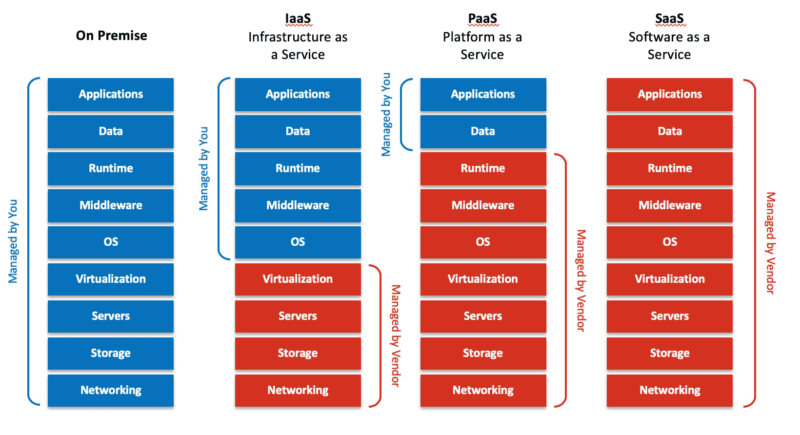
Now, let's explore these categories in more detail.
IaaS vs PaaS vs SaaS Explained Simply
The following article, 'IaaS vs PaaS vs SaaS Explained Simply' from Edgedelta, provides an excellent business-focused overview of these models. It uses the dining analogy and includes tables analyzing costs and ROI, which should resonate with your finance background.
Please read the following sections to get a solid grasp of these concepts: 'Understanding Cloud Service Models – The Foundation': Focus on the dining analogy and the 'Shared Responsibility Concept'. 'IaaS (Infrastructure as a Service) – Maximum Control': Understand what IaaS is, who uses it, and its benefits. Note the key players like AWS and Azure. 'PaaS (Platform as a Service) – Faster Development': Grasp its purpose as a development environment and who its primary customers are (developers). 'SaaS (Software as a Service) – Immediate Productivity': This is a huge category. Pay attention to the examples (Salesforce, Slack) and business benefits. 'Direct Comparison – IaaS vs PaaS vs SaaS': Study the 'Comprehensive Comparison Table' and the 'Decision Framework'. This will solidify the differences.
To summarize the key points from the reading:
- IaaS (Infrastructure as a Service): These companies provide the fundamental building blocks of computing. Their customers are typically other companies with technical teams who need maximum control to build custom systems. The dominant players are Amazon Web Services (AWS), Microsoft Azure, and Google Cloud Platform (GCP). This is a high-volume, relatively low-margin business driven by massive scale.
- PaaS (Platform as a Service): These companies build on top of IaaS to offer a ready-made environment for software developers. They make it faster and easier for other companies to build and run their own applications. Examples include Heroku and AWS Elastic Beanstalk.
- SaaS (Software as a Service): These companies provide fully-functional applications directly to end-users, usually via a web browser and for a subscription fee. This is the category most people are familiar with. Examples are everywhere: Salesforce (for sales), Workday (for HR), Slack (for communication), and Netflix (for entertainment).
2. Marketplaces and Platforms: The Power of Connection
Another major group of tech companies creates value not by selling a product they made, but by connecting different groups of users. These are known as marketplaces and platforms. Their power comes from creating "network effects"—the idea that the service becomes more valuable as more people join.
Marketplaces
A marketplace is a business whose primary function is to facilitate transactions between buyers and sellers. Think of it as a digital shopping mall or a broker. They make money by taking a small percentage of each transaction, known as a "take rate" or commission.

To understand the different flavors of marketplaces, the following video provides a clear classification system.
This video, 'Marketplace Business Models' by The Business Engineer, breaks down marketplaces into simple, understandable categories. This will help you classify them based on what they sell, who their customers are, and how many different groups are involved.
Watch the video from the beginning until the 5:20 mark. Pay close attention to the three ways to classify marketplaces: Product/Service Profile: Is it selling physical goods (like Etsy) or services (like Uber)? Customer Profile: Who is selling to whom? (B2B, B2C, C2C) Key Players: How many sides are there to the market? (Two-sided, three-sided, etc.)
Platforms
The term platform is often used interchangeably with marketplace, but it's a broader concept. While a marketplace's main purpose is transactions, a platform is a digital ecosystem that enables a wider range of interactions.
- All marketplaces are platforms, but not all platforms are marketplaces.
For example, Facebook is a platform. It connects you with friends (social networking), content creators (news feed), and businesses (pages). It also has a "Marketplace" feature for transactions, but that's just one part of the broader platform. Similarly, Apple's iOS is a platform that connects app developers with iPhone users. The App Store is the marketplace that sits on top of the iOS platform.
The distinction is subtle but important. Platforms create value in many ways beyond just enabling a sale, such as sharing information or building communities.
To clarify this crucial difference, let's turn to one last resource.
Marketplaces vs. platforms: What's the difference?
The article 'Marketplaces vs. platforms: What's the difference?' from Stripe (a major financial technology platform) provides a concise explanation of these two concepts.
Please read the following three short sections: 'What is a marketplace?': This will reinforce the definition. 'What is a platform?': Focus on how it's defined as a broader 'digital infrastructure' and the importance of 'network effects'. 'What’s the difference between a marketplace and a platform?': This section directly compares the two models using eBay and Facebook as examples. This is the most important part.
Test your understanding!
For each company below, identify its primary category: IaaS, SaaS, Marketplace, or Platform. Some may have elements of more than one, but choose the one that best describes its core business model.
- Shopify: Provides tools for businesses to create and run their own online stores.
- Netflix: Offers a library of movies and TV shows for a monthly fee.
- Airbnb: Connects people who want to rent out their homes with people who are looking for accommodations.
- Google Cloud Platform: Rents out servers, storage, and networking infrastructure to other companies.
- Microsoft Windows: An operating system that runs on PCs and allows users to run various software applications.
Show answer
- Shopify: Primarily SaaS. Businesses pay a subscription fee for software that helps them run their e-commerce operations. Shopify also has strong Platform characteristics, as it has an app store that connects merchants with third-party developers. This hybrid nature is common in successful tech companies.
- Netflix: Classic SaaS. You pay a subscription fee to access their software and content library.
- Airbnb: A Marketplace. Its core business is connecting two sides (hosts and guests) and facilitating a transaction (a booking).
- Google Cloud Platform: Primarily IaaS. Its core business is renting out fundamental computing infrastructure.
- Microsoft Windows: A Platform. Its primary value comes from connecting PC users with a vast ecosystem of software developers who create applications for Windows.
Conclusion
In this lesson, we've established the foundational categories of tech companies. Understanding these distinctions is crucial for analyzing how these businesses operate, compete, and make money.
Key Takeaways:
- Tech companies can be categorized based on their business model and how they deliver value.
- IaaS, PaaS, and SaaS are cloud service models where customers rent technology instead of owning it. The main difference is the level of management the vendor provides, which creates a trade-off between control and convenience.
- Marketplaces act as intermediaries, connecting buyers and sellers to facilitate transactions, and typically earn revenue from commissions.
- Platforms are broader ecosystems that enable diverse interactions between multiple user groups. Their value is driven by network effects, where the platform becomes more useful as more people join.
In our next lesson, we will build directly on this foundation by examining how different tech revenue models work. We'll explore how a SaaS company's subscription revenue differs from a marketplace's transaction fees or a social media platform's advertising income. This will bring us one step closer to your goal of understanding the financial mechanics of the tech world.