Hello! Welcome to your second lesson.
In our first session, we mapped out the tech industry landscape by identifying the major categories of companies: Infrastructure as a Service (IaaS), Platform as a Service (PaaS), Software as a Service (SaaS), Marketplaces, and Platforms. Now that we know what these companies are, we'll dive into how they make money.
Today’s lesson directly addresses the learning outcome: Explain how different tech revenue models work (e.g., subscription, transaction fees, advertising, licensing).
Understanding revenue models is fundamental to grasping the business of technology. From your finance background, you know that how a company generates revenue dictates its strategy, cost structure, and growth potential. A company that relies on large, infrequent sales behaves very differently from one that depends on small, recurring payments. We will see how these financial structures are a direct consequence of the company categories we discussed previously.
1. The Core Revenue Models in Tech
A revenue model is simply the framework a company uses to generate income from its products or services. In the tech world, the digital nature of products allows for a variety of models that are less common in traditional industries.
To get a quick overview of the most common approaches, let's start with a short video.
How to choose a revenue model for a software product
This video, 'How to choose a revenue model for a software product' from AltexSoft, provides an excellent introduction to the main revenue strategies used in the software industry. It will serve as a great roadmap for our lesson.
Watch the first part of the video from 00:50 to 02:20. Pay attention to the two main pathways it introduces: selling access directly or providing free access and generating income from other sources.
As the video highlights, revenue models essentially fork into two paths: charge users directly for the product, or offer the product for free and make money elsewhere. Let's explore the key models within these paths.
2. Direct Revenue: Licensing vs. Subscription
The most straightforward way to make money is to charge the customer for the product. The two dominant models for this are licensing and subscriptions.
The Traditional Approach: The Licensing Model
Historically, software was sold like any physical good: you paid a large, one-time fee to purchase a "license" that gave you the right to use the software indefinitely. Think of buying a copy of Microsoft Office 2007 on a CD-ROM.
This is a transactional model based on a one-time purchase. While simple, it has significant drawbacks for a modern business, especially regarding revenue predictability.
How to choose a revenue model for a software product
Let's continue with the AltexSoft video to see how the licensing model works and understand its limitations.
Watch the segment from 02:20 to 03:22. Notice the key challenge mentioned: the need to constantly attract new customers or convince existing ones to upgrade to generate a constant stream of income.
The Modern Standard: The Subscription Model
The subscription model has become the default for most software companies, particularly in the SaaS category we discussed in the last lesson. Instead of a large upfront payment, customers pay a smaller, recurring fee (monthly or annually) for ongoing access to the product and its updates.
This shift has profound financial implications. For the company, it transforms unpredictable, lumpy revenue into a steady, predictable stream of Monthly Recurring Revenue (MRR) or Annual Recurring Revenue (ARR). From a finance perspective, this is like creating an annuity, making the business far easier to forecast and value.
How to choose a revenue model for a software product
The AltexSoft video explains why the subscription model, pioneered by companies like Adobe, revolutionized the industry.
Watch from 03:22 to 04:31. Focus on the dual benefits: lower entry cost and continuous updates for customers, and a constant income stream for the company.
The image below provides a clear, side-by-side comparison of these two models across several business dimensions.
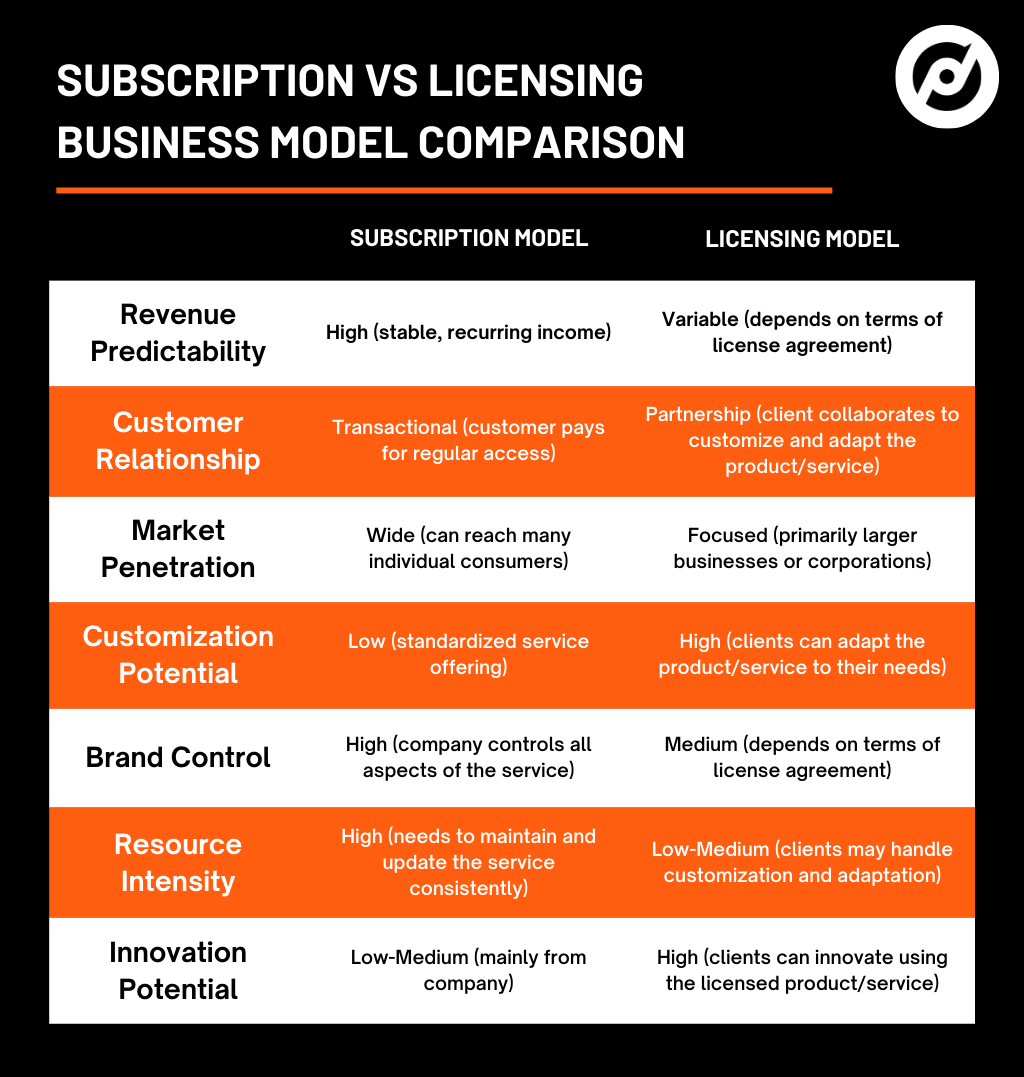
This shift from licensing to subscription is one of the defining characteristics of the modern tech economy, enabling the rise of the massive SaaS industry. We will dive much deeper into the key metrics that drive subscription businesses, like churn and customer lifetime value (LTV), in Module 4.
3. Indirect Revenue: Commission and Advertising
Now let's look at models where the primary user might not be the primary source of revenue. These are common for Marketplaces and Platforms.
The Intermediary's Cut: The Commission Model
Marketplaces like Airbnb, Uber, and Etsy make money by facilitating transactions between buyers and sellers. They don't sell their own products; they provide the platform for the transaction to happen and take a percentage fee, known as a commission or take rate.
The platform's revenue is directly tied to the total value of transactions flowing through it, a metric called Gross Merchandise Value (GMV). The more business the platform enables for its users, the more money it makes. This creates a powerful alignment of incentives.
How to choose a revenue model for a software product
The AltexSoft video refers to this as the 'commission-based' model. Let's watch its explanation.
Watch from 06:45 to 08:28. Note the variety of examples, from marketplaces like Etsy to aggregators like Expedia and ride-sharing apps like Uber.
Selling Attention: The Advertising Model
If a product is free to use, it's often because you, the user, are not the customer—you are the product being sold. Platforms with massive user bases, like Google, Facebook, and YouTube, offer their services for free to attract billions of users. They then charge advertisers for the opportunity to show targeted ads to that audience.
For this model to be viable, a company needs to achieve enormous scale. The revenue per user may be small, but when multiplied by millions or billions of users, it becomes a formidable business.
How to choose a revenue model for a software product
Finally, let's see how the advertising model works.
Watch from 08:28 to 10:05. The video makes a critical point: relying on ads alone is not a viable model for most businesses due to the need for a massive audience.
4. Variations and Hybrid Models
Few companies stick to just one revenue model. Most successful tech firms use a blend of strategies to maximize revenue and user growth. Let's look at two popular variations.
Usage-Based (Pay-As-You-Go)
This model charges customers based on how much of a service they consume. It's the standard for IaaS companies like Amazon Web Services (AWS), which bills for the amount of computing power, storage, and data transfer used. This model perfectly aligns cost with value—you only pay for what you use.
How to choose a revenue model for a software product
The AltexSoft video uses Audible as an interesting example of a hybrid 'pay-per-use' model combined with a subscription.
Watch from 04:31 to 05:51. This illustrates how a company can cater to different types of customers by combining a base subscription with usage-based top-ups.
The Freemium Model
Freemium is a powerful customer acquisition strategy that combines a free version of a product with a paid, premium version. The goal is to attract a large number of users with the free offering and then convert a small percentage of them into paying customers. Spotify, Dropbox, and Slack are classic examples.
The key to a successful freemium model is to make the free tier valuable enough to attract users, but limited enough that dedicated users have a compelling reason to upgrade.
How to choose a revenue model for a software product
Let's return to the AltexSoft video one last time to understand the freemium approach.
Watch from 05:51 to 06:45. Focus on how freemium is used to build a large user base and drive viral growth.
Test your understanding!
For each company below, identify the primary revenue model(s) it uses from the list we've discussed (Subscription, Licensing, Commission, Advertising, Usage-Based, Freemium).
- Zoom: Offers video conferencing services. There's a free version with a 40-minute meeting limit, and several paid tiers with more features and capacity.
- Stripe: Provides software that allows businesses to accept payments online. It charges businesses 2.9% + $0.30 for every successful card charge.
- The New York Times (NYTimes.com): Provides news content. Users can read a few articles for free each month before hitting a "paywall" that requires them to buy a subscription. The website also contains display ads.
- Salesforce: Sells Customer Relationship Management (CRM) software to businesses, charging a monthly fee per user.
Show answer
- Zoom: Primarily uses a Freemium model to acquire users and a Subscription model (with tiered, per-user pricing) to generate revenue.
- Stripe: A classic Commission (or transaction fee) model. Its revenue is a percentage of the payment volume it processes for its customers.
- The New York Times: Uses a Hybrid Model. It combines a Freemium-like approach (a few free articles) with a Subscription model (the paywall) and an Advertising model (display ads on the site).
- Salesforce: A pure Subscription model. This is the archetypal B2B (business-to-business) SaaS company.
5. Deeper Dive and Summary
We've covered the core concepts, but to build robust business literacy, it's helpful to see these models laid out with their pros, cons, and key metrics. The following reading provides an excellent, comprehensive summary.
The Complete Guide to Software Business Models
The article 'The Complete Guide to Software Business Models' from dev.to provides a fantastic breakdown of all the models we've discussed and more. It's a great reference piece to solidify your understanding.
Please read the introductory section, 'The Foundation: Core Business Model Families,' which provides a narrative overview of the Subscription, Freemium, Transaction/Commission, Advertising, and Pay-As-You-Go models. Then, carefully study the 'Quick Reference: Business Model Comparison' table. This table is extremely valuable. It summarizes each model's revenue structure, pros, cons, examples, and key metrics. Don't worry about understanding every metric right now; we will cover them in detail in future modules. Focus on the overall structure and trade-offs.
Conclusion
In this lesson, we dissected the primary ways tech companies generate revenue. By connecting these models to the company categories from our previous lesson, you can now see the clear link between what a company is (e.g., a SaaS provider or a Marketplace) and how it makes money (e.g., through subscriptions or commissions).
Key Takeaways:
- Licensing is the traditional model of a one-time sale, offering poor revenue predictability.
- Subscription models (SaaS) have become the standard, providing predictable, recurring revenue (MRR/ARR) for the company and lower upfront costs for the customer.
- Commission models are the engine of marketplaces, aligning the platform's success with the success of its users.
- Advertising models require massive scale and trade free user access for revenue from brands seeking an audience.
- Hybrid models (like Freemium and Usage-Based) are common, allowing companies to balance user acquisition with revenue generation and align costs with value.
In our next lesson, we will synthesize what we've learned about tech company categories and their revenue models to identify the key characteristics that differentiate tech companies from traditional businesses. We'll explore concepts like scalability, network effects, and switching costs, which are the direct result of the structures we've examined today.