Hello! Welcome to the first lesson of your course on the history of Christmas. Your goal is to explore this topic for your own interest, and we'll begin by digging into the world that existed long before the first Christmas was ever celebrated.
This first module, "Pre-Christian Roots," examines the ancient winter festivals that created a cultural and symbolic foundation for what Christmas would later become. In this lesson, we'll address the first learning outcome: explaining the significance of the winter solstice period for ancient cultures.
We will explore:
- The astronomical basis of the winter solstice.
- Its practical importance for survival in pre-modern societies.
- The profound spiritual and symbolic meanings it held, centered on themes of rebirth and light.
- The incredible stone monuments ancient peoples built to mark this celestial event.
Let's begin by understanding the science behind the solstice.
1. The Astronomical Turning Point
Before we look at how ancient people viewed the solstice, it's helpful to understand the celestial mechanics they were observing. The seasons are a result of the Earth's axial tilt, not its distance from the Sun. The winter solstice is a specific moment in this annual cycle.

The word "solstice" comes from the Latin solstitium, which means "sun standing still." For a few days around the solstice, the Sun's apparent path across the sky reaches its southernmost point (in the Northern Hemisphere) and seems to pause before reversing its journey northward, bringing with it the promise of longer days.
For a clear explanation of the astronomical definitions, please read the following brief section from a document by the Stanford Solar Center.
Ancient Observatories - Timeless Knowledge
This resource, 'Ancient Observatories - Timeless Knowledge', provides a concise scientific explanation of solstices, equinoxes, and seasons. It will ground our historical exploration in the underlying astronomy.
Please read the section titled 'Solstices, Equinoxes, and Zeniths, oh my!' starting on page 59. Focus on the definitions of 'Seasons' and 'Solstices' on pages 59 and 60. This will clarify the astronomical event our ancestors observed so keenly.
This predictable, cyclical event was the anchor of the year for ancient cultures. But why was it so important?
2. Significance for Survival and Society
In a world without electricity or modern calendars, the rhythm of the sun governed every aspect of life. The winter solstice was far more than an astronomical curiosity; it was a critical marker for survival.
- Agriculture: The solstice signaled that the days would start getting longer, providing a crucial reference point for planning the next agricultural cycle. It was a promise that spring, and the planting season, would eventually return.
- Resource Management: Midwinter was a time of scarcity. Most livestock had been slaughtered (so they wouldn't have to be fed through the winter), and the wine and beer from the autumn harvest were finally fermented and ready for drinking. The solstice marked a turning point when communities could celebrate, knowing they had survived the darkest part of the year.
- The Dawn of Prediction: Perhaps most importantly, tracking the solstice represented a major cognitive leap. By observing patterns and building monuments to track the sun, our ancestors moved from simply reacting to the seasons to predicting them. Given your background in informatics and mathematics, you can appreciate the profound shift from passive observation to creating a predictive model of the world. This ability to anticipate the future was a cornerstone of developing complex societies.
The following article eloquently describes this transition from observation to a deep, cultural knowledge.
Winter Solstice: Ancient Monuments & the Origins of Time
The article 'The Longest Night' by Shanil Virani provides a great narrative on why the solstice was so crucial, linking astronomical observation to the very development of human temporal consciousness.
Please read the sections titled 'Why the Solstice Mattered' and 'From Observation to Expectation'. Pay attention to how the author frames the solstice not just as a date, but as the emergence of a human ability to know and trust cosmic patterns.
3. Spiritual Meaning: The Rebirth of the Sun
The practical importance of the solstice was deeply interwoven with its spiritual significance. The longest night was a time of anxiety, but its end was a powerful symbol of life's victory over death and light's triumph over darkness.
This central theme of rebirth and renewal is found in winter solstice traditions across the ancient world. Many cultures personified the sun as a deity who was born, grew to full strength at the summer solstice, weakened into old age, and was then reborn at the winter solstice.
This recurring motif of a divine child or sun god being born at midwinter is a critical piece of the puzzle for understanding the later context of Christmas.
The following video explores these deeper spiritual meanings and their surprising universality.
The DEEPER Spiritual Meaning of the Winter Solstice | Through Ancient History
This video, 'The DEEPER Spiritual Meaning of the Winter Solstice', moves beyond the practical aspects to explore the rich symbolism and mythology tied to this time of year across many cultures.
Please watch from the beginning to 03:31, and then from 04:42 to 06:53. The first segment explains the symbolism of light and darkness. The second segment provides a fascinating overview of how many different ancient peoples—from the Egyptians and Romans to the Celts and Persians—celebrated the birth of a divine figure at this time.
Test your understanding!
After watching the video, what is a common mythological theme associated with the winter solstice across multiple, unconnected ancient cultures? Why do you think this theme was so widespread?
Show answer
A common theme is the birth of a divine son or sun god from a mother goddess, symbolizing the rebirth of the sun (light) from the darkness of the longest night (the womb of creation). This theme was likely so widespread because it's a powerful and natural metaphor for the observed astronomical event: from the weakest point of the sun and the darkest time of year, light and life begin to return and grow stronger, much like a newborn child.
4. Evidence in Stone: Monuments of the Solstice
How do we know that ancient people placed such importance on the solstice? They left behind enduring proof in the form of massive, sophisticated structures precisely aligned to this solar event. These are not just buildings; they are instruments, calendars, and temples carved into the landscape.
To get a sense of these incredible feats of engineering, watch this short segment.
Ancient History of Winter Solstice Traditions and Sites
The video 'Ancient History of Winter Solstice Traditions and Sites' by World History Encyclopedia offers a quick tour of some of the most famous solstice-aligned monuments.
Please watch the segment from 06:40 to 08:31. It highlights key sites like the Goseck Circle, Stonehenge, and Newgrange, which we will look at more closely.
Let's briefly examine two of these sites:
Newgrange (Ireland, c. 3200 BCE): Older than Stonehenge and the Pyramids of Giza, Newgrange is a large circular passage tomb. Its most remarkable feature is a small opening above the main entrance called a "roof-box." For just a few minutes at sunrise on the winter solstice, a narrow beam of sunlight penetrates this box, travels 19 meters (62 feet) down a stone passage, and illuminates the central chamber. This event makes it unambiguously clear that the structure was deliberately built to capture the moment of the sun's rebirth.
Stonehenge (England, c. 3000-2000 BCE): While often associated with the summer solstice, archaeological evidence of large-scale feasting suggests that midwinter was the more significant ceremonial time for the people who built Stonehenge. The main axis of the monument aligns with the winter solstice sunset.
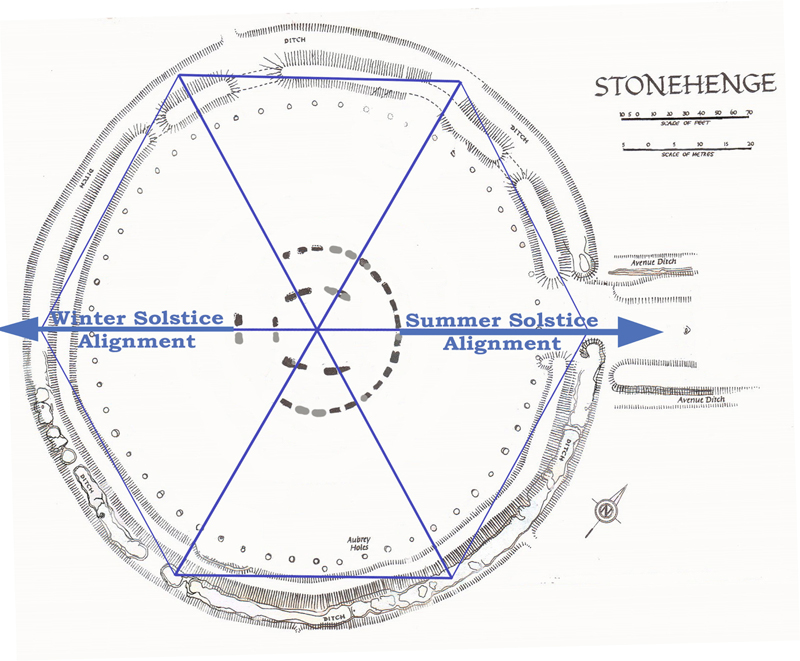
The construction of these sites required an impressive understanding of astronomy, engineering, and multi-generational planning. They are a powerful testament to the central role the winter solstice played in the worldview of our ancestors.
Conclusion
In this lesson, we've established the foundational importance of the winter solstice in the ancient world. The key takeaways are:
- Astronomically, the winter solstice is the shortest day of the year in a hemisphere, marking the point when the sun "stands still" and begins its journey back toward summer.
- Practically, it was a crucial marker for survival, governing agriculture and resource management, and its prediction marked a major step in human intellectual development.
- Spiritually, it was a powerful time of renewal, symbolizing the triumph of light over darkness and the rebirth of the sun, often represented as the birth of a divine son.
- Architecturally, cultures worldwide invested enormous effort to build monuments like Newgrange and Stonehenge, which served as calendars and ceremonial centers aligned with this pivotal solar event.
These ancient traditions of feasting, giving thanks, and celebrating the return of light in the depths of winter created a rich cultural soil. In our next lesson, we will focus on one of the most famous and influential of these winter festivals: the Roman festival of Saturnalia. We'll see how its customs of feasting, gift-giving, and social reversal directly influenced how Christmas would later be celebrated.