Hello! Welcome back to your course on the history of Christmas.
In our first lesson, we explored the universal significance of the winter solstice for ancient cultures. We saw how the astronomical event of the sun's "rebirth" was a powerful symbol of hope and renewal, celebrated with feasting and fire across the ancient world.
Today, we'll focus on one of the most vibrant and influential of these winter festivals: the Roman Saturnalia. This lesson aims to meet the learning outcome: Describe the key features of the Roman Saturnalia festival. We'll examine its origins, its unique rituals, and the lively customs that made it "the best of days" for the Romans—customs that will seem surprisingly familiar.
1. Origins and Official Rites
Saturnalia was a festival in honor of the god Saturn. In Roman mythology, Saturn was an ancient agricultural deity associated with seed, sowing, and the abundance of the harvest. He was also believed to have ruled over a mythical Golden Age, a time of peace, equality, and prosperity. The festival celebrated both the end of the autumn planting season and the hope of returning to this idyllic past.
The festival officially began on December 17th, the anniversary of the dedication of the Temple of Saturn in the Roman Forum. However, it was so popular that the celebrations unofficially expanded to last for a full week, ending on December 23rd.
The first day involved a solemn public ritual. To understand what this looked like, please watch the following video segment.
The video 'Saturnalia' by Historia Civilis provides a concise and clear explanation of the festival's opening ceremonies. It focuses on the key religious acts that kicked off the week of celebration.
Please watch the segment from 00:56 to 02:24. Pay attention to the three key parts of the ritual: the symbolic act performed on the statue of Saturn, the sacrifice, and the procession to the public banquet.
As you saw, the official festivities began at the Temple of Saturn with two key acts:
- The Loosening of the Bonds: Priests would remove the woolen bindings that fettered the feet of Saturn's cult statue for the rest of the year. This act symbolized the liberation of the god and, by extension, the liberation of society from its normal constraints.
- The Public Sacrifice and Banquet: Following a sacrifice, a grand public banquet known as a lectisternium was held. A statue of the god was placed on a couch as if he were the guest of honor, overseeing the feast.
Once these official rites concluded and the cry of "Io, Saturnalia!" (pronounced "Yo, Saturnalia!") was shouted, the private and more raucous celebrations began.
2. A World Turned Upside Down
The central theme of Saturnalia was the temporary subversion of the rigid Roman social order. It was a nostalgic nod to Saturn's Golden Age, where all people were equal. This inversion of norms was the festival's most defining feature.
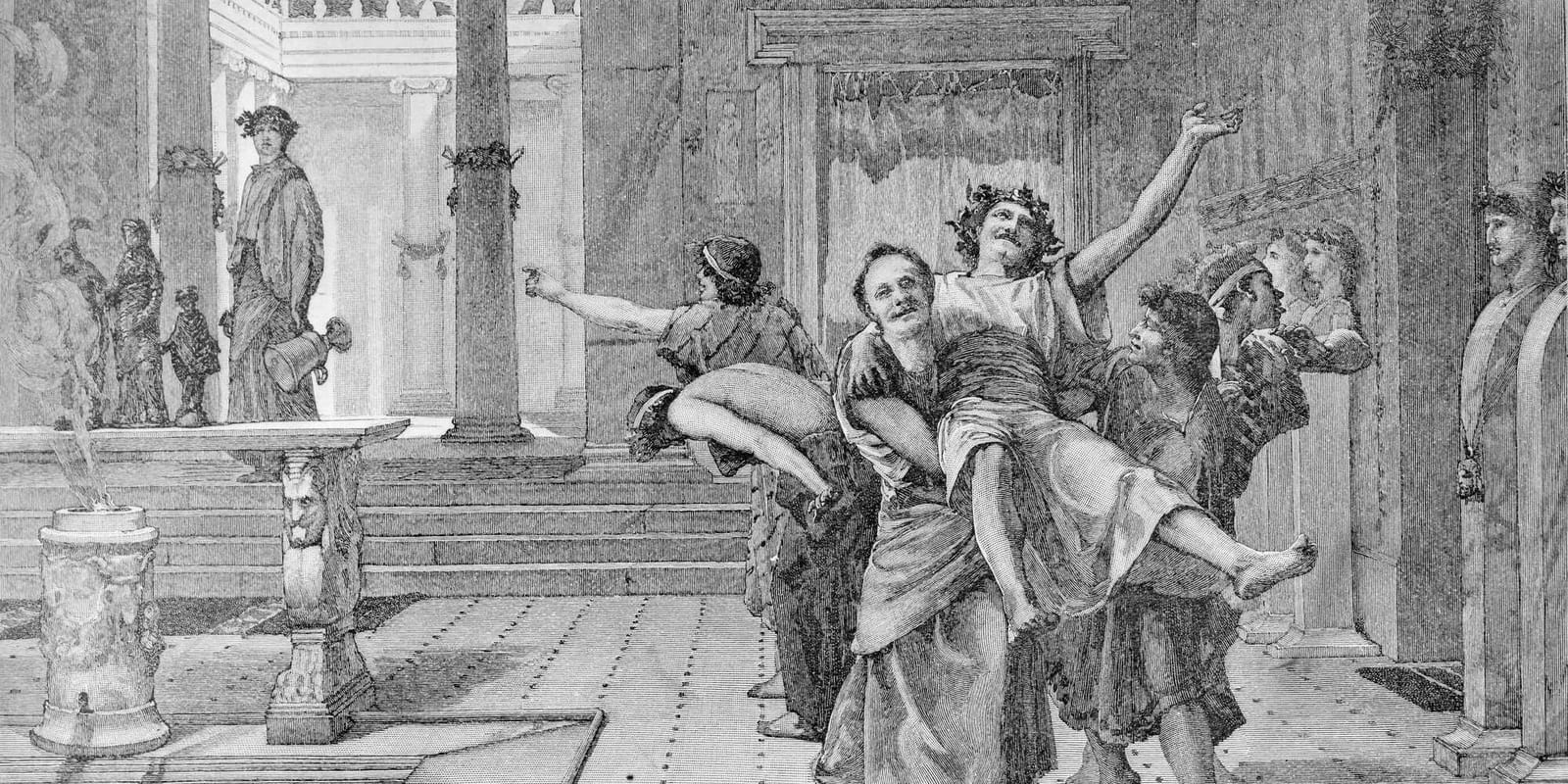
The "world turned upside down" manifested in several ways:
- Role Reversal: The most famous custom was the reversal of roles between masters and slaves. For the duration of the festival, slaves were permitted a level of freedom unheard of during the rest of the year. They could speak freely, even disrespectfully, to their masters without fear of punishment. In some households, masters would serve their slaves a banquet, or at the very least, they would all dine together as equals.
- Freedom Attire: Romans shed their traditional, status-defining togas. Instead, everyone—from senators to slaves—wore colorful dinner clothes called the synthesis and a conical felt cap called the pilleus. The pilleus was the symbol of a freed slave, so for everyone to wear one meant that, for a week, all were considered free.
- The King of Saturnalia: In private parties, a mock king, the Saturnalicius Princeps or "Ruler of Saturnalia," was chosen by lot. This person, often a child or a member of the lower classes, would issue whimsical and absurd commands that the other guests had to obey, such as singing a song, dancing, or taking a cold plunge. It was a parody of the absolute power held by real Roman rulers.
To see how these elements came together, watch the following overview of Saturnalia's traditions of social inversion.
Saturnalia - Rome's Awesome Pagan Christmas DOCUMENTARY
The video 'Saturnalia - Rome's Awesome Pagan Christmas' by Invicta provides an excellent summary of these role-reversal customs.
Please watch the clip from 07:12 to 08:09, which explains the role reversal, and then from 12:49 to 13:49, which details the tradition of the 'King of Saturnalia'.
3. Feasting, Fun, and Gifts
Beyond the structured social inversions, Saturnalia was, at its heart, a week-long party.
- Public Revelry: Normal business was suspended. The streets, normally dark and dangerous at night, were lit with torches and candles, encouraging all-night festivities. Public gambling with dice, usually forbidden, was permitted for everyone.
- Feasting and Drinking: Extravagant feasts were the norm. Following the public banquet on the first day, private homes and taverns were filled with people eating, drinking, and celebrating.
- Gift-Giving: The exchange of gifts was a central part of the festival, particularly on the later days known as the Sigillaria. These were often small, token gifts rather than expensive ones. Common presents included:
- Cerei: Wax candles, possibly symbolizing the return of light after the solstice.
- Sigillaria: Small, inexpensive figurines made of pottery or wax, from which the day of gift-giving took its name.
- Gag gifts, toys for children, and personalized items accompanied by short poems.
This tradition of gift exchange was socially complex, involving patrons and clients, family and friends, and creating an atmosphere very reminiscent of modern Christmas shopping and social obligations.
This next clip provides a wonderful description of the party atmosphere and the all-important custom of gift-giving.
Saturnalia - Rome's Awesome Pagan Christmas DOCUMENTARY
Let's return to the Invicta documentary to learn about the celebratory mood and gift-giving traditions.
Please watch from 09:43 to 12:49. This segment covers the carnival-like atmosphere and the details of gift exchange during the festival.
Test your understanding!
Saturnalia is famous for inverting the social order. Based on what you've learned, identify three distinct customs that embodied this theme of a "world turned upside down" and briefly explain how each one challenged normal Roman social structures.
Show answer
- Masters Serving Slaves: This is the most direct role reversal. In a society built on a strict hierarchy and the institution of slavery, having masters serve their slaves at a meal, even symbolically, was a profound (though temporary) challenge to the established power dynamic.
- The Wearing of the Pilleus by All: The pilleus was the cap of a freedman, a symbol of liberty. By having everyone, including senators and slaves, wear this cap, the festival visually erased class distinctions and created a temporary state of universal freedom.
- The Election of a "King of Saturnalia": Choosing a leader by lot, often from the lower rungs of society (like a child or slave), and giving them mock authority over the wealthy and powerful was a clear parody of the Roman political hierarchy. It replaced the established order of power and birthright with the randomness of chance and fun.
Conclusion
In this lesson, we have dissected the Roman festival of Saturnalia. We've seen that its key features were not just random revelry, but a structured and meaningful celebration rooted in deep cultural ideas.
The key takeaways are:
- Saturnalia was a week-long festival in late December honoring the god Saturn and a mythical "Golden Age" of equality.
- It began with a formal religious ceremony at the Temple of Saturn but quickly evolved into widespread celebration.
- Its most defining characteristic was social inversion: role reversals between masters and slaves, the wearing of common "freedom attire," and the rule of a mock king.
- The festival was also marked by features familiar to us today: massive feasts, all-night parties, and the widespread exchange of gifts, such as candles and small figurines.
The immense popularity of Saturnalia across the Roman Empire ensured that its customs were deeply ingrained in the culture. When Christianity began to spread, it didn't arise in a vacuum. The traditions of Saturnalia were so beloved that they wouldn't simply vanish. Instead, as we will see, many were adapted and absorbed into the celebration of Christmas.
In our next lesson, we will move into the early Christian era to describe the earliest historical evidence for Christmas celebrations and explore one of the great historical puzzles: why December 25th was chosen as the date for Christmas.