Hello! Welcome to the next lesson in our journey through the Victorian reinvention of Christmas.
In our previous lessons, we've explored how Victorians defined the holiday's spirit through Charles Dickens's A Christmas Carol, adopted the Christmas tree as its centerpiece, and synthesized the modern figure of Santa Claus. Today, we'll examine another cornerstone of the modern Christmas experience, born directly out of Victorian ingenuity and social change: the Christmas card.
This lesson will explain how sending Christmas cards evolved from a niche idea into a widespread popular tradition. We will look at the crucial social and technological developments that set the stage, meet the man who sent the very first card, and explore the factors that caused the practice to explode in popularity across Britain and America.
The Groundwork for a Tradition
Like many inventions, the Christmas card couldn't have existed without a few key preconditions falling into place. It emerged from a fertile ground of technological advancement and cultural shifts in the early 19th century. A confluence of postal reform, printing technology, and a renewed cultural enthusiasm for the holiday created the perfect environment for the Christmas card to be born.
The following video provides an excellent overview of these foundational elements.
To understand why Christmas cards appeared when they did, let's watch this segment from The History Guy's video, 'Christmas Cards: A History.' It explains the 'puzzle pieces' that needed to come together first.
Please watch from 00:55 to 04:03. As you watch, focus on the four key factors discussed: Early traditions of written greetings. The development of printing and paper production. The critical importance of postal reform. The cultural repopularization of Christmas itself.
As the video explained, the stage was set by the early 1840s. The Victorian revival of Christmas, which we've discussed, created the demand for a new way to express festive cheer. Meanwhile, affordable printing made illustrated media possible, and perhaps most importantly, the Uniform Penny Post, established in 1840, made communication cheap and accessible for the masses for the first time. For the price of a single penny stamp, anyone could send a letter anywhere in the UK. This was the true catalyst.
The First Card: A Victorian Solution to a Victorian Problem
With the postal system revolutionized, the volume of mail skyrocketed. For prominent individuals with large social circles, the holiday season brought with it an overwhelming obligation: handwriting dozens, if not hundreds, of personal Christmas letters. The first Christmas card was invented as an elegant and efficient solution to this very problem.
The story of the first card is tied to a key figure in 19th-century British public life and the founding director of the Victoria and Albert Museum. Let's read the V&A's own account of this event.
Please read the first main section of the article from the Victoria and Albert Museum. It details who created the first card, why he did it, and what it looked like.
As you've just read, Sir Henry Cole, a busy civil servant and reformer, commissioned the artist John Callcott Horsley to design a card in 1843. This allowed him to send a pre-printed greeting that could be personalized with a short note.
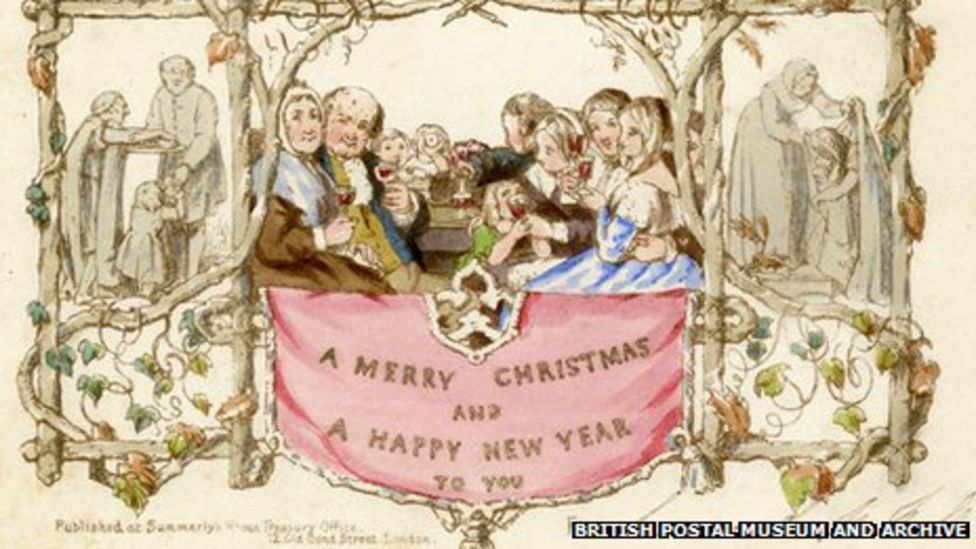
Interestingly, the venture was not an immediate commercial success. At one shilling each, the cards were expensive for the average person. They also sparked controversy from temperance groups who objected to the depiction of a child being offered a glass of wine. However, the idea had been planted.
From Novelty to National Craze
While Cole's card may have been ahead of its time, the practice of sending Christmas greetings grew steadily. By the 1860s, it had transformed from a novelty into a booming industry. This explosion in popularity was driven by new technology, savvy entrepreneurs, and the establishment of a visual language for the holiday.
Technological Leap: Chromolithography
The key innovation that turned Christmas cards into a mass-market product was chromolithography. This was a new printing process that allowed for the mass production of vibrant, multi-colored images at a low cost. Suddenly, beautiful, colorful cards were no longer a luxury item. This led to what the V&A article calls the "Victorian heyday for Christmas cards (1860 – 1890)."
Commercial Expansion
Printers who had previously made Valentine's cards, like Marcus Ward & Co., quickly moved into the Christmas market. They held design competitions, commissioned famous artists, and produced increasingly elaborate cards with embossing, fabric, and metallic inks.
The tradition also crossed the Atlantic. In the 1870s, a Prussian immigrant to the US named Louis Prang began mass-producing high-quality Christmas cards. He is often called the "father of the American Christmas card" and by 1881, his factory was printing five million cards a year.
Test your understanding!
Sir Henry Cole's card of 1843 and Louis Prang's cards of the 1870s were both commercially produced. Why did Prang's venture become a massive success while Cole's was initially a commercial flop?
Show answer
The primary reason lies in technology and cost. Cole's card was hand-colored and expensive (one shilling). By the 1870s, the development of chromolithography had made it possible to mass-produce colorful, high-quality cards at a fraction of the cost, making them affordable for a much wider audience. The market and the production technology had matured significantly in the intervening 30 years.
The Visual Language of Christmas
What did these cards actually look like? Victorians established much of the iconography we still associate with Christmas today.

However, alongside these familiar scenes, there was a parallel world of bizarre and surreal Christmas card imagery. To stand out in a saturated market, publishers produced cards with dead birds, knife-wielding frogs, menacing clowns, and anthropomorphic vegetables. While strange to us, these images tapped into specific Victorian cultural references, folklore, and a dark sense of humor.
Why Are These Christmas Cards So Weird?
To understand the meaning behind some of the stranger Victorian cards, let's watch a couple of segments from the video 'Why Are These Christmas Cards So Weird?'.
Please watch the two sections explaining the symbolism of dead birds (03:29 - 05:24) and frogs (05:24 - 07:28). This will give you a sense of how these seemingly morbid images conveyed messages of sympathy, good luck, and even social satire to a Victorian recipient.
These strange designs served as conversation pieces and collectibles. They remind us that the Victorian Christmas, for all its sentimentality, also had a side that was robust, unsanitized, and comfortable with a blend of the sacred and the profane.
Conclusion
The Christmas card is a perfect microcosm of the Victorian era's influence on the holiday. It was a product of industrial innovation, commercial ambition, and a desire to connect family and friends within a newly established festive framework.
Key Takeaways:
- The Christmas card was made possible by the convergence of postal reform (the Penny Post), advances in printing technology, and a cultural revival of Christmas.
- The first card was created in 1843 by Sir Henry Cole as a time-saving measure, designed by John Callcott Horsley.
- The tradition's massive growth from the 1860s was driven by chromolithography, which allowed for cheap, colorful mass production.
- The cards established much of the classic Christmas iconography we know today, but also included a subgenre of bizarre and surreal imagery that reflected Victorian humor and culture.
We've seen how a new industry sprang up to help people share the Christmas spirit. In our next lesson, we will broaden our focus and analyze the wider commercialization of Christmas in the 19th century, exploring how buying and selling became inextricably linked with the holiday season.