Hello! Welcome to your next lesson in our exploration of the history of Christmas.
In our last lesson, we tackled the complex question of why Christmas is on December 25th. We concluded that the date was most likely chosen through the "Calculation Theory"—an internal, theological process where early Christians linked Jesus's birth to his conception, which they had fixed at March 25th. However, we also saw that the date's immense popularity was secured because its winter solstice timing aligned perfectly with powerful solar symbolism, a theme present in both Christian thought and surrounding pagan religions like the cult of Sol Invictus.
Today, we build directly on that conclusion. Since the date wasn't simply "stolen," how did a new Christian festival, now fixed in the Roman calendar, begin to take on the characteristics we associate with the season? This lesson analyzes how early Christmas celebrations incorporated and reinterpreted customs from the major pagan winter traditions of the time. We are moving from the why of the date to the how of the customs.
1. A Shared Language: Solar Symbolism in the Roman Empire
The process of incorporating pagan traditions was not always a conscious "takeover." Often, it was a matter of using a shared cultural and symbolic language. In the Roman Empire of the 3rd and 4th centuries, the most powerful seasonal symbol was the sun.
As we discussed, the festival of Dies Natalis Solis Invicti (Birthday of the Unconquered Sun) was established on December 25th. Christians had long used solar imagery to describe Christ, referring to him as the "Sun of Righteousness" (Malachi 4:2) and the "light of the world" (John 8:12).
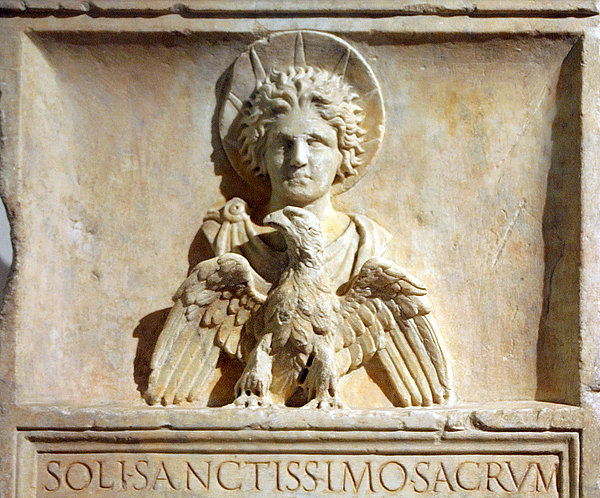
When early Christians described Jesus using solar terms, they weren't necessarily "copying" Sol Invictus. Instead, both pagans and Christians were drawing from the same deep well of cosmic symbolism associated with the winter solstice—the turning point when light begins to triumph over darkness. It was a parallel development rather than a direct appropriation.
The following video provides a detailed analysis of this dynamic, arguing that the shared solstice date is evidence of parallel traditions, not a "battle to usurp the day."
Did Christmas Copy the Sun God's Birthday?
The video 'Did Christmas Copy the Sun God's Birthday?' from ReligionForBreakfast explores the complex relationship between Christian and pagan solar symbolism. It lays out the argument for why this was more of a convergence on a cosmologically significant date than a simple theft.
Please watch from the beginning to 03:49 and then from 37:32 to 47:32. The first part introduces the topic, and the second, longer part presents the 'Calculation Theory' and argues that both Christians and pagans were independently motivated to tie their deities to the powerful symbolism of the winter solstice.
As the video explains, this was a case of two different groups finding the same date powerfully symbolic for their own reasons. The early Church Fathers didn't hide this connection; they leaned into it. St. Augustine, for example, urged his congregation to celebrate the day not because of the physical sun, but in honor of He who created the sun.
2. A Festive Atmosphere: The Influence of Saturnalia
While Sol Invictus provided the symbolic overlap, another Roman festival, Saturnalia, provided the festive atmosphere. Saturnalia was one of Rome's most beloved holidays, a week-long carnival of feasting, gift-giving, social role-reversal, and general merry-making that ended on December 23rd.
While Christmas was not created to replace Saturnalia (the dates don't align), the new Christian feast was born into a world where this was the dominant way to celebrate in mid-winter. It's highly probable that the general "spirit" of Saturnalia—feasting, decorating with greenery, and giving gifts—bled into the broader Christmas season, which would eventually expand to the "Twelve Days of Christmas."
Was Christmas moved to eclipse Rome's Saturnalia festival?
This article from National Geographic, 'Was Christmas moved to eclipse Rome's Saturnalia festival?', provides a concise description of Saturnalia and explains why it's considered an 'imperfect candidate' for direct appropriation, while still acknowledging its likely influence on winter customs.
Please read the sections 'Saturnalia in the Roman world' and 'Strategy or symbolism?'. Focus on the description of Saturnalia's customs and the article's conclusion about a 'subtler story' of cultural exchange.
The key takeaway is that the emergence of Christmas celebrations didn't happen in a vacuum. The existing traditions of Saturnalia created a cultural expectation for what a winter festival should look and feel like: joyful, communal, and abundant.
3. Northern Traditions: The Christianization of Yule
As Christianity spread north into Germanic and Scandinavian lands, it encountered a different set of winter solstice traditions, collectively known as Yule. Here, the process of incorporation was often more direct and, in some cases, a conscious strategy. The church, rather than banning these deeply ingrained folk customs, often absorbed and re-framed them within a Christian context.
The video below explores several key Yule traditions and how they were adapted.
Tracing Yule’s Ancient Roots | The Pagan Origins of Christmas Explained
The video 'Tracing Yule’s Ancient Roots' details several key pagan customs from Northern Europe and explicitly explains how they were reinterpreted and integrated into Christmas celebrations.
Please watch the following three sections: The Yule Log (07:01 - 14:50): Pay attention to the original symbolism of the log (sun's return, protection) and how it was reinterpreted to represent Christ as the 'light of the world.' Evergreens (14:50 - 22:57): Note how plants like holly and ivy, symbols of life's persistence, were given new Christian meanings (eternal life, Christ's sacrifice). The Process of Christianization (48:29 - 56:09): This final section summarizes the entire process, showing how the Church strategically co-opted pagan festivals.
This process of adaptation, known as inculturation, was a key strategy for the Christianization of Europe. A famous letter from Pope Gregory the Great in 601 AD to a missionary in England advised exactly this. He instructed that pagan temples should not be destroyed, but consecrated as churches, and that traditional feasts should be allowed to continue, but re-dedicated to the honor of God.
This allowed people to maintain their cultural traditions while adopting the new faith. The core symbols of Yule were incredibly powerful and adaptable:
- Light in the Darkness (Yule Log, Bonfires): Easily re-framed as Christ, the Light of the World.
- Life in the Midst of Death (Evergreens): A perfect metaphor for the promise of eternal life through Christ.
- Community and Abundance (Feasting, Gifting): Re-contextualized as Christian fellowship and charity, reflecting God's gift of his son.
Test your understanding!
A pagan Yule tradition involved decorating the home with holly, whose red berries and sharp leaves were symbols of life and protection in the dead of winter. How was this specific custom reinterpreted within a Christian framework?
Show answer
The evergreen nature of the holly plant was reinterpreted to symbolize eternal life through Christ. The sharp leaves were said to represent the crown of thorns worn by Jesus, and the red berries were said to represent the blood he shed. The original symbol of life and protection was thus transformed into a specific reminder of the Christian story of salvation.
4. A Word of Caution: Separating History from Myth
Given your background in informatics and machine learning, you understand the importance of reliable data and the dangers of "garbage in, garbage out." The topic of Christmas's pagan origins is an area where popular history is filled with misinformation. Many claims are based on superficial parallels, misunderstandings, or recent inventions that get repeated until they are accepted as fact.

It is crucial to approach these claims with the same critical eye you would apply to a dataset. We must ask: What is the earliest source for this claim? Is there a clear line of transmission, or is it just a parallel?
The historian Tim O'Neill, on his blog 'History for Atheists,' specializes in debunking popular historical myths. This article, 'Pagan Christmas, Again,' provides a rigorous, evidence-based critique of many common claims about the pagan origins of Christmas customs.
Please read the sections from 'Christmas Traditions' through to the end of 'Christmas Trees'. O'Neill challenges the supposed ancient origins of gift-giving, feasting, the Yule Log, the use of holly and mistletoe, and the Christmas tree, often tracing them to medieval or even modern times. Notice how he demands clear evidence for a tradition's origin and continuity.
O'Neill's analysis doesn't mean no cultural blending occurred. Rather, it cautions us against accepting simple stories. The history is often messier. Some traditions, like the Christmas tree, appear to be much more recent than ancient paganism. Others, like feasting, are so universal to human celebration that attributing them to a single pagan origin is problematic. The true story is a mix of conscious reinterpretation, natural cultural blending, and later inventions that were thought to be ancient.
Conclusion
Today we have seen that the customs of Christmas were not stolen in a single act, but developed through a complex process of cultural interaction over centuries.
Key Takeaways:
- Syncretism and Reinterpretation: Early Christmas did not simply copy pagan traditions. It absorbed powerful existing symbols—light, life, greenery—and reinterpreted them through a Christian theological lens.
- Roman Influence: The celebration inherited a symbolic language of solar worship from the wider Roman culture and a festive atmosphere of feasting and giving from festivals like Saturnalia.
- Germanic & Norse Roots: As Christianity moved north, it consciously "Christianized" many Yule traditions like the Yule log and decorating with evergreens, which became foundational to the modern Christmas aesthetic.
- Critical Evaluation is Key: Many popular claims about the "pagan origins" of specific customs do not hold up to historical scrutiny and appear to be medieval or modern inventions.
In our last two lessons, we've established when, why, and how Christmas began. We'll now move forward in time to see how this fledgling holiday evolved. In our next lesson, we will explore Christmas in the Middle Ages, focusing on the central role of the church mass and liturgy in shaping the celebration.