Welcome to the capstone lesson for Module 1. In the preceding lessons, you established the document roles in the FIPS 140-3 ecosystem, learned to check policy currency, resolved apparent source conflicts, traced requirements into evidence, separated vendor, laboratory, and CMVP responsibilities, and bounded product-validation claims correctly.
This lesson turns those methods into a reusable consulting work product: a requirements-source, policy-currency, and responsibility checklist. Its purpose is not merely to collect links. It creates an auditable answer to three questions that should precede any technical conclusion:
- Which source controls this question?
- Which revision and policy state apply at the relevant point in the engagement?
- Who must produce, assess, decide, and escalate?
For a complex module, this checklist becomes the control sheet that keeps engineering, the lab, product management, and the client from treating an obsolete document, an open guidance request, or an informal interpretation as if it were an authoritative requirement.
Treat policy answers as configuration-controlled engineering outputs
A FIPS 140-3 policy answer has its own configuration. “The standard says...” is not a defensible conclusion until the standard, clause, revision, CMVP overlay, applicability, and effective date have been identified.
A useful mental model is:
The checklist you build should therefore be question-centred, not document-centred. A document repository may contain every standard and guidance PDF, yet still fail to answer whether a particular requirement applies to a particular module, submission, or deployment.
For example, the question:
“May the module claim this approved security function in its security policy?”
is not answered simply by locating the relevant algorithm standard. It may require:
- the base ISO/IEC 19790 requirement and annex;
- the related ISO/IEC 24759 vendor and test evidence requirement;
- the CMVP replacement or modification in the SP 800-140 series;
- applicable Implementation Guidance;
- the current security-policy formatting requirements; and
- an owner for the supporting evidence and any unresolved interpretation.
The CMVP process illustration below is useful because it shows that the program is not a single-document assessment. Requirements, test methods, CMVP variations, laboratory assessment, and CMVP review are connected but distinct.
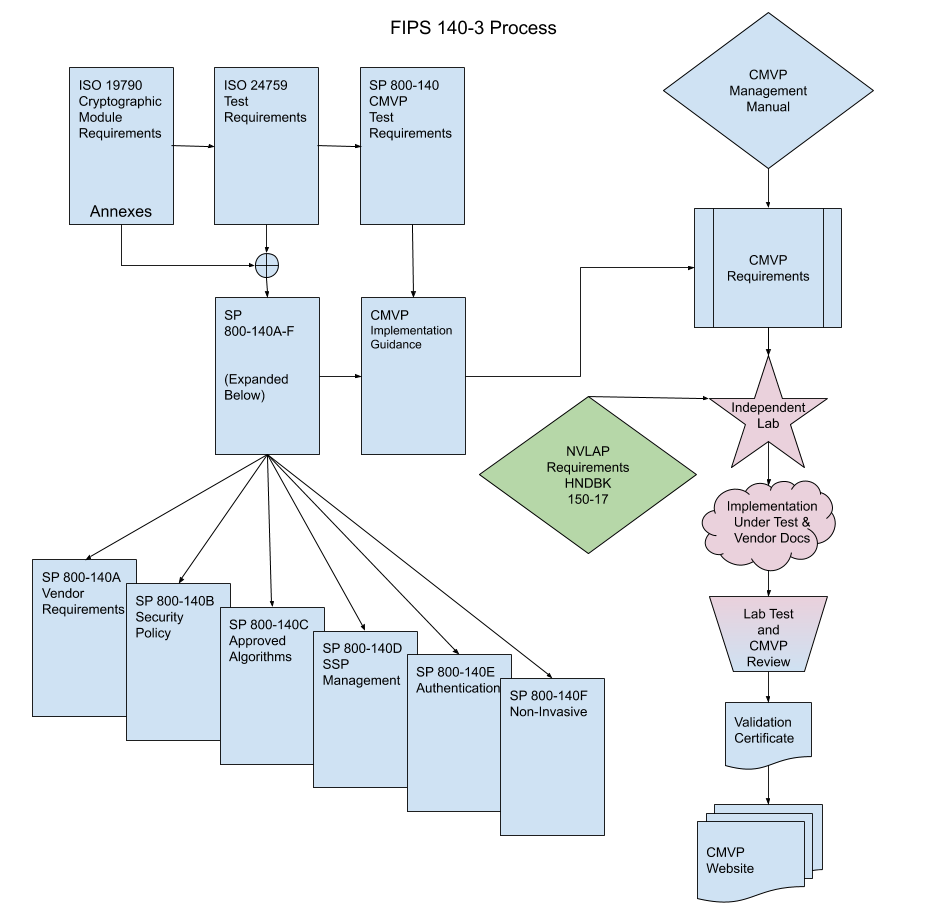
The diagram is a process map, not a simple hierarchy. A later or more specific document does not automatically replace every earlier document. The key question is always: what does the later source say it modifies, replaces, or clarifies?
Build the source map before answering the technical question
Study the CMVP standards overview now. It provides the authoritative program-level map that your checklist will encode.
Cryptographic Module Validation Program | CSRC
Read the NIST CSRC overview to establish the role of the ISO standards, the SP 800-140 series, the Implementation Guidance, the Management Manual, and the independent laboratory process. Focus on the distinction between a base requirement, a test or evidence method, a CMVP modification, and a program procedure.
Start with the “FIPS 140-3 Top Level Documents” and “SP 800-140 Documents” tables. Record the document titles, statuses, and the ISO clauses or annexes to which the SP 800-140 publications map. Then read the “Document Process Flow” section, especially the process account, to distinguish laboratory assessment from CMVP review and issuance. In “Abstracts,” read the entries for FIPS 140-3, ISO/IEC 19790, ISO/IEC 24759, and SP 800-140A through SP 800-140F. Pay particular attention to the DTR scope: a modification applies only where the publication identifies one. Also note the replacement pattern, which is materially different from a limited modification.
A practical source-role map
The following map is a useful permanent section of your checklist. It deliberately describes role, rather than claiming a simplistic universal ordering.
| Source family | Primary role in an engagement | Checklist question |
|---|---|---|
| FIPS 140-3 | Establishes the U.S. program framework and identifies CMVP as the validation authority using the ISO standards and NIST SP 800-140 publications. | Is this a FIPS 140-3 CMVP validation question rather than a legacy FIPS 140-2 or purely contractual question? |
| ISO/IEC 19790:2012 | Base security requirements for cryptographic modules, including security levels and requirement-area content. | Which clause or annex creates the underlying security requirement? |
| ISO/IEC 24759:2017 | Derived test methods plus vendor and laboratory evidence expectations associated with ISO/IEC 19790. | What must the vendor provide and what must the laboratory assess? |
| SP 800-140 | CMVP Derived Test Requirements; modifies identified ISO/IEC 24759 test and vendor evidence requirements. | Does the DTR alter the relevant test or evidence item? |
| SP 800-140A | CMVP modifications to ISO/IEC 19790 Annex A and associated documentation requirements. | What documentation content and supporting evidence are required? |
| SP 800-140B | CMVP security-policy requirements and modifications to Annex B and related test requirements. | What must be publicly stated in the security policy and associated tables? |
| SP 800-140C, D, E, F | CMVP replacements for specific ISO annexes and associated ISO/IEC 24759 sections concerning approved functions, SSP generation and establishment, authentication, and non-invasive attacks. | Does the relevant SP publication replace the ISO annex rather than merely modify selected items? |
| CMVP Implementation Guidance | CMVP clarification and interpretation, often for a defined technology, architecture, or assessment scenario. | Does a currently applicable IG resolve this exact design or evidence issue? |
| CMVP Management Manual | Programmatic and submission procedures, including process rules that are not themselves cryptographic technical requirements. | What submission, status, certificate, or change-management procedure applies? |
| NVLAP Handbook 150-17 | Requirements for laboratory accreditation, quality systems, competence, and reporting controls. | Is this a laboratory-accreditation matter rather than a vendor module requirement? |
| CMVP RFGs and Resolutions | A channel for published requests for guidance and CMVP responses; relevant to policy monitoring and issue tracking. | Is there an adopted CMVP resolution or later IG update that changes the current interpretation? |
Two details merit particular care.
First, the words modify, supersede, replace, and clarify have different consequences:
| Source relationship | Working rule for the checklist |
|---|---|
| Modifies identified requirements | Apply the base ISO content except where the CMVP publication explicitly changes it. |
| Replaces or supersedes an annex or test section | Use the CMVP publication as the controlling content for that defined area; do not rely on the displaced ISO text as if it remained operative. |
| Clarifies or interprets | Record the relevant IG identifier, scenario, resolution, and conditions. Do not generalize a technology-specific interpretation beyond its stated scope. |
| Defines program procedure | Apply it to submission, review, status, or maintenance procedure; do not mistakenly cite it as the underlying cryptographic technical requirement. |
| Draft or open request for guidance | Track it as a risk or anticipated change. Do not treat it as a final, generally applicable requirement without a clear CMVP basis. |
Second, source authority does not remove the need for applicability analysis. An active IG on processor algorithm accelerators, for example, may be authoritative for its stated scenario but irrelevant to a module that does not use such an accelerator. The checklist should make “not applicable, with rationale” an acceptable and reviewable outcome.
Make currency a recorded decision, not an assumption
The FIPS 140-3 Implementation Guidance is a living policy instrument. A sound consulting process checks the official announcement page at defined engagement gates rather than relying on a PDF saved when the project began.
Cryptographic Module Validation Program | CSRC
Use this official CMVP announcements page to see how the program identifies the latest Implementation Guidance, retains archived versions, and records changes by publication date. Read it as a model for the currency-control portion of your checklist, not as a substitute for reading the actual applicable IG section.
In the “FIPS 140-3 IG and RFG Announcements” section, locate the link labelled “FIPS 140-3 IG,” the release date displayed beside it, the archived-version mechanism, and the link to “RFGs and CMVP Resolutions.” In the chronological update log, find the dated entry immediately below the current IG link. Scan the update headings that intersect the technology in question. To see the level of specificity that a change record can carry, read the current change notice. For a live engagement, record the release date shown when you access the page, the date and time of your retrieval, and any newer or archived version that affects the project baseline.
The currency-control rule
For every question, establish two dates:
- The assessment baseline date — when the consultant checked the source set and formed the conclusion.
- The governing program date or milestone — the date that the applicable CMVP policy identifies for the relevant submission, review, transition, certificate, or maintenance decision.
Do not assume these are the same. A project may be designed against one release, submitted after a later release, and reviewed while an additional clarification is published. Whether a newer change applies depends on its stated applicability and transition language, not on intuition.
Use this decision sequence:
-
Identify the exact question.
Avoid “Is the module FIPS compliant?” Prefer: “What evidence must support the module’s approved-mode indicator for the stated interface and security level?” -
Locate the base requirement and the associated test or evidence requirement.
Record ISO/IEC 19790 and ISO/IEC 24759 locations separately. -
Find CMVP overlays.
Check the relevant SP 800-140 publication, then the active IG and current program procedures. -
Classify the state of each source.
Mark final, draft, withdrawn, superseded, archived, or current. A draft may be important for schedule risk but should not silently become a mandatory requirement in a client conclusion. -
Capture explicit applicability language.
Record any effective date, submission cutoff, transition period, scenario, module type, security level, algorithm, platform, or exception. -
Record the conclusion as of a date.
Write the result in a form that another consultant can reproduce months later.
A compact currency statement might read:
Currency determination: Checked the official CMVP standards and IG announcement pages on 2026-06-12. The listed final release and the applicable archived releases were reviewed for the identified requirement area. No published transition language was found that changes applicability to the current engagement milestone. This conclusion must be rechecked before laboratory submission and before final security-policy release.
The dates in that example are illustrative. Your record must use the actual retrieval date, exact document version, and real project milestone.
Do not confuse monitoring with permission
A published RFG, a laboratory’s preliminary view, or a discussion among vendors may signal an emerging policy issue. It does not automatically authorize a design decision.
Use the following disposition terms in the checklist:
| Disposition | Meaning | Recommended action |
|---|---|---|
| Controlling | A final, applicable source establishes the requirement or procedure. | Implement and trace to evidence. |
| Applicable clarification | An active IG or CMVP resolution resolves the scenario. | Apply only within its stated conditions. |
| Potentially changing | A draft, RFG, pending transition, or announced revision may affect the engagement. | Add a risk, owner, review date, and decision gate. |
| Historical only | An archived or superseded item explains prior treatment but does not control the current decision. | Retain for traceability; do not use as the current baseline. |
| Not applicable | The source or scenario does not apply to the module. | Record a concise technical rationale. |
| Unresolved | No authoritative conclusion is yet available. | Escalate through the agreed vendor-lab-CMVP route; do not make an unsupported claim. |
The reusable checklist
The following template is designed for a spreadsheet, requirements-management tool, or controlled engagement workbook. It is intentionally usable from initial client discovery through laboratory submission.
Part A — Engagement and question control
Use one record per material policy question. A single source register can support many records, but each question needs its own applicability conclusion.
| Field | Entry to record |
|---|---|
| Checklist ID | A stable identifier, such as SRC-ALG-014 or SRC-BOUNDARY-006 |
| Client and module | Legal vendor, module name, version, module type, target validation |
| Question | A specific technical or policy question, phrased so it can be answered |
| Decision required | Design choice, evidence content, policy statement, submission action, or customer claim |
| Configuration scope | Hardware revision, firmware or software version, operational environment, approved mode, and relevant options |
| Target milestone | Design freeze, laboratory kickoff, laboratory submission, CMVP review, certificate issuance, or post-validation change |
| Assessment baseline date | Date on which currency was checked |
| Risk if wrong | Certification delay, redesign, invalid claim, evidence rework, procurement impact, or security risk |
| Status | Open, monitoring, resolved, blocked, or superseded |
| Consultant conclusion | Short, bounded result with assumptions and limitations |
The configuration scope field is essential. A policy answer about a portable software module may change with operating environment, processor implementation, build option, algorithm parameter set, or whether a cryptographic feature is within the module boundary.
Part B — Requirements-source register
For every source that contributes to an answer, use the following row structure.
| Field | What to capture |
|---|---|
| Source ID | Internal identifier, such as ISO19790-7.4 or IG-10.3.A-R5 |
| Document and exact location | Full title, edition or revision, clause, annex, test evidence identifier, IG section, resolution, or manual section |
| Source role | Base requirement, test method, vendor evidence, CMVP modification, replacement, interpretation, procedure, accreditation rule, or monitoring item |
| Status | Final, current, archived, draft, withdrawn, superseded, or unresolved |
| Publication and revision date | The date stated by the issuing authority |
| Retrieved date and repository location | Retrieval date, official URL, controlled file location, and optional file hash or document-control identifier |
| Relationship to other sources | Modifies, replaces, clarifies, derives from, or is independent of another identified source |
| Applicability determination | Applicable, not applicable, partially applicable, or pending |
| Applicability rationale | Module type, security level, implementation detail, algorithm, environment, target milestone, or explicit exclusion |
| Requirement excerpt or concise paraphrase | Enough context for review; do not replace the authoritative text with an ambiguous summary |
| Evidence or action implied | Design artifact, test result, security-policy table, vendor affirmation, laboratory procedure, or escalation |
| Source owner | Person responsible for keeping this row current |
| Next review trigger | New IG release, architecture change, algorithm change, lab finding, submission gate, or certificate-maintenance event |
The register should preserve exact locations. “SP 800-140C” is often too broad. A reviewable entry identifies the applicable revision, table, requirement, note, or CMVP IG scenario.
Part C — Currency and applicability gate
Use this as a gate checklist whenever you open a substantial design question, prepare a laboratory package, or respond to a finding.
Source currency
- The question has a defined module configuration and target program milestone.
- The official CMVP standards page has been checked.
- The official IG and RFG announcements page has been checked.
- The revision date of every controlling source is recorded.
- The source is classified as final, draft, archived, withdrawn, or superseded.
- The current and any potentially relevant historical version are retained or linked in controlled storage.
- Any explicit effective date, transition date, cutoff, sunset date, or submission condition has been captured.
- Draft guidance and open RFGs are tracked as risk items, not silently applied as mandatory requirements.
- A recheck trigger is assigned before the next decision gate.
Applicability and source interaction
- The base ISO/IEC 19790 requirement has been identified.
- The corresponding ISO/IEC 24759 test and vendor-evidence material has been identified where applicable.
- The relevant SP 800-140-series publication has been checked.
- The effect of the SP publication is classified precisely: modification, replacement, or no effect.
- Active IG has been checked for technology-specific interpretation.
- Management Manual content has been checked if the question concerns process, submission, status, certificates, or maintenance.
- The module type, physical embodiment, security level, operational environment, algorithm, and implementation scenario have been considered.
- Any “not applicable” conclusion has a technical explanation.
- The conclusion identifies residual uncertainty rather than hiding it.
Use a requirement-decision record for source interactions
The source register says what you consulted. The requirement-decision record says how you resolved it.
Consider an approved-security-function question. The source map may identify:
- ISO/IEC 19790 Annex C as the original subject area;
- ISO/IEC 24759 section 6.15 as its associated test area; and
- SP 800-140C as the CMVP publication that replaces those defined materials.
The correct analysis is not “use all three requirements cumulatively.” The checklist should explicitly record the relationship:
| Decision field | Example entry |
|---|---|
| Question | Which approved security-function requirements control this module claim? |
| Base source | ISO/IEC 19790 Annex C |
| Associated test source | ISO/IEC 24759 section 6.15 |
| CMVP overlay | Current SP 800-140C revision |
| Overlay effect | Replaces the identified ISO annex and associated ISO/IEC 24759 test section |
| Applicable IG | Checked; record identifier if a scenario applies |
| Controlling conclusion | Use the applicable SP 800-140C content, with any relevant active IG interpretation |
| Evidence consequence | Update algorithm inventory, security-policy entries, certificate dependencies, and test strategy |
| Open issue | Record parameter, implementation, or certificate dependency not yet resolved |
| Escalation owner and due date | Named vendor owner, laboratory contact, and decision date |
This record is especially valuable when a client asks why an older ISO clause does not appear verbatim in the final evidence package. The answer is traceable: it was not ignored; it was replaced for CMVP purposes by a specifically identified publication.
Part D — Responsibility and escalation matrix
A useful checklist must distinguish work ownership from program authority. A consultant can prepare analyses, evidence matrices, and draft responses. That does not make the consultant an independent testing laboratory or the CMVP validation authority.
Use these role labels:
- R — Responsible: performs the work.
- A — Accountable: accepts the deliverable or owns the obligation.
- C — Consulted: provides technical input before a decision.
- I — Informed: receives the outcome.
The practical allocation below is a strong starting point. Contracts may allocate drafting work differently, but they cannot transfer the program functions of the laboratory, CMVP, or NVLAP.
| Activity | Vendor | Accredited laboratory | CMVP | Consultant | Notes |
|---|---|---|---|---|---|
| Define the module, boundary, configuration, and claimed levels | A/R | C | I | R/C | The vendor remains accountable for what it submits as its implementation. |
| Produce design, test, configuration, and guidance evidence | A/R | C | I | R/C | Consultant drafting support should remain traceable to vendor approval. |
| Maintain source and policy-currency register | A | C | I | R | Assign a named vendor owner even if the consultant operates the register. |
| Interpret an apparent source conflict for design planning | A/R | C | I | R/C | Record assumptions; do not present a planning view as CMVP policy. |
| Independently test and assess the implementation | C | A/R | I | C | Independence belongs to the accredited laboratory. |
| Assemble and submit the laboratory package | C | A/R | I | C | The laboratory creates the submission package and assessment results. |
| Resolve laboratory comments during review | A/R | R | C | R/C | Keep response ownership and final vendor approval explicit. |
| Make the final validation decision and issue the validation | I | C | A/R | I | CMVP, operated jointly by NIST and CCCS, performs this program function. |
| Publish the validation listing | I | I | A/R | I | A public listing is not created by vendor marketing or laboratory statements. |
| Accredit and oversee laboratory competence | I | R | I | I | NVLAP performs this function under its accreditation framework. |
Escalation rules
Add these rules directly to the checklist:
- Vendor-to-laboratory escalation: Use when evidence is incomplete, a design choice affects testability, or a technical interpretation needs independent assessment.
- Laboratory-to-CMVP escalation: Use through the applicable CMVP process when the question cannot be resolved from controlling sources and materially affects validation treatment.
- Consultant limitation: A consultant may identify the ambiguity, assemble precedent and evidence, and draft the question. The consultant must not represent a private opinion as a CMVP decision.
- Open RFG limitation: An open RFG is a monitoring item. It does not itself authorize a deviation from a published requirement.
- Change-trigger rule: Any change to module boundary, algorithm implementation, operational environment, security-relevant configuration, evidence claim, or cited policy source triggers a currency and applicability recheck.
Part E — Closeout and audit trail
A checklist is complete only when its conclusions can be reconstructed. Before closing a policy question, confirm:
- Every controlling conclusion links to a precise source location.
- Every source row records revision, status, and retrieval date.
- The relationship among ISO, SP 800-140, IG, and program procedure is explicit.
- Every evidence item has a vendor owner and a repository location.
- Every laboratory-facing action has a due date and status.
- Every unresolved issue has an escalation route and decision deadline.
- Marketing, procurement, or product claims use terminology consistent with the validated-module scope.
- The answer includes assumptions, exclusions, and a recheck trigger.
- The vendor has approved the final conclusion where it makes a claim or commits product behavior.
- The checklist version is retained with the validation evidence package.
A concise final decision statement should be capable of standing alone:
Conclusion: For the stated software-module version, operational environment, and target laboratory-submission milestone, the identified CMVP publication replaces the relevant ISO annex and associated test section. The active IG was checked as of the recorded baseline date; no applicable scenario was identified. The vendor must update the security-policy table and algorithm evidence inventory. The accredited laboratory will independently assess the resulting evidence. Currency must be rechecked before submission because the requirement area is subject to active CMVP guidance updates.
That is materially stronger than: “Reviewed standards; appears compliant.”
Operating the checklist during a real engagement
For a satellite communications or secure gateway product, begin the checklist before architecture decisions harden. A late discovery that an accelerator, entropy source, embedded library version, supported protocol option, or security-policy representation is governed by newer CMVP interpretation can otherwise propagate into redesign, test repetition, and invalid customer claims.
Use three recurring review points:
| Engagement gate | Checklist focus |
|---|---|
| Discovery and scope definition | Confirm the intended validation path, source baseline, likely module type, key technical assumptions, and high-risk policy dependencies. |
| Pre-laboratory readiness review | Recheck IG currency, freeze the source register, ensure every evidence item has a vendor owner, and identify issues that need laboratory discussion. |
| Submission and post-validation change review | Recheck program procedures, transition rules, current IG, certificate implications, and whether the change affects the validated configuration or public claims. |
This produces a reusable client-facing tool rather than a one-time analysis. Over time, your source register becomes a controlled knowledge base: each resolved question contains the authoritative source path, applicability rationale, evidence consequence, and escalation precedent for similar future modules.
Key takeaways
A strong FIPS 140-3 consultant does not answer policy questions from memory or from a single standard. The reusable checklist developed here ensures that every conclusion has:
- a precise question and configuration scope;
- a mapped set of base requirements, test methods, CMVP overlays, and interpretations;
- a recorded currency and applicability determination;
- clear separation between modification, replacement, clarification, and program procedure;
- a named owner for vendor evidence, laboratory assessment, CMVP decision, and escalation; and
- a controlled audit trail with recheck triggers.
This completes Module 1. In the next module, you will use this discipline during client discovery: translating an ambiguous product description into a validation strategy, defensible scope, claimed security levels, and an early risk-aware engagement plan.