Good to see you again. In the previous lesson, you separated vendor responsibility, independent laboratory assessment, and the CMVP validation decision. That distinction now becomes visible to customers, auditors, and procurement teams through the language used in product claims.
The central discipline is simple but often mishandled: CMVP validation attaches to a defined cryptographic module in a defined validated configuration. It does not automatically attach to every system, application, appliance, cloud service, or device that incorporates that module.
By the end of this lesson, you will be able to examine a claim such as “FIPS 140-3 compliant,” “FIPS certified,” or “FIPS 140-3 Inside,” identify exactly what is being claimed, and determine whether the available validation evidence actually supports it.
Start with the object, not the slogan
A certificate number is important, but it is not a transferable badge that can be attached to an entire product portfolio. The first consulting question is therefore:
What exact object was validated, and what exact object is being advertised, procured, or deployed?
There are two legitimate but fundamentally different situations.
-
The product is itself the validated cryptographic module.
For example, a hardware security module, cryptographic appliance, smart card, or a bounded software library may be both a commercial product and the module described in the CMVP validation entry. -
The product incorporates a separately validated cryptographic module.
For example, an application, satellite gateway, cloud service component, or networking appliance may embed a validated software library or hardware module. The surrounding product is not thereby itself validated.
The distinction depends on the validated cryptographic boundary, not on how prominent cryptography is in the product’s marketing material. A router may depend critically on an embedded validated library for TLS and IPsec, yet the router’s operating system, protocol stack, management plane, configuration workflow, and non-cryptographic features remain outside the scope of that library’s CMVP validation.
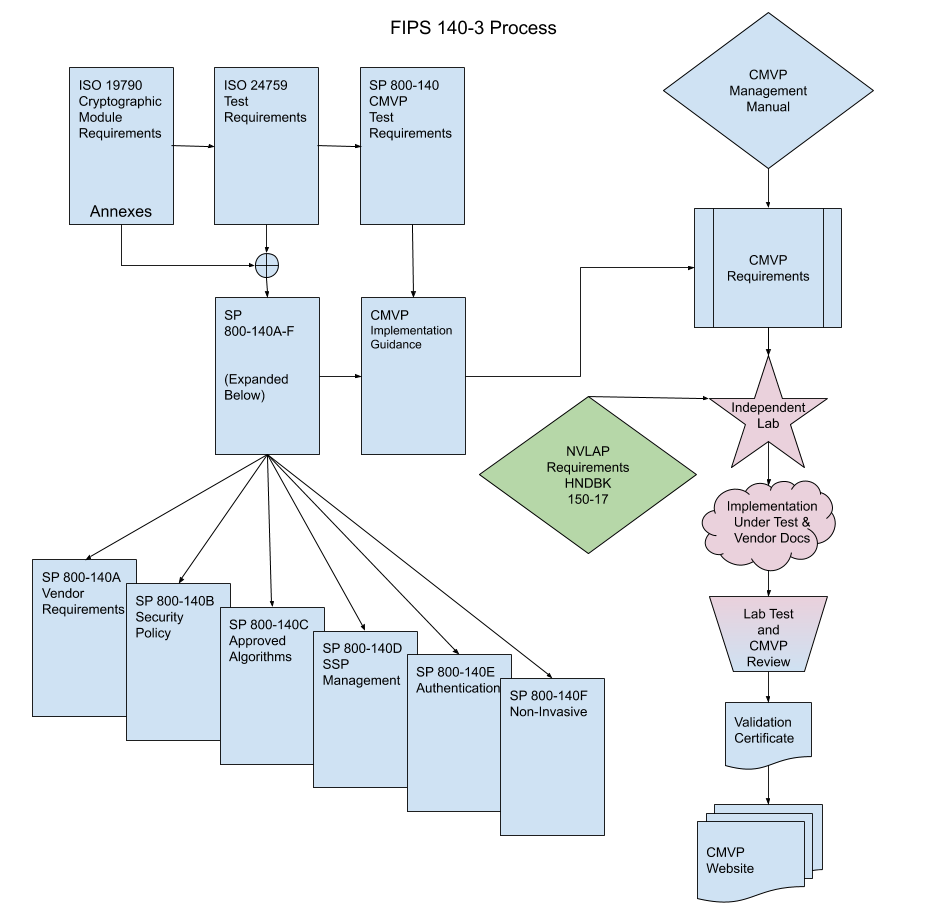
This is consistent with the configuration-bound traceability approach from the earlier lessons:
If any of these terms changes, the validity of the claim must be reconsidered rather than assumed.
The CMVP’s explicit distinction
Read the official CMVP FAQ before applying the decision method below. It provides the authoritative baseline: a validated module can be embedded in another product, but the product cannot claim itself to be validated merely because it uses that module.
Cryptographic Module Validation Program | CSRC
Read the relevant CMVP FAQ entries from NIST CSRC. They establish the formal distinction between a validated module, an embedded validated module, and a vendor assertion of compliance.
Read FAQ P-17 once, beginning with the embedding rule. Focus on both conditions: the integrated product must not alter the original validated module, and CMVP validation does not assure that the parent product uses it correctly. Then read P-18, especially the compliant-versus-validated distinction. Finally, in the “Standards/Guidance” portion, read SG-7 and SG-8. In SG-8, follow the verification guidance, noting the need to compare a vendor statement with the CMVP validation entry, including version and operational-environment information.
Two statements from this guidance deserve to become fixed review rules.
Rule 1: An embedded module does not validate the parent product
A product may reference an incorporated validated module only if it does not alter that validated module. The permitted scope of the claim is that the product utilizes or contains the validated module.
It is not accurate to infer:
Nor may one infer:
The latter limitation is particularly important in complex systems. A client may have a validated library in its bill of materials while another component:
- calls a different cryptographic provider;
- invokes operating-system cryptographic APIs outside the module;
- uses a non-approved algorithm for a security service;
- uses the validated library in a non-validated configuration; or
- runs a binary or platform outside the certificate’s validated configuration.
The phrase FIPS 140-3 Inside can be accurate as a narrow statement of inclusion while still being insufficient evidence that the deployed solution meets a customer’s cryptographic-control requirement.
Rule 2: “Validated” is not a synonym for “compliant” or “certified”
CMVP’s terminology is deliberate:
- Validated refers to a cryptographic module that has completed the CMVP process and has a CMVP-issued certificate number.
- Compliant can express a vendor’s belief that its implementation meets FIPS 140-3 requirements, but it is not CMVP validation.
- Certified is common commercial shorthand, but CMVP directs users to the term validated and to the certificate number.
- Approved normally characterizes an algorithm, method, or operation under the applicable cryptographic rules. It does not establish that a module, product, or system has been validated.
Thus, neither of these statements proves module validation:
- “Our application uses AES-256.”
- “Our product uses FIPS-approved algorithms.”
- “Our product is FIPS compliant.”
- “Our product has been designed to meet FIPS 140-3.”
They might be relevant technical facts. None identifies a CMVP-validated module and its applicable configuration.
A practical taxonomy of claims
Use the following table to classify a claim before deciding whether it is supportable.
| Claim category | What it actually asserts | Minimum evidence | What it does not establish |
|---|---|---|---|
| Validated module claim | The named cryptographic module was validated under CMVP | CMVP certificate number; matching validation entry; security policy; exact version and configuration evidence | That every broader product containing it is validated |
| Embedded-module claim | A product contains or uses a named validated cryptographic module | Identification of the module and certificate; evidence that the embedded module is unaltered | That the parent product is validated or uses the module correctly for all relevant cryptography |
| Compliance assertion | The vendor believes its implementation meets FIPS-related requirements | Vendor technical rationale, ideally bounded and qualified | Independent CMVP validation |
| Algorithm claim | A product uses a specified approved or validated algorithm implementation | Algorithm certificate or implementation evidence, as applicable | Module validation, product validation, or correct system integration |
| Protocol or product-security claim | A protocol, service, appliance, or system provides cryptographic protection | Architecture, configuration, test, and deployment evidence | That the protocol itself was tested or validated by CMVP |
The fifth category matters because customers often contract for outcomes such as “FIPS-compliant VPN,” “FIPS cryptography in the cloud,” or “validated secure communications.” Those may be reasonable procurement requirements, but they need to be decomposed into verifiable statements. CMVP validates the cryptographic module; it does not, merely by issuing a module certificate, validate the entire protocol implementation or system architecture.
Example 1: the product is the module
Suppose a vendor sells a network-attached hardware security module. The CMVP validation entry identifies the appliance model, firmware version, hardware revision, and security level. The cryptographic boundary in the security policy is the appliance itself.
A supportable product claim could be:
“The Cryptographic Appliance Model A, firmware version 4.2, is a FIPS 140-3 validated cryptographic module, Certificate #XXXX, when operated in the validated configuration described in its security policy.”
The qualifications are not needless legal decoration. They identify the object, version, certificate, and configuration to which validation applies.
A risky variant would be:
“All deployments of Model A are FIPS 140-3 validated.”
That claim may overreach if optional firmware, maintenance interfaces, operating modes, hardware revisions, or field updates fall outside the validated configuration.
Example 2: a product contains the module
Now consider a satellite communications gateway running an embedded operating system and a validated cryptographic library. The gateway application uses the library for selected TLS and IPsec services. The validated boundary is the library, not the full gateway.
A properly scoped statement is:
“Gateway B incorporates Cryptographic Library C, Certificate #YYYY, for the cryptographic services identified in the deployment documentation.”
A claim such as “Gateway B is FIPS 140-3 validated” would be inaccurate unless the CMVP certificate identifies Gateway B itself as the validated module.
Even the narrower statement needs technical confirmation. The consultant should determine whether the production binary is the validated library version, whether it is configured in the validated mode where relevant, whether the listed operational environment applies, and whether all cryptographic services relevant to the customer’s requirement actually route through it.
Example 3: an algorithm claim is not a module claim
A vendor may state that a product uses AES, SHA-256, RSA, or an implementation with algorithm-validation evidence. That may support a portion of an assurance argument, but it does not support the statement:
“The product is FIPS 140-3 validated.”
Module validation covers substantially more than algorithm selection: boundary definition, interfaces, roles, services, authentication, sensitive security parameter management, self-tests, operational environment, lifecycle assurance, and other applicable requirement areas. Later modules in this course will show how algorithm certificates connect to, but do not substitute for, the module validation argument.
Official wording, logo use, and the endorsement trap
A marketing claim should be accurate even without a logo. When the vendor uses the official FIPS 140-3 logo or phrases, however, the CMVP’s wording rules make the scope distinction especially explicit.
Cryptographic Module Validation Program | CSRC
Read NIST CSRC’s official logo and phrase guidance. It gives a concise, client-facing formulation of the difference between a validated module that is itself the product and a product containing a validated module.
Read the “What are the official FIPS 140-3 validated product logos?” and “What are the guidelines for the use of the FIPS 140-3 logo?” portions. Focus first on the scope of permission. Then read the stated use of “FIPS 140-3 Validated” when the module is the product, versus “FIPS 140-3 Inside” when the product contains the module. Finish with the status and endorsement limits.
The official distinction can be condensed as follows:
| Situation | Appropriate scope of wording |
|---|---|
| The cryptographic module is the product | “FIPS 140-3 Validated” together with the certificate number |
| The product contains a validated cryptographic module | “FIPS 140-3 Inside” together with the certificate number |
| No CMVP certificate exists for the claimed module | Do not use “FIPS 140-3 Validated” or imply CMVP validation |
Two cautions follow.
First, the certificate number must be part of the claim. A phrase such as “FIPS validated” without a certificate number, named module, or version gives the reader no practical way to verify scope.
Second, CMVP validation is not product endorsement by NIST, CCCS, the U.S. Government, or the Canadian Government. A claim such as “NIST-approved encryption appliance” should be treated as a red flag unless it is carefully rewritten. NIST may publish a validation entry for a module; that does not constitute endorsement of the vendor or the overall product.
Evaluate a claim in seven consulting steps
A good reviewer does more than decide whether a sentence sounds plausible. They turn a vague commercial statement into a bounded technical proposition.
1. Normalize the claim
Rewrite the marketing statement in a form that exposes its implied assertion:
[Named object] is [claimed status] under [standard or program], evidenced by [certificate or record], in [identified configuration].
For example:
“Secure Gateway 6 is FIPS 140-3 validated.”
becomes:
“Secure Gateway 6, as a whole, is the CMVP-validated cryptographic module.”
That normalized statement is easy to test against the CMVP record. If the certificate instead identifies an embedded library, the original statement is overbroad.
2. Identify the claimed object and the validated object
Obtain the exact names used in:
- the product data sheet or purchase proposal;
- the CMVP validation entry;
- the security policy;
- the software bill of materials or firmware manifest; and
- the installation and administrative guidance.
Then ask whether the claimed product and certificate-listed module are the same object.
Names alone are unreliable. “Product X FIPS Edition” may be a commercial bundle, while the certificate covers only “Crypto Library X, version 3.4.” The distinction becomes clear only when you compare boundaries, versions, and deployment artifacts.
3. Check the certificate as a configuration record
A certificate number is necessary but not sufficient. Compare the offered or deployed configuration against the CMVP entry and security policy.
At minimum, compare:
| Check | Why it matters |
|---|---|
| Vendor and module name | Establishes that the cited certificate belongs to the claimed module |
| Module version, part number, or release | Prevents a certificate for an earlier build being applied to a later product |
| Hardware or firmware revision | Determines whether the physical or firmware configuration matches |
| Operational environment | Especially important for software and firmware modules |
| Cryptographic boundary | Distinguishes the validated module from the host product |
| Claimed security level | Avoids attributing a level to an unvalidated configuration |
| Approved-mode instructions | Determines how the module must be configured and operated |
| Certificate status and procurement applicability | Separates factual listing status from the customer’s specific acceptance requirement |
The FAQ’s recommendation to compare a vendor’s signed statement with the CMVP validation entry is useful here. The vendor should be able to state clearly whether the offered item is the validated module itself or incorporates one, identify the certificate number, and describe how the module provides the relevant cryptographic services.
4. Check for alteration of the embedded module
If the claim is an embedded-module claim, determine whether the parent product modifies the validated module. Relevant changes can include:
- recompilation with changed build options;
- source patches or vendor-specific forks;
- replacement of a validated component with a newer library release;
- changes within the validated boundary;
- loading new executable applications into a validated module; or
- deployment on a platform or environment not covered by the validation.
The key point is not that every surrounding system change invalidates a module certificate. It is that the vendor cannot casually carry a certificate forward when the object within the validated boundary, or its applicable validated configuration, has changed.
5. Trace the product’s relevant cryptographic paths
For the customer’s actual use case, identify the security services that matter: encryption of stored sensitive data, TLS termination, VPN tunnelling, digital signatures, key establishment, authentication, or key management.
Then trace each path:
This step addresses a different question from literal claim accuracy:
- Claim question: Does the product actually contain the cited validated module?
- Solution-assurance question: Does the deployed product use that module appropriately for the cryptographic functions the customer cares about?
A product can satisfy the first while failing the second. The CMVP FAQ expressly cautions that correct utilization of an embedded module is outside the assurance provided by that module’s validation.
6. Look for terminology that improperly expands scope
The following red flags are common in proposals, website copy, architecture documents, and procurement responses.
| Risky wording | Why it is problematic | Better formulation |
|---|---|---|
| “The platform is FIPS 140-3 certified.” | “Certified” is imprecise, and “platform” may be larger than the validated module. | Name the validated module, certificate number, version, and applicable configuration. |
| “FIPS compliant encryption.” | Does not identify a CMVP-validated module; may only express vendor belief. | State whether a named validated module is used, and for which functions. |
| “NIST-approved product.” | Implies government endorsement. | “Contains a CMVP-validated cryptographic module, Certificate #XXXX.” |
| “FIPS 140-3 Inside.” | May be correct but incomplete for a deployment assurance claim. | Add the module name, certificate, version, and a separate explanation of relevant cryptographic-service routing. |
| “Uses FIPS-approved AES.” | Algorithm status does not establish module or product validation. | Identify the module and its validated configuration; keep the algorithm statement separate. |
| “FIPS validated cloud service.” | A cloud service is often broader than a module and may be continuously changing. | Identify the validated module(s), their boundaries, versions, and deployment controls. |
7. Issue a bounded conclusion
Your conclusion should state both the disposition of the wording and the remaining technical assurance gap.
For the gateway example, a sound conclusion could read:
The statement “Gateway B is FIPS 140-3 validated” is not supported by the cited CMVP certificate, which applies to Cryptographic Library C rather than to the gateway as a whole. Subject to confirmation that the deployed library version and operational environment match the validation entry and that the library is unaltered, the narrower statement “Gateway B incorporates Cryptographic Library C, CMVP Certificate #YYYY” is supportable.
This embedded-module statement does not, by itself, demonstrate that all cryptographic services relevant to the customer’s use case are performed through the validated module in its validated configuration. That requires separate architecture, configuration, and deployment evidence.
This is the kind of conclusion a client can act on: it corrects the claim without conflating marketing accuracy, CMVP scope, and system-level compliance.
A compact claim-review record
For a client engagement, capture each reviewed claim in a short decision record rather than leaving the analysis in email threads.
| Field | Content to record |
|---|---|
| Claim as received | Exact wording, medium, date, and claimant |
| Claimed object | Product, service, module, library, appliance, or deployment |
| Claimed status | Validated, compliant, approved, certified, inside, or another term |
| Cited evidence | Certificate number, CMVP entry, security policy, vendor letter, version manifest |
| Validated object | Exact CMVP-listed module name and version |
| Boundary relationship | Same object, embedded module, external dependency, or unsupported |
| Configuration match | Version, part number, hardware, firmware, operational environment, approved mode |
| Relevant crypto-service paths | Which customer-relevant functions use the module and how |
| Claim disposition | Supported, supportable if rewritten, unsupported, or insufficient evidence |
| Approved replacement wording | Precise statement the vendor may use |
| Residual assurance issue | What CMVP validation does not establish for the broader product |
This record has a useful engineering property: it prevents a team from treating the certificate number as the conclusion. The certificate is an input to the scope analysis, not a substitute for it.
Key takeaways
A FIPS 140-3 validation is a claim about a defined cryptographic module and its validated configuration. The commercial product may be that module, or it may merely contain it.
- A product may claim to be FIPS 140-3 Validated only when the product itself is the validated cryptographic module covered by the CMVP entry.
- A broader product that incorporates an unaltered validated module may state FIPS 140-3 Inside with the relevant certificate number, but it must not claim that the entire product is validated on that basis alone.
- A validated module inside a product does not assure that the product invokes it correctly for all relevant cryptographic services.
- “Compliant,” “approved,” and “certified” should never be allowed to blur the distinction between a vendor assertion, an algorithm property, and CMVP module validation.
- A defensible review compares the actual product, boundary, version, environment, mode, and cryptographic call paths with the CMVP validation entry and security policy.
Next, you will consolidate the first module’s methods into a reusable requirements-source, policy-currency, responsibility, and claim-review checklist for use in client engagements.