Introduction
Welcome to the next major phase of your learning journey! We've just concluded our deep dive into advanced React, focusing on performance optimization within the browser. Now, we're shifting our attention from the client-side to the server-side, beginning our module on Node.js and Express.
Given your experience building backend services and REST APIs, you're already familiar with what Node.js can do. This module is designed to explore the how and the why. We'll start with the most fundamental concept that defines Node.js and is the key to its performance characteristics.
This lesson addresses the learning outcome: Explain how Node.js's event-driven, non-blocking I/O model enables high concurrency and how it differs from traditional multi-threaded models. By the end, you'll have a robust mental model of the Node.js runtime, preparing you to write more efficient and scalable backend code.
1. The Concurrency Challenge: Traditional vs. Node.js Models
At its core, a web server's job is to handle multiple client requests concurrently. The architectural approach to handling this concurrency is a critical design decision that has profound implications for performance and resource usage.
The Traditional Approach: Thread-Per-Request
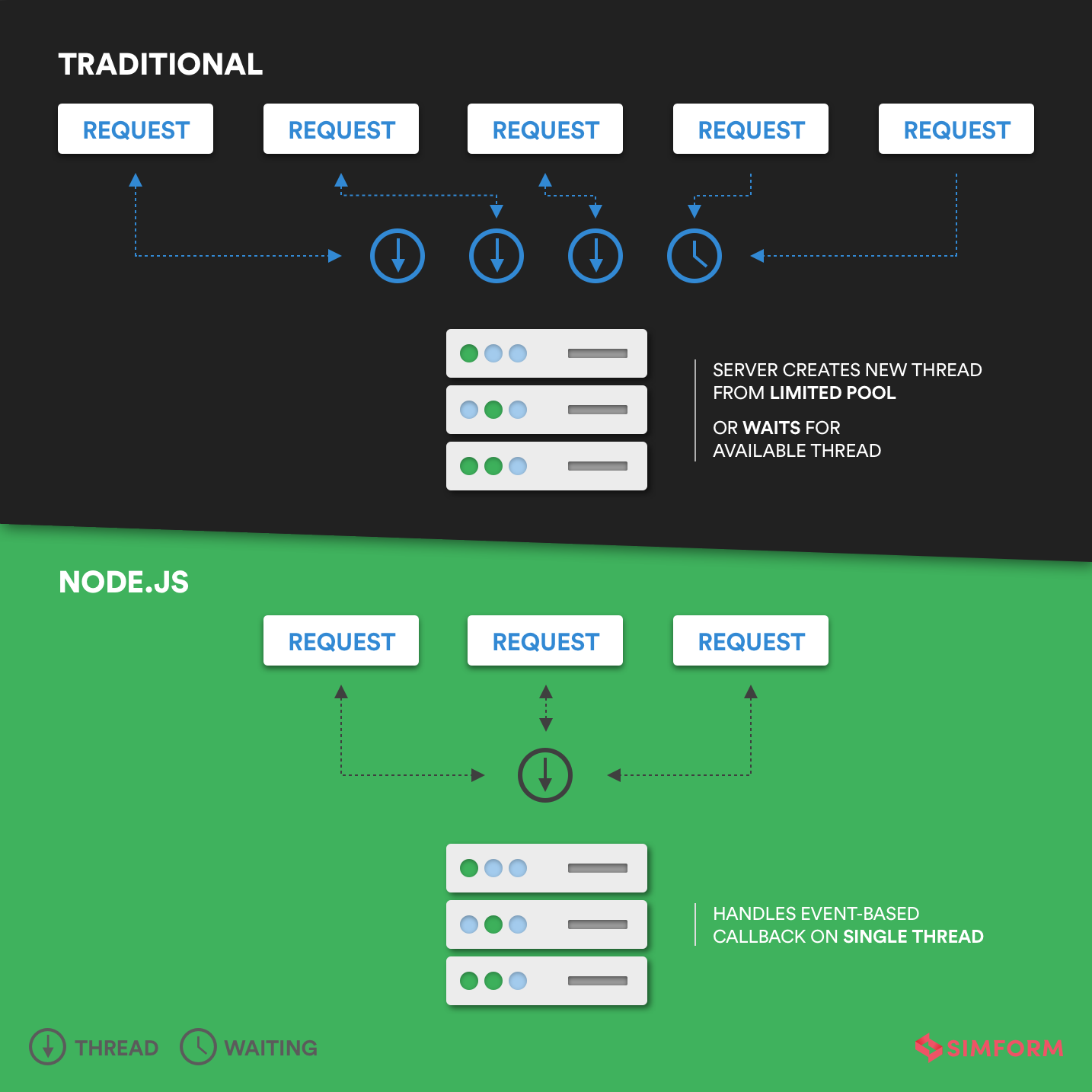
Many traditional web servers, like Apache, use a multi-threaded, "thread-per-request" model. In this architecture, the server maintains a pool of threads. When a new request comes in, an available thread is assigned to handle it from start to finish. If that request involves a slow I/O operation (like querying a database), the thread is "blocked"—it sits idle, consuming memory and waiting for the operation to complete. If all threads are busy, new requests must wait in a queue.
The Node.js Approach: Single-Threaded and Event-Driven
Node.js takes a fundamentally different approach. It runs your JavaScript code on a single main thread. Instead of blocking on I/O operations, it uses a non-blocking, event-driven model.
This image provides a clear visual comparison of the two models.
To get a high-level overview of how Node.js accomplishes this, let's watch a short video that introduces the core concepts.
The Genius Behind Node.js Single Thread Model 🚀
This video, 'The Genius Behind Node.js Single Thread Model', provides an excellent introduction. It explains the limitations of both pure single-threaded and traditional multi-threaded models, setting the stage for why Node.js's architecture is so effective for I/O-heavy applications.
Watch from the beginning up to 00:05:05. Focus on: The explanation of processes vs. threads. The drawbacks of the traditional multi-threaded model (memory overhead, context switching). The introduction of Node.js's single-threaded, event-driven, non-blocking I/O model as the solution.
2. Deconstructing the Node.js Model
The phrase "single-threaded, event-driven, non-blocking I/O" can be dense. Let's break it down piece by piece. The key insight is that while your JavaScript application code runs on a single thread, Node.js itself uses more than one thread under the hood to perform work.
Understanding Node.js, Threads, libuv, and Server Scalability
This article, 'Understanding Node.js, Threads, libuv, and Server Scalability', does a fantastic job of demystifying what 'single-threaded' truly means in the context of Node.js. It clarifies the roles of the main thread and the background worker threads.
Read the sections titled 'Node.js: Single-Threaded — What Does It Actually Mean?', 'Handling I/O: The Role of libuv', and 'Node.js Scalability: Handling 10,000+ Connections'. Pay close attention to the explanation of the libuv thread pool—this is the mechanism that prevents the main event loop from blocking.
As the article explains, the Node.js process consists of two key areas:
-
The Main Thread (with the Event Loop): This is where your JavaScript code is executed. It takes requests, initiates asynchronous operations, and runs the callbacks for completed operations. Its goal is to do work as fast as possible and never wait.
-
The Worker Pool (via
libuv):libuvis a C++ library that provides Node.js with its asynchronous capabilities. It manages a pool of threads (typically 4 by default, but configurable). When your code initiates a potentially blocking operation (like file system access, DNS lookups, or certain crypto functions), the Node.js API hands that task off to thelibuvworker pool. A worker thread performs the blocking task, and once it's complete, it places the result and the corresponding callback into a queue to be picked up by the Event Loop.
This architectural diagram provides a comprehensive visual summary of how these components interact.

This division of labor is what allows a Node.js server to handle high concurrency. The single main thread is free to accept new requests and run quick computations while the worker threads are busy with slow I/O operations in parallel.
3. A Deep Dive into the Event Loop's Mechanics
You now have a solid high-level model. For someone with your background and goals, it's worth going deeper to understand the internal mechanics of the Event Loop itself. It's not just a single queue; it's a multi-phase process that determines the precise order of execution for different asynchronous tasks.
First, let's turn to the official Node.js documentation for the canonical definition of the event loop phases.
The official Node.js documentation provides the definitive guide to the Event Loop. Reading this will give you the formal vocabulary and structure.
Read the sections 'Phases Overview' and 'Phases in Detail'. Your goal is not to memorize every detail, but to understand that the loop has distinct phases (timers, poll, check) and each phase has its own queue of callbacks.
The existence of these phases explains some of the more subtle behaviors in Node.js, such as the difference between setTimeout(..., 0) and setImmediate(). The following video provides a brilliant, practical demonstration of these concepts, showing how the phase-based loop leads to execution orders that might otherwise seem unpredictable.
A Deep Dive Into the Node js Event Loop - Tyler Hawkins
This talk, 'A Deep Dive Into the Node js Event Loop', is perfectly aligned with your goal of understanding the 'why'. It masterfully connects the theoretical phases of the event loop to the practical, sometimes non-deterministic, output you see when running code.
Watch from 00:10:24 to 00:20:03. This is the most crucial part of the talk. Observe: How setImmediate() is introduced and compared to setTimeout(..., 0). The non-deterministic race condition when they are run in the main module. The key moment when the code is moved inside an I/O callback (fs.readFile), and the execution order becomes deterministic (setImmediate always runs first). The final explanation using the event loop phase diagram, which ties everything together.
This deep dive reveals a key principle: the execution order of asynchronous callbacks depends on which phase of the event loop is currently active. When code runs within an I/O callback (the poll phase), the loop's next step is the check phase, guaranteeing that setImmediate callbacks run before any timers.
Conclusion
In this lesson, we dissected the core of the Node.js runtime. You've seen how its unique architecture allows it to achieve high concurrency for I/O-bound applications without the resource overhead of traditional multi-threaded models.
Key Takeaways:
- Traditional Model: Servers like Apache often use a thread-per-request model, where threads are blocked on slow I/O operations, limiting scalability.
- Node.js Model: Node.js uses a single main thread to execute your JavaScript via an Event Loop. This thread is never blocked on I/O.
- Non-Blocking I/O: When an asynchronous I/O operation is requested, Node.js offloads it to the system. This is managed by the
libuvlibrary, which uses a small worker thread pool to perform the heavy lifting in the background. - Event-Driven: Once a background task completes,
libuvnotifies the Event Loop, which then executes the associated JavaScript callback on the main thread. This ensures the main thread is always busy with active work, not waiting. - Event Loop Phases: The Node.js Event Loop is a multi-phase process (
timers,poll,check, etc.). The specific phase dictates the execution order of different types of asynchronous tasks, explaining the nuanced behavior of functions likesetTimeoutandsetImmediate.
What's Next?
Now that you have a firm grasp of the Node.js runtime environment, our next lesson will focus on how code is organized and shared within that environment. We will explore the differences between the two module systems in Node.js: the traditional CommonJS (require) and the modern ES Modules (import), including their distinct syntax and loading behaviors.