Introduction
Welcome back! In our previous lesson, we established the foundation of a Node.js application by examining its module systems, CommonJS and ES Modules. You learned how their different loading behaviors—synchronous for CJS and asynchronous for ESM—shape how we structure our code.
Now, we'll build on that foundation by introducing Express.js, the de facto standard framework for building web servers with Node.js. This lesson focuses on the single most important architectural concept in Express. The learning outcome is to explain the middleware pattern in Express and how the next() function passes control through the request-response cycle.
This pattern is not just a feature; it's the very essence of how Express applications are built. Understanding it is crucial for everything from parsing request bodies and handling authentication to logging and error management. We'll explore how Express uses a chain of functions to process an incoming request, and the pivotal role the next() function plays in that chain.
Let's start with a high-level view of this process.
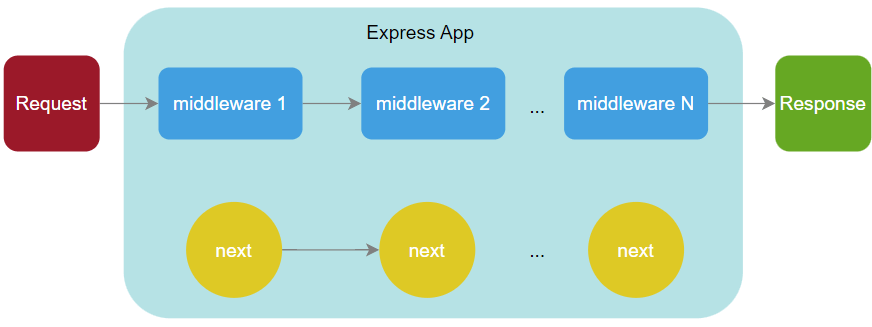
1. The Core of Express: A Chain of Functions
At its heart, an Express application is a series of functions called "middleware". When a request hits your server, it travels through this chain. Each middleware function has a specific job. It can inspect the request, modify it, send a response, or pass control to the next middleware in the chain.
A middleware function has a standard signature: (req, res, next).
req: The request object, containing information about the incoming HTTP request.res: The response object, used to send a response back to the client.next: A function that, when called, passes control to the next middleware.
The proper use of next() is fundamental. If a middleware function doesn't send a response, it must call next() to avoid leaving the request hanging.
To see this in action, let's watch a detailed walkthrough that builds a simple middleware chain from scratch.
What is Express middleware and how does it work? (in-depth)
The video 'What is Express middleware and how does it work? (in-depth)' provides an excellent, code-driven explanation of the middleware pattern. This first segment introduces the concept and clearly demonstrates the crucial role of next().
Watch from 00:15 to 09:40. As you watch, pay close attention to: The standard (req, res, next) signature of a middleware function. What happens when a middleware is added to a route but next() is not called. How calling next() allows the request to proceed to the final route handler.
As the video demonstrated, every middleware function faces a choice:
- End the cycle: Send a response to the client (e.g., using
res.send(),res.json(),res.sendStatus()). - Continue the cycle: Pass control to the next middleware in the chain by calling
next().
A common bug, especially for beginners, is calling next() and trying to send a response in the same code path, which leads to an error. A middleware should do one or the other.
2. Order and Scope: The Middleware Pipeline
The sequence in which you define your middleware is not arbitrary—it's critical. Express executes middleware in the exact order they are added to the application. This has significant implications for your application's logic.
Middleware can be applied in two primary ways:
- Application-level middleware: Using
app.use(), this middleware will run for every incoming request, regardless of the path or HTTP method. - Route-level middleware: Applied directly to a route definition (e.g.,
app.get('/', myMiddleware, ...)), this middleware will only run for requests that match that specific route and method.
Let's continue with the same video to see how order and scope work together.
What is Express middleware and how does it work? (in-depth)
This next segment demonstrates how the order of app.use() calls defines the execution pipeline and how you can mix application-level and route-level middleware.
Watch from 09:40 to 17:53. Focus on how changing the order of app.use() calls changes the console output, proving the sequential execution. Note how a request first passes through all matching application-level middleware before hitting the route-specific ones.
This principle is why a middleware like express.json(), which parses the request body, must be placed before any route handlers that need to access req.body. If the order were reversed, req.body would be undefined in your route handler.
This concept is so fundamental that misunderstanding it can lead to severe bugs in production.
Understanding Middleware in Express.js
The article 'Understanding Middleware in Express.js' shares a real-world story that powerfully illustrates why middleware order is everything.
Read the section 'The Order That Almost Ended My Career'. This short anecdote provides a memorable, practical context for the concepts you just saw in the video.
3. Advanced Middleware Patterns
Beyond simple logging, middleware enables powerful and elegant architectural patterns. Since you're interested in the under-the-hood mechanics, let's explore three advanced patterns that are essential for building robust APIs.
A. Passing Data via the req Object
Middleware functions share the same req and res objects. This allows one middleware to add properties to the req object, making that data available to all subsequent middleware in the chain. This is the core mechanism behind authentication systems like Passport.js, which typically validate a token and attach a user object to req.
What is Express middleware and how does it work? (in-depth)
Let's see a practical demonstration of this data-passing pattern.
Watch from 24:57 to 29:48. The video shows how a property added to req in one middleware can be read and even modified by another middleware later in the chain. This is a fundamental technique for sharing request-scoped data.
B. Error-Handling Middleware
What happens when an error occurs? Instead of littering your code with try...catch blocks that send responses, Express provides a special type of middleware for centralized error handling.
Error-handling middleware is unique in two ways:
- It has a signature with four arguments:
(err, req, res, next). - It must be defined after all other
app.use()calls and routes.
When you call next() with an argument, like next(error), Express skips all remaining regular middleware and jumps directly to the first error-handling middleware.
What is Express middleware and how does it work? (in-depth)
This final clip from the video explains the special nature of error-handling middleware.
Watch from 17:53 to 24:57. Notice how calling next(err) triggers the error handler, and why placing the error handler at the end of the file is non-negotiable.
This pattern is especially powerful for handling errors from asynchronous operations. Instead of handling the error inside the catch block of a promise or async function, you can simply pass it to next.
Getting Started With An Express And ES6+ JavaScript Stack
The article 'Getting Started With An Express And ES6+ JavaScript Stack' provides an excellent code example of refactoring asynchronous route handlers to use a central error-handling middleware.
Read the section 'Cleaning Up Our Architecture'. Focus on how the catch (e) block is simplified to just next(e), delegating all error logic to the centralized middleware at the bottom of the file. This is a clean, professional pattern.
C. Asynchronous Middleware and the "Unwinding" Stack
When working with async middleware, the execution flow is particularly interesting. When a middleware calls await next(), it pauses its own execution and passes control down the chain. Only after the rest of the chain has completed and control returns does the code after await next() execute.
This creates a "U" shaped execution path, often called the "unwinding" of the stack.
This pattern is useful for tasks that need to happen both before and after the main request processing, such as performance timing. You can record a start time before await next() and calculate the duration after it completes. This is a direct look at the control flow management that your preference for conceptual understanding will appreciate.
Conclusion
You have now explored the middleware pattern, the architectural backbone of Express.js. This is more than just an API detail; it's a powerful design pattern for composing functionality and handling requests in a clean, modular way.
Key Takeaways:
- Middleware is a Chain: An Express application processes requests by passing them through a chain of middleware functions.
- The
(req, res, next)Signature: Each middleware has access to the request, the response, and thenextfunction to continue the chain. next()Passes Control: Callingnext()is essential for passing control to the subsequent middleware. A middleware must either callnext()or send a response.- Order is Critical: Middleware executes in the order it is defined. This is crucial for dependencies, like parsing a request body before accessing it.
- Error Handling is Special: Error-handling middleware has a
(err, req, res, next)signature, is triggered bynext(error), and must be defined last to act as a global catch-all. - Patterns: Middleware enables powerful patterns like passing data on the
reqobject and the "unwinding" stack withasync/await.
What's Next?
With a firm grasp of the middleware pattern, you're now equipped to understand more complex Express applications. In the next lesson, we will dive deeper into handling asynchronous operations within Express routes. We'll compare different strategies like using raw callbacks, promise chains, and async/await with robust error handling, building directly on the concepts you've learned today.