Welcome to the first lesson of our module on the Foundations of Financial Modeling. Your extensive background in market research and business strategy has given you a keen sense of a company's performance, particularly through metrics like P&L. This module will build on that foundation by equipping you with the formal structures and techniques of financial modeling, a crucial skill for the deep quantitative analysis required in strategic foresight and revenue optimization.
Today, we'll start with the bedrock of any financial model. Our goal is to explain the purpose of the three core financial statements—the Income Statement, the Balance Sheet, and the Cash Flow Statement—and, most importantly, to understand how they are intricately linked. Mastering this conceptual framework is the essential first step before we begin building these models in Python.
The Three Pillars of Financial Reporting
A company's financial health is told through a story with three parts. Each part, or financial statement, answers a different fundamental question about the business. Together, they provide a comprehensive view of a company's performance and position.
To begin, let's get a clear definition of each statement and its role.
Finance guide: The 3-statement financial model explained
This article provides concise definitions for each of the three statements. Please read the introductory sections to understand their individual purposes.
First, read the section What are the three financial statements? to get an overview. Then, scroll down to the "Components of the 3-statement model" and read the brief descriptions and formulas for the three components: the Income Statement, the Balance Sheet, and the Cash Flow Statement.
As you've just read, we can summarize the purpose of each statement as follows:
- The Income Statement: Answers the question, "Is the company profitable?" It measures revenues and expenses over a specific period (like a quarter or a year) to arrive at the "bottom line": net income. Given your experience with P&L management, this statement is likely the most familiar to you.
- The Balance Sheet: Answers the question, "What is the company's net worth at a specific moment?" It presents a snapshot of a company's assets (what it owns), liabilities (what it owes), and shareholders' equity (the owners' stake). It is governed by the fundamental accounting equation: Assets = Liabilities + Equity.
- The Cash Flow Statement: Answers the question, "Where did the company's cash come from and where did it go?" It reconciles the accrual-based net income from the Income Statement to the actual change in cash over the same period.
Visualizing the Connections
Understanding these statements individually is one thing; the real power comes from seeing how they work together as an integrated system. Before we break down the mechanics, let's look at a visual map of how information flows between them.

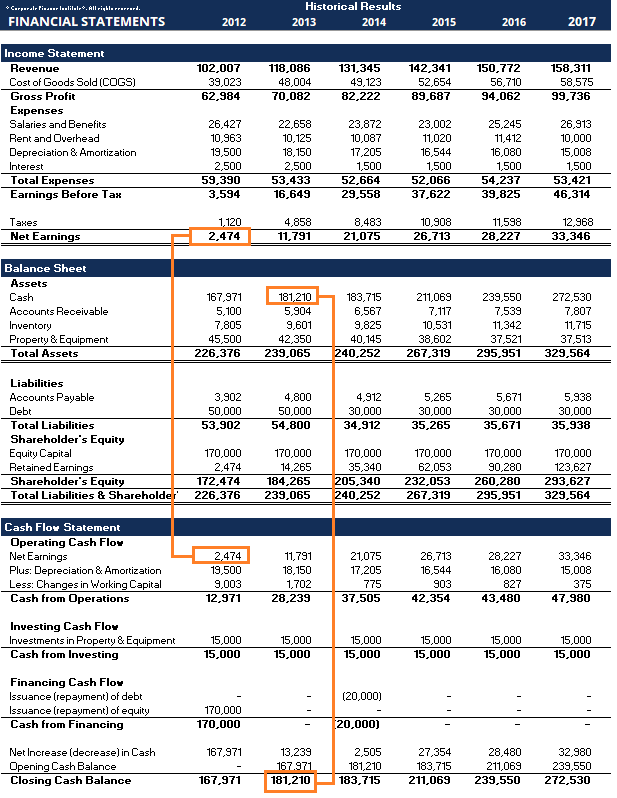
This schematic shows the core connections. Now let's see how these links appear in a set of actual financial statements. The highlighted lines in the image below trace the exact same flows shown in the diagram above.
The Mechanics of the Interlinks
Now that you have a visual model, let's explore the mechanics of these connections. A helpful analogy is to think of the statements in terms of "pushing" and "pulling" information:
- The Income Statement is a "giver"—it pushes its key output, Net Income, to the other two statements.
- The Cash Flow Statement is a "taker"—it pulls information from both the Income Statement and the Balance Sheet.
- The Balance Sheet is the ultimate anchor. It pulls from the Income Statement and pushes to the Cash Flow statement, but it must always remain in balance.
The following video provides an excellent conceptual breakdown of these dynamics. It reveals a key insight: the Cash Flow Statement is essentially an explanation of the change in every Balance Sheet account except for cash itself.
How the 3 Financial Statements Connect Together
This video from "Your CFO Guy" explains the connections using a clear "push/pull" analogy and helpful examples.
Please watch the following segments: The high-level flow, which introduces the push/pull concept. The role of Net Income, explaining its link to the Balance Sheet and Cash Flow Statement. The Balance Sheet's link to the CFS. Pay close attention to the "secret" of the cash flow statement revealed here. The final recap, which summarizes the key connections.
Let's solidify the three primary links you saw in the video:
-
Income Statement → Cash Flow Statement: Net Income is the starting line for the Statement of Cash Flows (using the indirect method, which is most common). Because Net Income includes non-cash expenses like Depreciation & Amortization, these must be added back to determine the true cash flow from operations.
-
Cash Flow Statement → Balance Sheet: The final line of the CFS is the net change in cash for the period. This value is used to calculate the ending cash balance, which then appears as the "Cash" line item under Assets on the next period's Balance Sheet. This is the crucial link that ensures the Balance Sheet balances from one period to the next.
-
Income Statement → Balance Sheet: This is often considered the most important link, centered on Retained Earnings. Net Income for the period is added to the Retained Earnings account in the Shareholders' Equity section of the Balance Sheet. Any dividends paid out to shareholders are then subtracted. The formula is:
This represents the cumulative profit that the company has reinvested back into the business over its lifetime.
Putting It All Together
Being able to articulate these connections clearly is a fundamental skill in finance. The following reading provides a concise, professional summary formatted as an answer to a common interview question.
How are the Three Financial Statements Linked?
This resource provides a sample response that synthesizes all the concepts we've discussed.
Please read the example response in the "Accounting Interview Question" section. As a self-check, try to rephrase this explanation in your own words.
Conclusion
In this lesson, we established the foundational concepts of the three-statement model. We defined the unique purpose of the Income Statement, Balance Sheet, and Cash Flow Statement and, most critically, mapped the mechanical and logical links that bind them into an integrated system.
Key Takeaways:
- The Income Statement measures profitability over a period, culminating in Net Income.
- The Balance Sheet provides a snapshot of assets, liabilities, and equity at a single point in time, always adhering to Assets = Liabilities + Equity.
- The Cash Flow Statement reconciles accrual-based profit to actual cash changes over a period.
- Key Links:
- Net Income is the starting point for the Cash Flow Statement.
- Net Income increases Retained Earnings on the Balance Sheet.
- The ending cash balance from the Cash Flow Statement becomes the cash asset on the next period's Balance Sheet.
In our next lesson, we will transition from theory to practice. You will apply these principles to build a historical Income Statement and Balance Sheet for a company using Python and the pandas library, taking the first concrete step in constructing a full financial model.