In our previous lesson, we explored the breathtaking ambition of Honoré de Balzac's La Comédie humaine, understanding it as a systematic project to document the entirety of 19th-century French society. You saw how Balzac positioned himself as a "secretary" to his era, aiming to write the unwritten "history of manners." Now, we will move from the grand architectural plan to the bricks and mortar of his literary construction.
This lesson focuses on two of the most important realist techniques Balzac employs in Père Goriot. First, we will examine his use of detailed social description, where settings are not mere backdrops but living environments that reflect and shape the characters. Second, we will analyze the powerful role of economic motivation, exploring how the pursuit of money and status becomes the central driving force of the narrative. By understanding these techniques, you will begin to see precisely how Balzac built his realistic vision of the world, piece by piece.
The Power of Place: Description as Diagnosis
In literary realism, the physical environment is never neutral. For Balzac, describing a place was like conducting a social and moral diagnosis. A room, a building, or a neighborhood reveals the character of its inhabitants and the society they belong to. The quintessential example in Père Goriot is the boarding house, the Maison Vauquer.
The connection between person and place is so absolute that Balzac makes it explicit. Consider this contemporary illustration of the proprietress, Madame Vauquer.
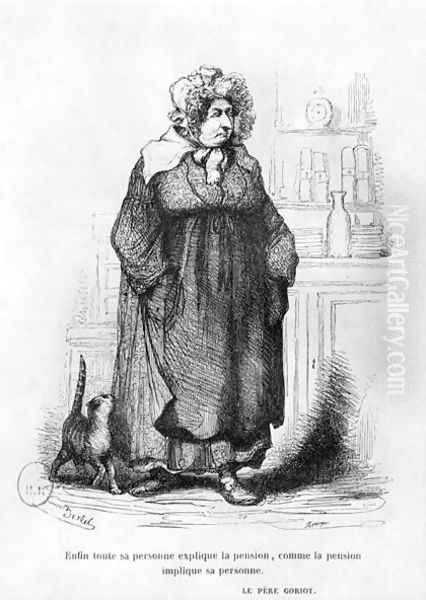
This statement is a perfect summary of Balzac's method. The shabby, decaying, and stingy nature of the pension is a direct extension of Madame Vauquer's own character, and vice versa. They are a unified entity. To understand how Balzac builds this effect not just with a single character but with an entire milieu, it's helpful to examine his descriptive technique more closely.
[PDF] International Journal Of English and Studies (IJOES)
This article offers a detailed analysis of Balzac's descriptive method. The author, Antara Bhatia, explains how Balzac's obsessive detailing goes beyond simple realism to create a world rich with symbolic meaning.
Please read the section that analyzes the description of the Maison Vauquer. Start from the paragraph beginning "One of these jigsaw pieces" and continue to the end of the long paragraph that concludes with "universal human experience". As you read, focus on how Balzac invests every object with significance, creating a milieu where the physical surroundings are "inextricably linked" to the characters' psychology and social standing.
As the reading explains, Balzac’s descriptions function as a "method of ‘signification’." The peeling wallpaper, the musty smells, the chipped statue—every detail is a signifier pointing to the moral and social decay of the world he is depicting. The Maison Vauquer is not just a cheap boarding house; it is a microcosm of Parisian society, a social laboratory where Balzac gathers his "social species."

The power of this technique lies in its ability to make abstract social forces tangible. The squalor of the boarding house is not just scenery; it is the physical manifestation of poverty, social failure, and moral compromise.
[PDF] Honoré de Balzac and the Rise of Realism in Literature
This academic paper reinforces the symbolic importance of Balzac's settings.
Please read the short paragraph in the section "Detailed and Lifelike Settings" that begins with the analysis of the Maison Vauquer. This passage explicitly states that the building's dilapidated state "mirrors the moral and emotional degradation of its inhabitants."
The Engine of Society: Economic Motivation
If detailed description provides the physical laws of Balzac's universe, the engine that drives everything within it is money. In the post-revolutionary society Balzac depicts, aristocratic lineage is being supplanted by wealth as the primary measure of worth. Ambition, love, family ties, and morality are all refracted through the prism of economic calculation.
The following clip from a documentary on Balzac makes this point succinctly and powerfully.
This segment of the documentary explores the central role of money and social climbing in La Comédie humaine.
Please watch the section from "The french revolution had changed everything". A literary expert explains how society became dynamic, with money as the key agent of social mobility, and concludes that "money in Balzac's novels... is one of the main characters."
This idea of money as a "character" is fundamental to understanding Père Goriot. The novel presents a world where human relationships are transactional and social success is a ruthless competition for wealth. Let's examine this through the novel's two central figures: Goriot and Rastignac.
1. Père Goriot: The Tragedy of a Living Bank Account
Goriot's story is a devastating critique of a society where even paternal love is quantified and commodified. He made his fortune as a vermicelli-maker, a classic bourgeois entrepreneur. He then liquidates his love for his daughters into dowries, enabling them to marry into the aristocracy. His tragedy unfolds as his daughters, having "spent" his value, discard him. He is no longer a father but a depleted asset.
[PDF] Honoré de Balzac and the Rise of Realism in Literature
This paper directly connects Goriot's tragedy to the theme of materialism.
First, read the paragraph in the section "Balzac and the Rise of the Bourgeoisie" that begins with the analysis of Goriot's sacrifices. Then, jump to the section "Influential Works of Honoré de Balzac" and read the first paragraph under the heading "Father Goriot". These sections lay out how Goriot's relentless financing of his daughters' social ambitions leads to his own destruction.
2. Eugène de Rastignac: An Education in Social Physics
If Goriot represents the tragic consequence of this new world order, Eugène de Rastignac represents the process of learning to master it. He arrives in Paris as an ambitious but naive young man from the provinces, believing in honor and merit. He quickly learns that success is not about virtue but about cold, hard cash and strategic connections. His character arc is an education in the ruthless physics of social climbing. The entire plot is propelled by his calculated attempts to acquire a rich wife or mistress to finance his ambitions.
[PDF] Honoré de Balzac and the Rise of Realism in Literature
This text analyzes Rastignac's character development as a cornerstone of Balzac's realism.
In the section "Complex and Multidimensional Characters," please read the paragraph that starts with the analysis of Rastignac's evolution. It shows how his transformation from a naive student to a shrewd social climber is driven by his desire for "wealth and power."
Balzac’s genius is to show this economic hunger not as an abstract force, but as something visceral, written on the very bodies of his characters. In the novel's opening, he describes the impoverished residents of the Maison Vauquer, noting that their "thin lips contained greedy teeth"—a brutally physical image of a life defined by want.
Conclusion
In this lesson, we have dissected two of Balzac’s core realist techniques as they appear in Père Goriot. You've seen how he uses detailed description not just to paint a picture, but to create a meaningful milieu where the environment is a diagnostic tool for society. You've also seen how he places economic motivation at the heart of his narrative, revealing a world where money has become the ultimate measure of all things.
Here are the key takeaways:
- Detailed Description as Milieu: Balzac’s settings, particularly the Maison Vauquer, are not passive backdrops. They are meticulously described to reflect and influence the moral, social, and psychological states of the characters.
- The Intertwining of Person and Place: As symbolized by Madame Vauquer and her pension, character and environment are mutually defining.
- Economic Motivation as the Prime Mover: In Balzac’s world, characters' actions, relationships, and moral choices are overwhelmingly driven by the pursuit of wealth and social status.
- Characters as Case Studies: Figures like Goriot and Rastignac serve as powerful illustrations of the consequences and strategies for survival in a materialistic society.
We have now examined how Balzac builds his world and what forces drive it. In our next lesson, we will look more closely at who inhabits this world. We will analyze how Balzac uses characterization to represent distinct social types and class structures, and also consider the lingering elements of Romanticism that coexist with his realist project.