Welcome back. In our last lesson, we examined two of Honoré de Balzac's foundational realist techniques: his method of detailed description to create a meaningful milieu, and his focus on economic motivation as the primary engine of his characters' lives. We saw how the squalid Maison Vauquer was a prime example of his descriptive power, where the setting itself seemed to embody the moral character of its inhabitants.
Today, we will delve much more deeply into that specific setting. Our goal is to analyze the role of the Parisian boarding house as a microcosm for social realism. A microcosm, in this literary sense, is a miniature world that reflects the structures, hierarchies, and conflicts of the larger society. You will see how Balzac uses the Maison Vauquer not merely as a backdrop, but as a carefully constructed social laboratory where the dramas of 19th-century Paris play out on a small, concentrated stage.
The Boarding House as Social Laboratory
One of Balzac's most effective realist strategies is to bring a diverse range of social "species" together in a single, contained environment. The Maison Vauquer is precisely this kind of space. It is home to the penniless student (Rastignac), the fallen bourgeois (Goriot), the mysterious criminal hiding in plain sight (Vautrin), and the petit-bourgeois landlady (Mme Vauquer), among others. By placing them under one roof, Balzac can efficiently stage the interactions, clashes, and alliances that define his vision of society.
This concept of a building as a container for a cross-section of society is a powerful visual metaphor.

The house becomes the novel's focal point, a nexus connecting the lowest rungs of society with the highest echelons of Parisian life. To formalize this idea, let's turn to an analysis of the novel's setting.
Père Goriot: Analysis of Setting | Literature and Writing | Research Starters | EBSCO Research
This research starter from EBSCO provides a concise overview of the novel's settings and immediately establishes the importance of the Maison Vauquer.
First, read the introductory paragraph, which defines the boarding house as a "microcosm of society." Then, continue to the section "Maison Vauquer" and read the two paragraphs there. Focus on how the text explains that the house is the "novel’s main focal point" because it connects characters from different social strata.
As the reading highlights, the Maison Vauquer allows for a "complex, but plausible, pattern" of crisscrossing paths. It is the geographic and social center of gravity for the novel. This structure allows for a systematic analysis of social forces, much like observing interactions within a contained experiment.
A Hierarchy in Miniature
The microcosm of the Maison Vauquer is not just a random assortment of people; it is a meticulously ordered world that reproduces the class hierarchy of Paris in miniature. This social stratification is physically inscribed onto the very architecture of the building.
The residents' rooms are allocated according to their ability to pay, which directly corresponds to their social standing.
- The Ground Floor: This is the domain of Madame Vauquer and the common areas—the dining room and salon—where the social life of the pension plays out.
- The First Floor (US Second Floor): This floor houses the most respectable and well-off boarders.
- The Second Floor: This is for the less affluent residents, like the old man Goriot at the start of the novel.
- The Third Floor (Garret): The highest and cheapest rooms are reserved for the poorest inhabitants, such as the student Rastignac and, eventually, Goriot himself after his finances are depleted.
This vertical arrangement is a direct and powerful metaphor: the higher you are in the building, the lower you are on the social ladder. A character's movement between floors becomes a clear indicator of their changing fortunes. Goriot's descent from a respectable room to a miserable garret is a physical manifestation of his social and economic ruin.
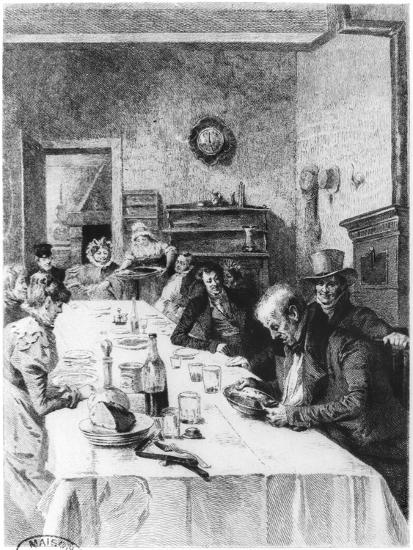
This hierarchy is also performed daily in the dining room, the house's primary social stage.
To get a more dynamic sense of this environment, the following video provides a good summary of the setting's atmosphere.
Père Goriot - Honoré de Balzac
This video review from the channel bigalbooks effectively captures the squalid atmosphere of the boarding house and its central role in the narrative.
Watch the segment from the beginning, where the narrator describes the "decrepid Paris boarding house" and notes how Balzac brings this "sordid place to life." This section emphasizes the atmosphere of decay that permeates the microcosm.
A Moral Crucible
The Maison Vauquer is more than just a social map; it is a moral crucible. The atmosphere of decay, desperation, and "boardinghouse smell" that Balzac so vividly describes is not merely descriptive. It creates a moral environment where virtue is tested and cynicism flourishes.
It is within the walls of the pension that the novel's central moral drama unfolds: the education of Eugène de Rastignac. He arrives as a young man with noble ideals, but the environment quickly teaches him the ruthless logic of Parisian society. The most potent lessons come from his fellow boarder, the arch-criminal Vautrin, who acts as a tempter, offering Rastignac a shortcut to wealth and power through crime. The squalor of the boarding house is the fertile ground in which Vautrin’s cynical philosophy can take root. The setting makes his amoral proposition seem not just shocking, but like a logical response to the world the characters inhabit.
Balzac's descriptive technique, which we began to analyze in the last lesson, is key to creating this moral atmosphere. Every detail signifies something beyond itself.
[PDF] International Journal Of English and Studies (IJOES)
We return to this article by Antara Bhatia to explore more deeply how the description of the boarding house creates its unique moral and psychological atmosphere.
Find the paragraph that begins with the sentence "The possibility of depth and multiple meanings..." and read from there until the end of the paragraph concluding with "universal human experience". Pay close attention to how the author explains that seemingly insignificant objects are "invested with another layer of meaning" and how the physical description is designed to suggest a mental and moral one.
As the article argues, Balzac’s goal is to create a milieu where the "physical descriptive statement" suggests a "mental one." The "chipped, scaling surface" of the statue of Cupid, the sticky furniture, the musty smells—these are not just details. They are the physical evidence of a world of moral decay and failed aspirations. The Maison Vauquer, therefore, is the perfect microcosm for social realism because its physical reality is inseparable from the social and moral reality of its inhabitants.
Conclusion
In this lesson, we have focused on the Maison Vauquer to analyze its function as a realist device. We have moved from seeing it as merely a well-described setting to understanding it as a complex, functioning microcosm of 19th-century Parisian society.
Here are the key takeaways from our analysis:
- The Maison Vauquer as Microcosm: The boarding house functions as a social laboratory, concentrating a wide cross-section of Parisian society into a single, observable space.
- Hierarchy in Miniature: The physical layout of the house, particularly the vertical arrangement of rooms, serves as a direct metaphor for the social class structure.
- A Moral Crucible: The squalid and desperate atmosphere of the pension creates a testing ground for the characters' morality, making it the ideal stage for the central conflicts of the novel.
- Setting as Destiny: For Balzac, the environment is not passive. The Maison Vauquer actively shapes the destinies and moral choices of those who live within it, demonstrating the realist principle that individuals are products of their society.
We have now established the world of Père Goriot and the forces that govern it. In our next lesson, we will turn our attention more fully to its inhabitants, analyzing how Balzac uses characterization to represent social types and class structures. We will also investigate the residual romantic elements in the novel and consider how they coexist with Balzac's overarching realist ambitions.