Welcome to your course on literary realism. Before we can dive into the great realist novels of the 19th century, we must first establish a shared vocabulary and a systematic approach to reading fiction. Your background in mathematics has accustomed you to the power of clear definitions and structured systems, and literary analysis, at its foundation, is no different. We are seeking to understand how a complex work is constructed from its fundamental components.
This first lesson is dedicated to that foundation. Our goal is to identify and describe the five key elements of any narrative: plot, character, setting, point of view, and theme. By the end of our session, you will have a toolkit of concepts that will allow you to deconstruct and analyze any story you encounter, which will be the essential first step in understanding what makes the realist novel a unique and powerful form.
The Anatomy of a Story
Think of a novel as an intricate system designed to produce an effect on the reader. The author manipulates several core components to build a world, tell a story, and explore an idea. Understanding these components is the first step in literary analysis.
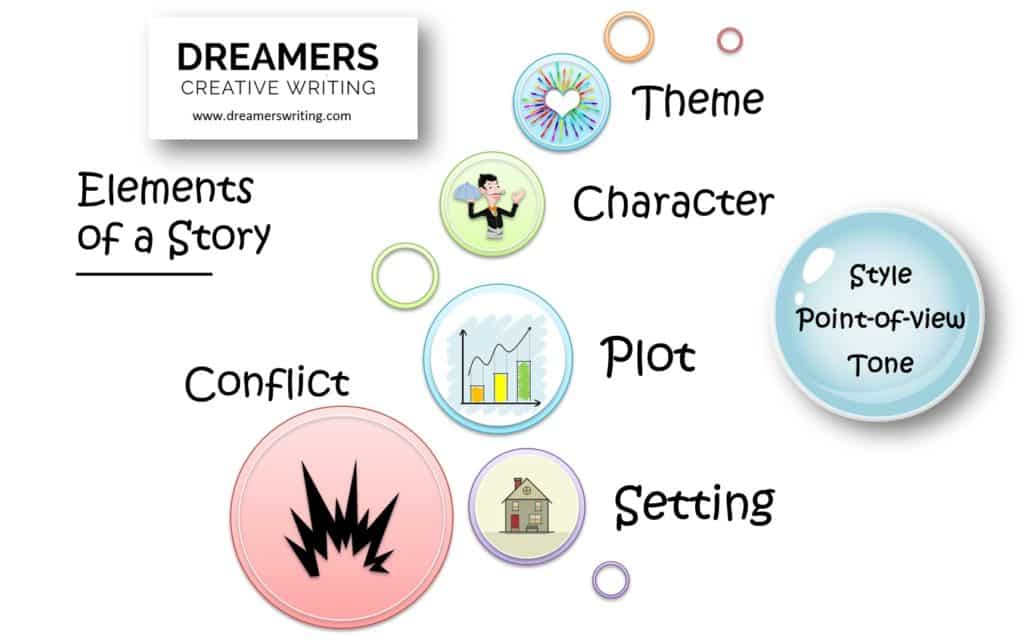
The five most essential elements, which we will focus on, are:
- Plot: The sequence of events.
- Character: The individuals who act and are acted upon.
- Setting: The time and place.
- Point of View: The perspective from which the story is told.
- Theme: The central idea or message of the story.
To begin, please read this brief overview that introduces these concepts.
23.5 The Elements of Fiction and Drama - Pressbooks.pub
This introductory text from Composition for Commodores provides a helpful "Who, What, When, Where, How?" framework for understanding the basic elements of literature.
Please read the entire section, starting from the introduction down to the bulleted list of elements. This will give you a high-level map of what we're about to cover.
Now, let's examine each of these elements in more detail.
1. Plot: The Structure of Events
The plot is the causal sequence of events in a story—the "what happens." It's not just a list of occurrences, but the logical and emotional structure that connects them. While stories can be arranged in many ways, many Western narratives follow a classical structure that can be visualized as an arc or a pyramid.

To understand this structure, we'll look at a more detailed breakdown of these components.
23.5 The Elements of Fiction and Drama - Pressbooks.pub
This resource provides clear, detailed definitions for each stage of the traditional plot structure, from the inciting incident to the dénouement.
In the section titled "Plot," please read the definitions for each of the key terms, from the dénouement. As you read, think about how each stage serves a specific function in managing narrative tension.
These stages form a logical progression:
- Exposition: The introduction of the initial state, where we learn about the characters and setting.
- Inciting Incident: An event that disrupts the initial state and establishes the central conflict.
- Rising Action: A series of events that build tension and complicate the conflict.
- Climax: The peak of tension, the turning point where the central conflict comes to a head.
- Falling Action: The events following the climax, where the consequences unfold and tension decreases.
- Dénouement/Resolution: The conclusion, where the conflict is resolved and a new stable state is established.
While this linear model is a useful analytical tool, keep in mind that many authors, especially those we'll study later, manipulate this structure for specific effects, for instance, by using flashbacks.
2. Character: The Agents of the Narrative
Characters are the individuals who drive the plot. Their desires, decisions, and flaws create the conflict that gives a story its energy. Conflict is the engine of narrative, representing a struggle between opposing forces.
Elements of Literary Fiction: Characters, Setting, Plot, Theme, and Point of View
This video, "Elements of Literary Fiction," offers a concise explanation of character roles and a very useful taxonomy of literary conflict.
Please watch the segment from the beginning of the 'Characters' section until the start of the 'Setting' section. Pay close attention to the six types of conflict described, as they provide a precise way to categorize the struggles that define a character's journey.
As the video explains, conflict can be internal (a struggle within a character's own mind, like a moral dilemma) or external (a struggle against an outside force). These external forces can be another character, society, nature, or even technology or supernatural forces.
To analyze characters effectively, we also need to classify them based on their complexity and role in the story.
23.5 The Elements of Fiction and Drama - Pressbooks.pub
This text expands on the concepts of character and conflict, introducing essential terms for describing character types and their functions within a narrative.
Read the entire "Character" section. Focus on understanding the distinctions between: Protagonist and Antagonist Foil, a character who highlights the traits of another through contrast. Also, familiarize yourself with the concepts of static/flat vs. dynamic/round characters described in the earlier, more general section on Characterization.
To summarize the key distinctions:
- Protagonist: The central character, whose journey the story follows.
- Antagonist: The character or force that opposes the protagonist.
- Round/Dynamic Characters: Complex, multi-faceted individuals who change and develop over the course of the story.
- Flat/Static Characters: Simple characters with one or two defining traits who do not change.
- Foil: A character who contrasts with the protagonist to highlight particular qualities.
Realist fiction, as we will see, is particularly celebrated for its creation of psychologically deep, round characters.
3. Setting: The Time and Place
The setting is the context in which the story occurs—the where and the when. However, it is more than just a backdrop. A well-realized setting contributes to the story's mood, influences the characters' actions and beliefs, and can even become a symbolic force in the narrative.
For a formal definition, let's turn back to our primary resource.
23.5 The Elements of Fiction and Drama - Pressbooks.pub
These sections define setting and explore its function beyond simple time and place, including its contribution to mood and its role as a reflection of social and cultural context.
First, read the brief initial definition under the heading Setting. Then, jump down to the more detailed section also titled "Setting" and read from the beginning of that section to the end. Note the crucial distinction between the story's setting and the author's own historical context.
For realist authors, the social and historical setting is paramount. Their goal was often to capture the reality of a specific society at a specific moment in time, making setting one of the most important elements in the novels we will read.
4. Point of View: The Narrative Lens
Point of view (POV) determines through whose eyes we experience the story. It is the filter through which all information is relayed to the reader. It is crucial to distinguish between the author (the real person who wrote the book) and the narrator (the fictional voice telling the story).
The choice of narrator fundamentally shapes our understanding of the plot, our perception of the characters, and our interpretation of the theme.
23.5 The Elements of Fiction and Drama - Pressbooks.pub
This resource provides one of the clearest and most comprehensive introductions to point of view, carefully defining the different narrative modes.
Please read the detailed section titled Narration and Point of View. Focus on mastering the difference between: First-Person: The narrator is a character in the story ("I"). Third-Person Limited: The narrator is outside the story but has access to the thoughts and feelings of one character. Third-Person Omniscient: The narrator is "all-knowing" and can access the thoughts and feelings of any character.
This element will become particularly significant when we study Gustave Flaubert, who perfected a specific kind of third-person narration that revolutionized the novel.
5. Theme: The Central Idea
Finally, we arrive at the theme. If plot is the "what" and character is the "who," theme is the "why." It is the central, abstract idea that the story explores. The theme is what connects the concrete narrative to broader questions about life, society, and the human condition. This is where literature most directly engages with the realm of philosophy.
A theme is not a topic (a single word like "justice" or "love"), but rather a complete statement or question about that topic (e.g., "The pursuit of justice often requires personal sacrifice").
23.5 The Elements of Fiction and Drama - Pressbooks.pub
These sections define theme as the underlying message and explain how recurring elements, or motifs, can help a reader identify it.
First, read the initial definition under the heading Theme. Then, skip down to the more detailed "Theme" section and read from the beginning to the end. Note the important point that a theme must be expressed as a complete sentence.
Identifying themes is often the ultimate goal of literary analysis. By examining how the plot is structured, how the characters grapple with conflict, how the setting influences them, and how the point of view frames it all, we can deduce the central questions and ideas the author is investigating.
Conclusion
In this lesson, we have assembled the foundational toolkit for literary analysis. You can now identify and describe the five core elements of narrative fiction:
- Plot: The structured sequence of events, often following a pattern of rising and falling action around a climax.
- Character: The agents of the story, defined by their desires and their internal and external conflicts.
- Setting: The time, place, and socio-historical context that shapes the story's world and its inhabitants.
- Point of View: The narrative lens (first-person, third-person limited, or third-person omniscient) that filters the story for the reader.
- Theme: The central, abstract idea or question that the narrative serves to explore.
These five elements are the axioms of our system. In the next lesson, we will use them to build our first major definition: Literary Realism. We will explore when and why this movement emerged in 19th-century Europe and define its core characteristics, seeing how realist authors used these narrative elements in a new and distinctive way.