Welcome to our final lesson in this foundational module. We have journeyed from the basic mechanics of next-token prediction to a strategic analysis of the major LLM providers. Our last lesson concluded that for your goal of building a production logistics agent on GCP, the Gemini family of models offers a powerful combination of capability, speed, and cost-effectiveness. We have, in essence, chosen the "brain" for our agent.
Today, we address a crucial question: What exactly is an agent? Is it just a fancier name for a chatbot? The answer is a definitive no. This lesson will define what constitutes an AI agent from a software engineering perspective, contrasting it with the more familiar chatbot paradigm. We will explore the architectural differences that give agents their defining characteristics: autonomy, reasoning, and the ability to take action.
By the end of this lesson, you will be able to clearly articulate what makes an agent different from a chatbot, setting the stage for the rest of the course where we will build these very systems.
Level 1: Beyond Conversation
At the highest level, the distinction is one of purpose. Chatbots are designed for conversation; agents are designed for action. A chatbot's primary function is to process an input and generate a textual response. An agent, on the other hand, is given a goal and autonomously orchestrates a series of actions to achieve it.
This video from Jeff Su provides an excellent, accessible breakdown of the conceptual levels, moving from a simple LLM call (like a chatbot) to an AI workflow, and finally to a true AI agent.
This video, "AI Agents, Clearly Explained," is perfect for establishing the foundational concepts. It builds the idea of an agent from the ground up, starting with what a basic LLM can and cannot do.
Please watch the following segments to build your mental model: Level 1: Large Language Models: This covers the baseline capability of an LLM, highlighting its passive nature and knowledge limitations. Level 2: AI Workflows: This explains how humans can orchestrate LLMs with tools, but the human is still the central decision-maker. This is a key intermediate step. Level 3: AI Agents: This is the core of the video. Pay close attention to how the LLM itself becomes the decision-maker, capable of reasoning, acting, and iterating. The final wrap-up provides a clear visual summary of the three levels.
The key takeaway is the shift in the decision-making role. In a chatbot or a simple AI workflow, the human is the pilot. In an agentic system, the LLM is the pilot, using tools and reasoning to navigate towards a goal.
A Tale of Two Systems: A Logistics Example
Let's make this concrete with an example relevant to your interest in logistics. Imagine a customer reporting a damaged package.

As the "Chatbot vs AI Agent" flowchart illustrates, the chatbot follows a rigid, linear script. It gathers information, logs a ticket, and offers pre-defined solutions. If the user isn't satisfied, its only recourse is to escalate to a human. It cannot do anything beyond its script.
The AI agent, in contrast, operates with autonomy.
- It detects the order automatically.
- It reasons about the user's intent (refund vs. replacement).
- It takes action by initiating the replacement or refund process in backend systems.
- It interacts with other tools to provide a reference number or tracking information.
- It maintains state by updating logs and following up with the client.
The chatbot is a conversational front-end to a ticketing system. The agent is the system, capable of orchestrating other systems to resolve the problem.
The Architectural Divide
This difference in capability stems from a fundamental difference in architecture. A chatbot is often a thin layer over an LLM's text generation API. An agent is a more complex system built around an LLM, equipping it with additional components.
The following article provides a software engineer's overview of AI agents, which you should find very clear.
AI Agents — A Software Engineer's Overview
This article from DEV Community breaks down the concept of an AI agent from a developer's perspective.
Please read the following sections: First, read the definition in the "What is an AI Agent?" section. Then, jump to the section "Core Architectural Components" and read the description of the four fundamental parts: Model, Tools, Memory, and Reasoning and Planning. This is the most important part of the article. Finally, review the comparison table which neatly summarizes the differences.
As the article explains, an agent architecture typically comprises four key components, which are also highlighted in the image "AI Agents Characteristics" below.
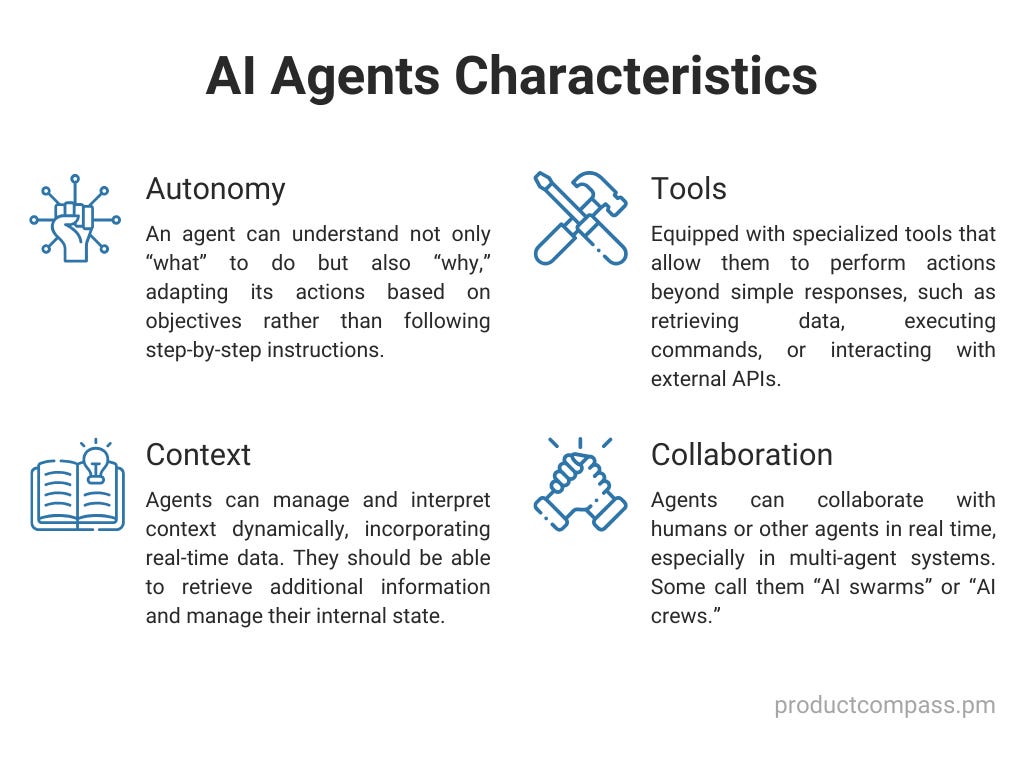
- Model: The core LLM that acts as the reasoning engine or "brain."
- Tools: The agent's hands. These are functions, APIs, or other services that allow the agent to interact with the outside world (e.g., call a database, query a shipping API, send an email). Your .NET experience in building Web APIs and using
HttpClientis directly applicable to creating and consuming these tools. - Memory: The agent's ability to retain information. This includes short-term memory (the current conversation context) and long-term memory (persistent knowledge about the user, past interactions, or relevant facts).
- Reasoning and Planning: The loop that orchestrates the other components. Given a goal, the agent reasons about a plan, selects a tool, executes it, observes the result, updates its memory, and repeats the cycle until the goal is achieved. Frameworks like ReAct (Reason+Act), which we'll cover in Module 7, formalize this process.
A chatbot might have a model and some short-term memory, but it typically lacks a rich set of tools and a sophisticated reasoning loop. It is reactive, not proactive.
From Chatbot to Agent: A .NET Demonstration
To see this transformation in a familiar C# context, let's look at how the Semantic Kernel SDK enables these agentic capabilities. The following video demonstrates building a simple news agent. It starts by showing how a plain LLM call fails at a task requiring real-time information, and then shows how adding a "plugin" (a tool) and a "planner" (a reasoning loop) creates a capable agent.
Use Semantic Kernel to build AI Apps and Agents - a simple intro!
This video, "Use Semantic Kernel to build AI Apps and Agents," provides a simple but powerful C# demonstration of the core concept.
Watch the introduction from the beginning. The presenter clearly shows a standard AI model failing to get current news, then demonstrates a completed agent that can. This is the chatbot-vs-agent difference in action. Next, watch the section on plugins from 10:43 to 17:13. A plugin in Semantic Kernel is simply a C# class with methods exposed as tools for the AI. Notice how adding this tool gives the AI a new capability it didn't have before. The [KernelFunction] attribute is how you expose your C# code to the agent. Finally, watch the segment on planning from 17:13 to 21:21. This demonstrates how the agent can autonomously chain tools together (get news, then save to a file) to accomplish a multi-step goal given in a single prompt. This is the reasoning/planning loop at work.
This video provides a fantastic preview of what we will be building. The key insight is that an agent isn't some magical, monolithic model. It's a software system you, as a developer, construct by giving a powerful reasoning model (like Gemini) access to a well-defined set of tools (your C# functions and APIs).
The Five Dimensions of Difference
To synthesize everything, we can break down the distinction between chatbots and AI agents across five key architectural dimensions.
AI agent vs chatbot: What's the key differences
This article from DevRev offers a sharp, practical analysis of the architectural differences and why they matter for building systems that can actually get work done.
First, review the comparison table near the top of the article. It provides a concise summary. Next, read the section Five dimensions where AI agents and chatbots actually differ. This provides a detailed explanation of the architectural gaps between the two types of systems across Understanding, Action, Memory, Reasoning, and Learning.
As you read, note the concept of "agent-washing"—vendors labeling what are essentially retrieval-based chatbots (RAG bots) as "AI agents." Understanding the true architectural requirements for agency will allow you to critically evaluate tools and technologies as you move forward. An agent doesn't just retrieve information; it reasons about it and acts upon it.
Conclusion
In this lesson, we have formally defined the AI agent and drawn a clear line between it and a chatbot. Let's recap the key takeaways:
- Purpose: Chatbots are for conversation; agents are for action and goal completion.
- Autonomy: Chatbots are reactive and follow scripts. Agents are proactive, capable of making independent decisions to achieve a goal.
- Architecture: An agent is a system built around a core LLM (the model), equipped with Tools to act, Memory to maintain context, and a Reasoning/Planning loop to orchestrate its actions.
- Role of the LLM: In a chatbot, the LLM is a response generator. In an agent, the LLM is the central decision-maker.
This concludes our first module on the foundations of LLMs and generative AI. You now have a robust conceptual framework, from understanding how models work to choosing one for a specific task and defining the agentic system you intend to build.
In our next lesson, we will begin Module 2 and transition from theory to practice. We will roll up our sleeves and set up your development environment in Google Cloud, enable the Vertex AI APIs, and configure the authentication necessary to make your very first call to the Gemini API from a .NET application.