Welcome to the next lesson in our journey to refine your professional writing. In our previous session, we focused on using professional collocations, the natural partnerships between words that make your writing sound fluent and authoritative. You learned to move from functional phrases to polished ones, like using 'implement guidelines' instead of 'put in place guidelines'.
Today, we will build directly on that skill. Now that you have the building blocks, this lesson will teach you how to connect them. We will explore how to use professional transition words and phrases to create a smooth, logical flow between your ideas. Mastering this will elevate your writing from a series of correct statements to a coherent and persuasive message, a crucial skill for drafting clear board correspondence and shareholder communications.
The Power of the Right Connection
Good writing is not just about having the right information; it's about guiding your reader's thinking. Transition words are the signposts that show your reader the relationship between your ideas. Are you adding a point? Contrasting two options? Explaining a result? The transition word you choose provides this crucial context.
For your role, selecting the right transition word is also a matter of professional tone. A simple word like 'but' or 'so' is fine for casual chat, but in a formal email to the board, a more professional alternative like 'however' or 'consequently' demonstrates a higher level of command over the language.
The following video from mmmEnglish brilliantly illustrates this difference. You will see a "casual" version of a story and then a "professional" one. As you watch, pay close attention to the linking words used in each version.
How To Connect Ideas In English [with Linking Words]
Watch the segments introducing "casual Emma" and "professional Emma".
First, watch the casual story from the beginning. Listen for common, everyday linking words like 'and', 'but', 'so', and 'because'. Then, watch the professional presentation from the next segment and notice how different words are used to connect the same kinds of ideas.
As you saw, the core message can be the same, but the choice of linking words dramatically changes the tone. Professional Emma sounded more formal and analytical simply by choosing her connectors carefully.
Let's break down those key upgrades:
- To Add Information: Instead of
and, tryas well asorin addition. - To Show Contrast: Instead of
but, usehoweverorwhereas. - To Show a Result: Instead of
so, usetherefore,as a result, orconsequently. - To Give a Reason: Instead of
because, usesinceordue to. - To Give an Example: Instead of
like, usefor instanceorsuch as.
A Framework for Your Writing
To use transition words effectively, it helps to think about their function. What logical connection are you trying to make? The article "Transition Words & Phrases" from QuillBot provides a fantastic, detailed framework. While it mentions "essays," the principles are universal for any formal writing, including your professional emails.
Transition Words & Phrases | List & Examples
This article categorizes transition words by their logical function, which will help you choose the perfect word for your purpose. It also contains a powerful before-and-after example.
First, read the section categorizing transitions into four main types: Sequential, Additive, Causal, and Adversative. You don't need to memorize them all; just get a feel for the categories. Then, pay close attention to the two example paragraphs—one without transitions and one with them. Notice how the second version is much clearer and easier to follow.
The difference is striking, isn't it? The second paragraph guides the reader, while the first forces the reader to guess the connections between the sentences. This clarity is exactly what you want to achieve in your own writing.
To help you in your day-to-day work, here is a handy visual guide that groups many of these words by their function. You can think of it as a "cheat sheet" for finding the right transition.
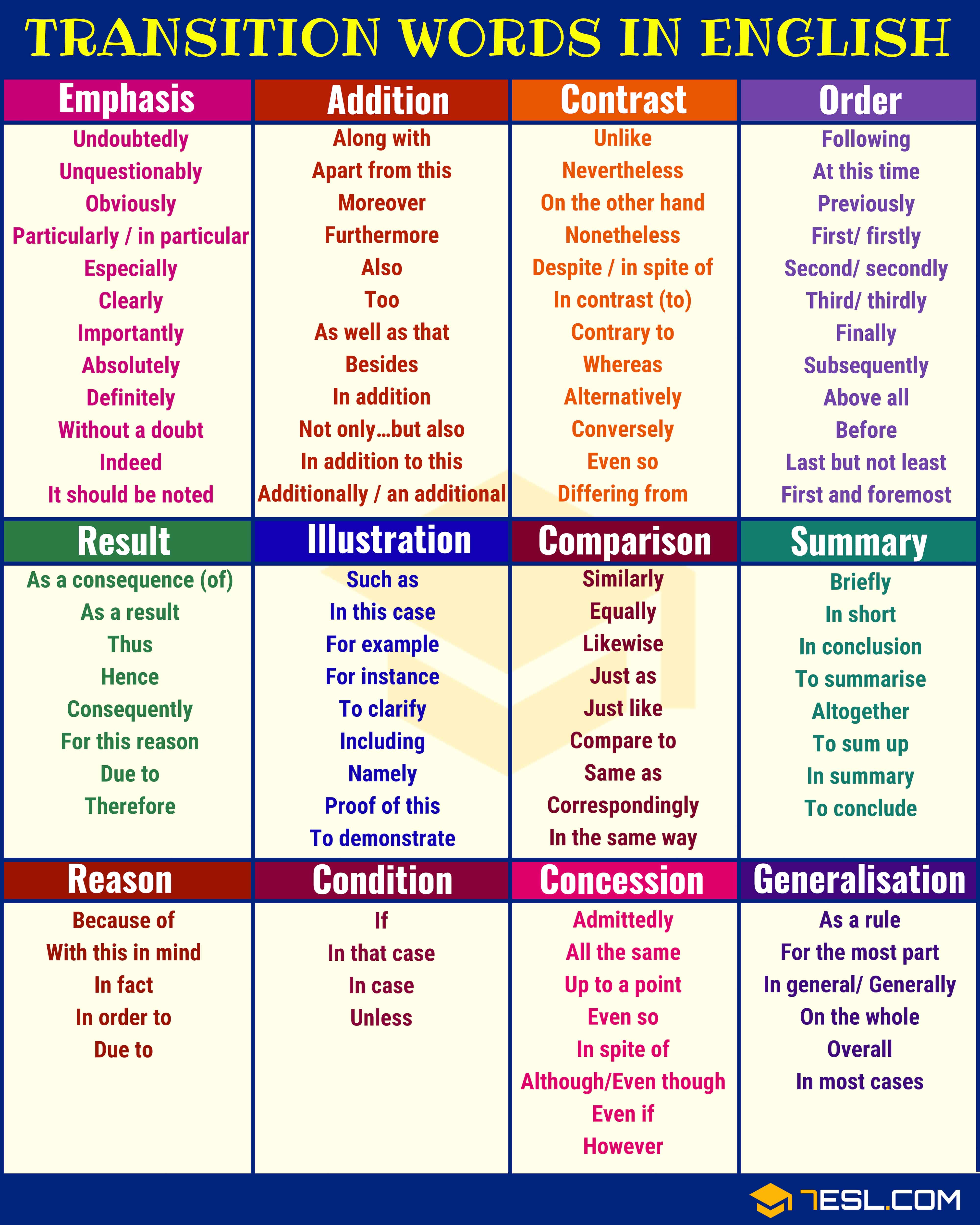
This chart organizes a wide variety of transition words by their rhetorical function, such as showing emphasis, contrast, addition, or result.
Avoiding Common Mistakes
Knowing which words to use is only half the battle. Knowing how not to use them is what adds the final layer of polish. In informal writing and speech, it's common to start sentences with 'And', 'But', or 'So'. In formal business writing, this is best avoided.
The QuillBot article you just reviewed has an excellent section on this.
Transition Words & Phrases | List & Examples
This section covers common pitfalls that can undermine a professional tone.
Please read the subsection titled Beginning a sentence. The advice here is critical for elevating the formality of your writing. Instead of starting a sentence with 'But...', begin with 'However, ...'. Instead of 'So...', use 'Therefore, ...' or 'As a result, ...'. This single change will make an immediate impact on your professional tone.
Your Turn: Putting It into Practice
Let's apply these concepts to a scenario from your field. The following sentences report on a board discussion, but they are choppy and disconnected. Rewrite them into a single, flowing paragraph using appropriate transition words from this lesson.
Original Sentences:
The finance committee presented the quarterly report. The sales figures exceeded projections. The operations budget was overspent. The board approved the report. A follow-up meeting on the budget overrun was scheduled.
Take a moment to think about the logical links.
- The first two sentences add related, positive information.
- The third sentence introduces a contrasting point.
- The fourth and fifth sentences describe the results or consequences of the discussion.
Click to see a suggested rewrite and analysis
Suggested Rewrite:
The finance committee presented the quarterly report. Notably, the sales figures exceeded projections; however, the operations budget was overspent. Nevertheless, the board approved the report. Furthermore, they scheduled a follow-up meeting to address the budget overrun.
Analysis:
- Notably: This transition word for emphasis highlights the good news about sales figures.
ImportantlyorIn particularwould also work well. - however: This adversative transition creates a clear contrast between the positive sales news and the negative budget news.
- Nevertheless: This word of concession shows that despite the budget problem, the board still approved the report. It acknowledges the negative point but moves the decision forward.
- Furthermore: This additive transition smoothly adds the final action point (the follow-up meeting) to the list of outcomes.
In additionwould also be a good choice here.
Conclusion
In this lesson, you've learned to build bridges between your ideas using transition words. This skill is fundamental to crafting writing that is not only clear but also polished and persuasive.
Here are your key takeaways:
- Transitions create logical flow: They act as signposts that guide your reader through your argument.
- Formality matters: In professional contexts, replace casual connectors (
but,so) with more formal alternatives (however,consequently) to enhance your tone. - Choose by function: Select transition words based on the relationship you want to show, whether it's addition, contrast, cause, or sequence.
- Refine your sentence starters: In formal writing, avoid beginning sentences with 'And', 'But', or 'So'.
You now have the tools to connect your thoughts with precision and professionalism. In our next lesson, we will continue to refine your vocabulary by focusing on selecting appropriate synonyms to add variety and avoid repetition, ensuring your writing remains engaging and dynamic.