In our last lesson, we focused on selecting individual words that are precise and professional, moving from 'get' to 'obtain' or 'need' to 'require'. This is a crucial skill for adding polish to your writing. Now, we will build on that by exploring how these professional words naturally partner with each other.
This lesson introduces you to business collocations: words that frequently appear together, like 'convene a meeting' or 'submit a proposal'. Mastering these combinations is the key to moving beyond grammatically correct sentences to writing that sounds truly fluent, natural, and authoritative. For your role in company secretarial communications, using the right collocations demonstrates a high level of professional competence.
What Are Collocations?
At its core, a collocation is a pair or group of words that just "sounds right" to a native or proficient speaker. For example, we say 'heavy rain', not 'strong rain'. The same principle applies to business English. Using the wrong word combination, even if the meaning is understandable, can make your writing sound awkward.
The short video clip below offers a perfect explanation of why collocations are so important for sounding natural.
225 Useful Collocations You MUST Know | 1-Hour Vocabulary Masterclass
Watch this introduction from the video "225 Useful Collocations You MUST Know" by Interactive English.
Pay close attention to the speaker's example of 'raise your vocabulary' versus 'build your vocabulary' from the explanation. This highlights exactly how collocations work.
As you can see, choosing 'build' over 'raise' is what makes the phrase sound professional. Your goal is to internalize these natural pairings for your own writing.
The image below shows some common business collocations you might see in a general office context. These are the kinds of phrases we will be mastering.
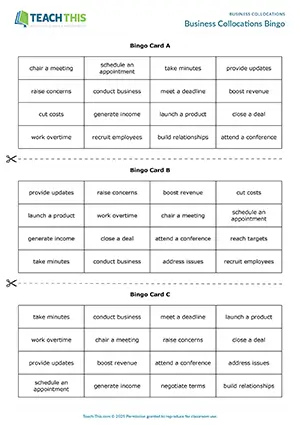
This image shows three bingo cards with various business collocations, such as 'chair a meeting', 'meet a deadline', and 'boost revenue'.
Building Your Bank of Professional Collocations
To make your board and shareholder communications more impactful, we will focus on collocations built around strong, professional verbs. These verbs act as pillars, and learning the nouns that typically follow them will significantly improve your writing.
The resource below provides an excellent list of such "power verbs" and their common collocations.
Speak like a Manager: 100+ Business English Collocations · engVid
This guide from engVid replaces general verbs with more professional alternatives and lists the nouns they typically pair with.
In the section Change general English to business English, carefully review the tables for the following verbs, which are highly relevant to a company secretarial role: Identify: You often need to identify issues, problems, risks, or opportunities for the board. Implement: This is key for when the board decides on new policies, plans, or strategies that the company must put into action. Resolve: Essential for describing how the company deals with conflicts, issues, or disputes.
Collocations for Your Specific Context
Beyond general business language, your role requires a more specialized vocabulary related to corporate governance, contracts, and legal matters. Using the correct collocations in these areas is not just a matter of style—it's a matter of precision and accuracy.
This next resource, an e-book on collocations, contains sections that are highly relevant to your work.
1000-english-collocations-ebook.pdf
This e-book provides lists of collocations for various topics. We'll focus on the business and legal sections.
Please read the following two sections: Lesson 16 – Business: This section, starting on page 33, covers foundational business actions. Focus on phrases like set up a company, gain market share, make a deal, and sign a contract. Lesson 23 – Law/Justice: Starting on page 47, this is extremely pertinent to your work. Pay close attention to collocations like upholding and enforcing the law, reach a verdict, and appeal the verdict.
Collocations for Communication and Problem-Solving
Finally, a significant part of your role involves communicating decisions, addressing issues, and managing expectations. There are specific collocations that make these interactions smoother and more professional.
This video focuses on collocations used in professional communication.
22 Essential English Collocations for Business Communication
This video from "Derek Callan - English for Professionals" groups collocations by function, such as collaboration and problem-solving.
Watch the following segments: Give a briefing: This is the correct phrase for providing a concise update, such as briefing the board on a new development. Address concerns: When shareholders or board members raise worries, this is the professional way to say you are dealing with them. Resolve conflicts: This collocation is perfect for describing how the company handles internal disagreements or disputes.
Your Turn: Putting It into Practice
Now, let's apply what you've learned. Rewrite the following sentences to include a more natural and professional collocation from this lesson.
- The committee was unable to make a decision on the matter.
- Following the audit, we must put in place the new guidelines by next month.
- The CEO will give a short talk on the quarterly results before the meeting.
- Management has a responsibility to answer the worries of the employees regarding the merger.
Click to see suggested rewrites and analysis
-
Original: The committee was unable to make a decision on the matter.
- Rewrite: The committee was unable to reach a verdict on the matter.
- Reason: 'Reach a verdict' is a stronger, more formal collocation used for official judgments or decisions made by a group like a committee or jury.
-
Original: Following the audit, we must put in place the new guidelines by next month.
- Rewrite: Following the audit, we must implement the new guidelines by next month.
- Reason: 'Implement' is the standard professional verb for putting a plan, policy, or system into operation.
-
Original: The CEO will give a short talk on the quarterly results before the meeting.
- Rewrite: The CEO will give a briefing on the quarterly results before the meeting.
- Reason: 'Give a briefing' specifically means to give a short, concise summary of information, which is more precise than 'give a short talk'.
-
Original: Management has a responsibility to answer the worries of the employees regarding the merger.
- Rewrite: Management has a responsibility to address the concerns of the employees regarding the merger.
- Reason: 'Address concerns' is a standard business collocation that implies dealing with issues systematically and professionally, rather than simply answering them.
Conclusion
In this lesson, you've taken the next step toward professional polish by focusing on collocations. You learned that writing with fluency and authority isn't just about individual words, but about how they fit together naturally.
Here are your key takeaways:
- Collocations create fluency: Using word combinations that sound natural (e.g., 'implement a plan', not 'do a plan') is a hallmark of a proficient writer.
- Build around strong verbs: Verbs like
implement,resolve,identify, andaddressare powerful starting points for many important business collocations. - Context is key: The most effective collocations are specific to your field. Phrases like 'uphold the law' and 'sign a contract' add precision to your work in a company secretarial context.
- Practice makes perfect: Actively look for and use these collocations in your daily writing until they become second nature.
You now have a framework for choosing not just the right words, but the right word partnerships. In our next lesson, we will learn how to connect these phrases and ideas logically using professional transition words and phrases to improve the overall flow of your emails and reports.