Welcome back. In the previous lesson, we established a robust foundation for error handling by designing custom Error subclasses. You learned how to create a hierarchy of errors that carry meaningful, machine-readable context, enabling your application to make intelligent decisions based on the type of failure, not just its message.
This lesson puts that foundation to immediate use. Now that we can distinguish between a temporary network glitch and a permanent authorization failure, we can build a more resilient system. We will tackle one of the most common and critical patterns in distributed systems: implementing a retry mechanism with exponential backoff. For someone who has architected high-availability e-commerce platforms, you know that external services are inherently unreliable. This lesson will give you the tool to build a frontend that gracefully handles transient backend failures, making your application feel robust and reliable even when its dependencies are not.
Why This Matters at a Senior Level
A mid-level developer, when faced with a failed API call, might retry it once or twice after a fixed delay. A senior engineer understands that this naive approach can be dangerous at scale. When a service is struggling, thousands of clients retrying simultaneously with fixed delays creates a "thundering herd" that can push the service over the edge, causing a full-blown outage. Senior engineers implement exponential backoff with jitter: a strategy that intelligently spaces out retries, giving the service time to recover while also preventing clients from retrying in synchronized, traffic-choking waves. This demonstrates a grasp of distributed systems principles, a key differentiator in senior-level interviews and a non-negotiable skill for building resilient, high-scale applications.
Core Concepts
1. The Necessity of Retries: Embracing Transient Failures [Always asked]
In any system involving network communication—fetching data from an API, connecting to a database, processing a message from a queue—failures are not exceptional events; they are inevitable. These are often transient failures:
- A server returning
503 Service Unavailablebecause it's temporarily overloaded. - A network request timing out due to a momentary connection drop.
- A
429 Too Many Requestsresponse from a rate-limited API.
In these cases, the operation would likely succeed if attempted again after a short wait. Simply giving up and showing an error to the user leads to a brittle and frustrating experience. A retry mechanism is our primary tool for handling this class of error.
The simplest retry logic might just be a loop. However, retrying immediately and repeatedly is often counterproductive, as it can overwhelm an already struggling service. This is where a more sophisticated delay strategy becomes essential.
2. Exponential Backoff: The Polite Retry Strategy [Always asked]
Instead of retrying with a constant delay, exponential backoff increases the wait time after each failed attempt.
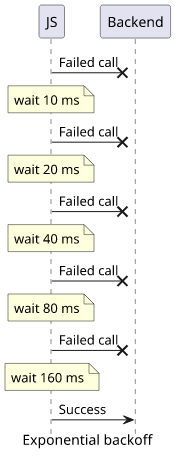
The core idea is to back off exponentially, giving a struggling system more and more time to recover. This approach starts with a short delay for quick recovery from blips but scales up the waiting period for more persistent issues.
Build a Retry Mechanism with Exponential Backoff | jsmanifest
This article provides an excellent narrative on why retry logic is crucial and breaks down the concept of exponential backoff.
Read the introduction to understand the real-world impact of retry logic. Then, focus on the section "Understanding Exponential Backoff" to grasp the mathematical principle behind the increasing delays.
3. Building the retryWithBackoff Utility [Always asked]
Let's implement this. Our goal is a generic async function that can wrap any Promise-returning operation. We'll use a for loop to manage attempts, a try...catch block to execute the operation, and a small promise-based sleep utility to handle the delay.
The following resource provides a clean, modern implementation using async/await.
Build a Retry Mechanism with Exponential Backoff | jsmanifest
This section provides a solid starting point for our implementation.
Study the code block in the section "Building a Basic Retry Function". Pay close attention to how the for loop, try...catch, and the await new Promise(...) delay are orchestrated.
Let's break down the core components of that implementation:
- The Loop:
for (let attempt = 0; attempt <= maxRetries; attempt++)controls the number of tries. - The Attempt: Inside a
tryblock, wereturn await fn(). If it succeeds, the function exits with the resolved value. - The Failure: If
fn()throws an error, thecatchblock executes. We store the error. If we've exhausted all retries (attempt === maxRetries), we re-throw the last captured error. - The Delay: If more retries are available, we calculate the
delayand "sleep" for that duration usingawait new Promise(resolve => setTimeout(resolve, delay)).
This structure forms the backbone of any robust retry utility.
4. Adding Jitter to Prevent Thundering Herds [Always asked]
Even with exponential backoff, if thousands of clients experience a failure at the same time, they will all retry at the same intervals (1s, 2s, 4s...). This creates synchronized waves of traffic, defeating the purpose of backing off.
The solution is jitter: adding a small, random amount of time to each delay. This spreads out the retry attempts from different clients, smoothing the traffic load on the recovering service.
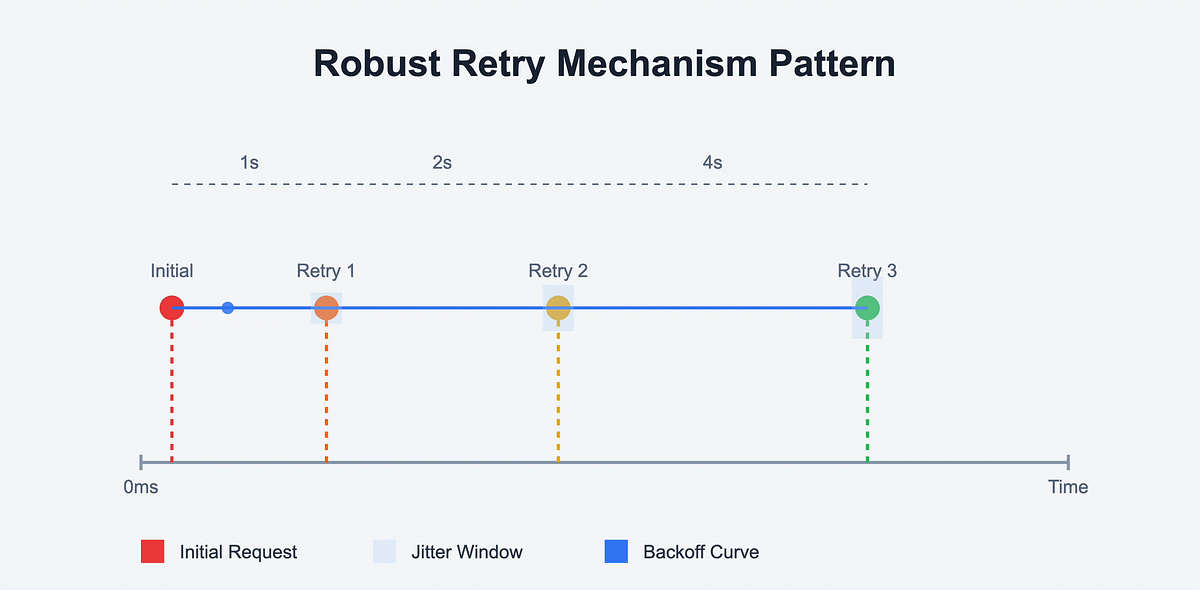
A common strategy is "full jitter," where the wait time is a random value between 0 and the calculated backoff delay.
Let's see how to add this to our utility. The following resource provides a concise implementation of jitter logic.
Using fetch(), AbortSignal, And setTimeout() To Apply Retry ...
This article, while focused on a full API client, has an excellent, isolated helper method for applying jitter.
Find the private method applyJitter at the end of the ApiClient class implementation. The author applies a +/- 20% randomization, which is a simple and effective approach. We can adapt our delay calculation to use a similar principle: const jitter = delay * Math.random(); await sleep(delay + jitter);
5. Conditional Retries with shouldRetry [Always asked]
The final piece of a production-ready utility is control. We should not retry every error. As we discussed in the last lesson, some errors are permanent. Retrying a 404 Not Found is pointless; the resource is gone. Retrying a 401 Unauthorized without new credentials will fail every time.
We need to provide a way for the caller to decide if an error is retryable. This is typically done by passing a shouldRetry predicate function in the options. This function receives the error and returns true or false.
This is where your custom error classes from the previous lesson become incredibly powerful.
// From previous lesson:
class DatabaseError extends ApplicationError { /* ... */ }
class AuthorizationError extends ApplicationError { /* ... */ }

// The shouldRetry predicate in action:
await retry(fetchData, {
  retries: 5,
  shouldRetry: (error) => {
    // Only retry on specific, transient error types.
    return error instanceof DatabaseError || error.statusCode === 503;
  }
});
The resource below provides a great example of implementing this logic based on HTTP status codes.
Using fetch(), AbortSignal, And setTimeout() To Apply Retry ...
This resource offers a great perspective on designing the retry logic to be intelligent about which errors it acts upon.
First, read the section that discusses the design principle of separating concerns. This is a key senior-level insight. Then, examine the code for the isRetryableError method. It demonstrates a clear, practical implementation of a shouldRetry predicate that inspects HTTP status codes to differentiate transient failures (like 5xx) from permanent ones (like 4xx, with some exceptions).
Mental Model: The Polite Knocker
Think of interacting with a web service as knocking on a door.
- No Retry: You knock once. If there's no answer, you immediately walk away, assuming no one is home.
- Simple, Fixed-Delay Retry: You knock, wait 5 seconds, knock, wait 5 seconds, knock... You're persistent, but you might be annoying the person inside who is trying to get to the door. If a hundred people do this at once, it's chaos.
- Exponential Backoff: You knock. No answer. You take a few steps back and wait 10 seconds. You knock again. Still nothing. You wait 30 seconds, then a full minute. You're politely giving the person more and more time to answer, assuming they might be busy.
- Exponential Backoff with Jitter: You do the same as above, but you randomize your wait times slightly. Instead of exactly 10 seconds, maybe you wait 8. Instead of 30, maybe 35. This ensures that you and all the other people on the street aren't knocking in a perfectly synchronized, terrifying rhythm. You are being polite, patient, and just unpredictable enough to not cause a synchronized disturbance.
Conclusion
You have now built one of the most important utilities for frontend resilience. You can wrap any asynchronous operation in a robust retry mechanism that uses exponential backoff to politely give services time to recover and jitter to prevent cascading failures at scale. Crucially, you've connected this pattern back to our previous work on custom errors by implementing a shouldRetry predicate, ensuring your application only retries what's sensible. Mastering this pattern is a significant step towards thinking about system reliability, a core competency of a senior engineer.
Key Takeaways:
- Transient network failures are normal, and robust applications must handle them gracefully.
- Exponential backoff increases the delay between retries, preventing a struggling service from being overwhelmed.
- Jitter adds randomness to delays, preventing synchronized "thundering herds" of clients retrying at the same time.
- A
shouldRetrypredicate is essential for distinguishing between transient (retryable) and permanent (non-retryable) errors, often by inspecting HTTP status codes or custom error types. - The final utility should be a highly configurable function that wraps any async operation and encapsulates this logic.
In our next lesson, we'll continue exploring advanced asynchronous control flow by tackling cancellation. You'll learn how to use AbortController to cancel in-flight fetch requests and other async operations—a perfect complement to our retry utility when a user navigates away or cancels an action before all retries are complete.