Hello! Welcome to your next lesson in our Irrigation Design course.
In our last session, we established the climatic foundation for our calculations by defining Reference Evapotranspiration (ET₀). You learned that ET₀ is a standardized, weather-driven value representing the water lost from a perfect, hypothetical grass surface. It's our universal starting point.
Today, we will connect that climatic baseline to the specific plants in your landscape. Not all plants are as thirsty as the "perfect grass" of ET₀. Our goal for this lesson is to select and apply the appropriate Crop Coefficient (Kc) for different plant types and densities. The Crop Coefficient is the key that unlocks the actual water requirement for each of your hydrozones.
By the end of this lesson, you will be able to look at a hydrozone—whether it's lawn, shrubs, or trees—and assign it a specific Kc value that accounts for its unique characteristics.
1. What is a Crop Coefficient (Kc)?
The Crop Coefficient (Kc), also often called a Plant Factor (PF) in landscaping, is a simple but powerful multiplier. It adjusts the general ET₀ value to reflect the specific water needs of a particular plant or group of plants.
The relationship is defined by the core formula of plant water needs:
Where:
- is the Crop Evapotranspiration, or the actual water requirement of your specific plants (in mm/day).
- is the Reference Evapotranspiration we discussed in the last lesson (in mm/day).
- is the Crop Coefficient (a dimensionless value, usually between 0.1 and 1.0).
Think of Kc as a percentage. If ET₀ represents 100% of the potential water use on a hot day, a drought-tolerant plant with a Kc of 0.3 only needs 30% of that water. A lush, water-loving plant with a Kc of 0.8 would need 80%.
For a quick overview, let's look at a simplified table of Plant Factors.
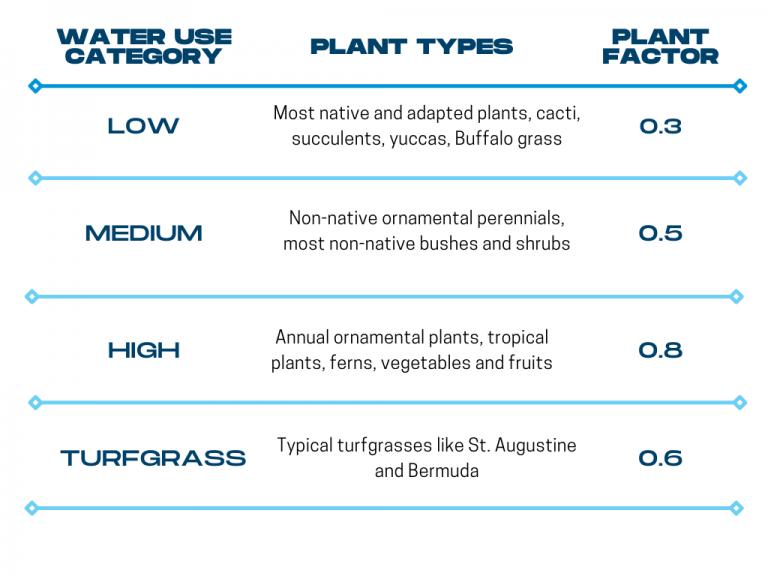
Using this table, if your local ET₀ for the peak summer month is 6 mm/day, the basic water requirement for a standard lawn (Turfgrass) would be:
This simple approach is great for initial estimates. However, as a landscape architect dealing with complex and varied planting schemes, you'll need a more refined method.
2. A More Precise Kc: The Three-Factor Method
A single Kc value for "shrubs" or "trees" is an average. It doesn't account for the specific conditions of your site. Is the shrub a drought-tolerant succulent or a water-loving hydrangea? Are the trees planted sparsely in an open field or densely as a screen? Are they next to a hot, sun-baked wall or in a cool, shady courtyard?
To achieve professional precision, we can break Kc down into three contributing factors. This approach, detailed in many irrigation design manuals, allows you to build a custom Kc for each hydrozone.
The formula is:
Let's define each of these:
- Species Factor: Reflects the inherent water needs of the plant species itself. Low-water-use plants have a low factor, and high-water-use plants have a high factor.
- Density Factor: Accounts for how closely the plants are spaced. Densely packed plants have higher overall water use than sparsely arranged ones.
- Microclimate Factor: Adjusts for the specific location of the plants. A "high" microclimate (e.g., full sun, reflective surfaces, windy) increases water needs, while a "low" one (e.g., shade, wind protection) decreases them.
This method gives you, the designer, much more control and accuracy.
Low-Volume Landscape Irrigation Design Manual
The 'Low-Volume Landscape Irrigation Design Manual' from Rain Bird provides an excellent, practical explanation of this three-factor method. It includes the tables we will use for our calculations.
Please read the section 'Calculate Kc' (page 22). It introduces the three factors. Then, carefully examine Table 4-2 (Species Factors), Table 4-3 (Density Factors), and Table 4-4 (Microclimate Factors) on pages 22 and 23. These tables are your primary tools for this section.
3. Calculating Kc in Practice: A Worked Example
Let's apply the three-factor method to a common scenario you might encounter in a villa garden design.
Scenario: You have a hydrozone consisting of a hedge of shrubs. They are planted with average density along a property line that is in full sun for most of the day and adjacent to a paved driveway. The shrubs are considered to have an "average" water requirement for their species.
Let's use the tables from the Rain Bird manual to find our Kc.
-
Find the Species Factor (Table 4-2):
- Plant Type:
Shrubs - Water Need:
Average - Species Factor = 0.5
- Plant Type:
-
Find the Density Factor (Table 4-3):
- Plant Type:
Shrubs - Density:
Average - Density Factor = 1.0
- Plant Type:
-
Find the Microclimate Factor (Table 4-4):
- Plant Type:
Shrubs - Microclimate:
High(due to full sun and reflected heat from the pavement). - Microclimate Factor = 1.3
- Plant Type:
-
Calculate the final Kc:
So, for this specific hydrozone, you would use a Kc of 0.65. This is more precise than simply picking a generic value for "shrubs," as it accounts for the specific conditions of the site.
Test your understanding!
Now it's your turn. You are designing irrigation for a hydrozone within a villa's interior courtyard. This zone contains several ornamental trees that are considered low-water-use. They are sparsely planted (low density), and the courtyard location is protected and mostly shaded (low microclimate).
Using the tables from the Rain Bird manual (LINK), calculate the appropriate Kc for this hydrozone.
Show answer
Here is the step-by-step calculation:
-
Find the Species Factor (Table 4-2):
- Plant Type:
Trees - Water Need:
Low - Species Factor = 0.2
- Plant Type:
-
Find the Density Factor (Table 4-3):
- Plant Type:
Trees - Density:
Low - Density Factor = 0.5
- Plant Type:
-
Find the Microclimate Factor (Table 4-4):
- Plant Type:
Trees - Microclimate:
Low - Microclimate Factor = 0.5
- Plant Type:
-
Calculate the final Kc:
The Kc for this hydrozone is 0.05. This extremely low value reflects a combination of drought-tolerant plants in a very protected, low-demand environment, resulting in minimal water needs.
Conclusion
You have now learned the critical step of tailoring the general climatic data (ET₀) to the specific plants you are irrigating. This bridge between weather and biology is what allows for efficient and effective irrigation design.
Key Takeaways:
- The Crop Coefficient (Kc) is a multiplier used to adjust ET₀ for a specific plant's water needs.
- The fundamental formula is .
- For quick estimates, you can use a single Kc value from a general table based on broad plant categories (e.g., lawn, shrubs).
- For professional precision, you should calculate a custom Kc using the Three-Factor Method: . This allows you to account for the unique conditions of each hydrozone.
Next Steps
In the previous lesson, you learned how to find ET₀. In this lesson, you mastered calculating Kc. In our next lesson, we will put these two pieces together. You will practice using the formula to calculate the final daily water requirement, expressed in millimeters per day (mm/day), for each hydrozone in a sample project.