Hello! In our last lesson, we finalized the hydraulic design for our villa project by sizing all the mainline and lateral pipes. We now have a complete plan that specifies every piece of hardware, ensuring the system can deliver the necessary flow and pressure to every emitter.
Today, we shift from the 'how' of water delivery to the 'how long'. This lesson directly addresses the learning outcome: Calculate the required irrigation runtime for each zone to meet its water requirement. We will determine the precise duration each zone needs to operate to satisfy the unique water needs of the plants within it, a critical factor for both water conservation and landscape health.
By the end of this lesson, you will be able to:
- Calculate runtimes for sprinkler zones using the concept of precipitation rate.
- Calculate runtimes for drip zones using a volume-based approach.
- Understand how to group watering days to promote healthier plant growth.
This calculation is the final input needed before we can create a complete irrigation schedule for an automatic controller, which is a key part of your final project deliverables.
1. The Core Principle of Runtime Calculation
At its heart, calculating runtime is straightforward. The basic formula is:
However, the way we measure "Amount Needed" and "Rate Applied" differs between sprinkler and drip systems. Let's break down each method.
2. Runtime for Sprinkler Zones (e.g., Lawns)
For sprinkler systems, we think in terms of applying a uniform depth of water (in millimeters) over the entire zone, similar to rainfall.
-
Water Needed (Depth): In a previous module, we calculated the daily water requirement for our plants, called the Crop Evapotranspiration (
ETc), in mm/day. For example, a lawn in summer might need anETcof 5 mm/day. -
Water Applied (Rate): This is the Precipitation Rate (PR) of the zone, measured in mm/hour. It tells you how quickly your sprinkler setup applies water over its area. You might recall this from an earlier lesson. The formula is:
Remember: 1 Liter applied over 1 square meter results in a water depth of 1 mm.
-
Runtime Calculation: With these two values, the runtime calculation is simple:
Worked Example: Villa Lawn Zone
Let's use our capstone villa project's lawn zone.
- Water Needed: Let's assume after checking local climate data, the peak summer
ETcfor our turfgrass is 5 mm/day. - Zone Area: The lawn area is 250 m².
- Total Zone Flow: From our hydraulic design, the total flow for this zone is 30 GPM. We need to convert this to Liters/hour:
- 30 GPM × 3.785 L/GPM = 113.55 Liters/minute
- 113.55 L/min × 60 min/hr = 6813 L/hr
- Calculate Precipitation Rate (PR):
- Calculate Daily Runtime:
So, to replace the 5 mm of water lost each day, you would need to run this sprinkler zone for about 11 minutes.
3. Runtime for Drip Irrigation Zones
For drip irrigation, it's more intuitive to think in terms of total volume. We need to replace a certain volume of water (Liters), and we know the total volume per hour our drip system delivers.
How to Calculate Drip Line Length and Run Time
The website 'WaterIrrigation.co.uk' provides a very clear, practical, four-step guide for this exact calculation. This method is perfect for designing systems for villas and gardens.
Please read the sections titled 'Drip Line Calculation', the 'Working Example - Raised Bed', and the 'Working Example - Tree Circle'. Focus on the four-step calculation summary, as we will apply that method directly.
As the guide explains, the process is:
- Calculate Required Liters per day:
Area (m²) × ETc (mm/day) = Liters/day - Calculate System Output (L/h):
Number of Emitters × Emitter Flow Rate (L/h) - (Optional) Convert to L/m:
System Output (L/h) ÷ 60 - Calculate Run Time:
Required Liters per day ÷ System Output (L/h or L/m)
Worked Example: Villa Shrub Zone
Let's apply this to our project's shrub zone.
- Water Needed: The
ETcfor established shrubs is lower, let's say 3 mm/day. The zone area is 120 m².- Required Liters = 120 m² × 3 mm = 360 Liters/day
- System Output: Our design for this zone uses an inline dripline with emitters spaced every 0.5m over a total length of 200m. The emitters are rated at 2 L/h.
- Number of Emitters = 200m length / 0.5m spacing = 400 emitters.
- System Output = 400 emitters × 2 L/h = 800 L/h
- Calculate Daily Runtime:
This zone would need to run for 27 minutes each day to meet the plants' water needs.
Test your understanding!
You have designed a small drip zone for a planter box.
- Area: 15 m²
- Plant Type: Flowers with an
ETcof 6 mm/day. - System: You've used individual drippers. There are 30 drippers in total, each with a flow rate of 4 L/h.
Calculate the required daily runtime in minutes.
Show answer
- Required Liters: 15 m² × 6 mm/day = 90 Liters/day.
- System Output: 30 drippers × 4 L/h = 120 L/h.
- Runtime (hours): 90 L/day ÷ 120 L/h = 0.75 hours/day.
- Runtime (minutes): 0.75 hours × 60 min/hr = 45 minutes.
4. Smart Scheduling: Watering Frequency and the Water Budget Method
While you can run your system for the calculated time every day, it's often better for the plants and more water-efficient to water less frequently but for longer periods. This encourages deeper root growth, making plants more resilient.
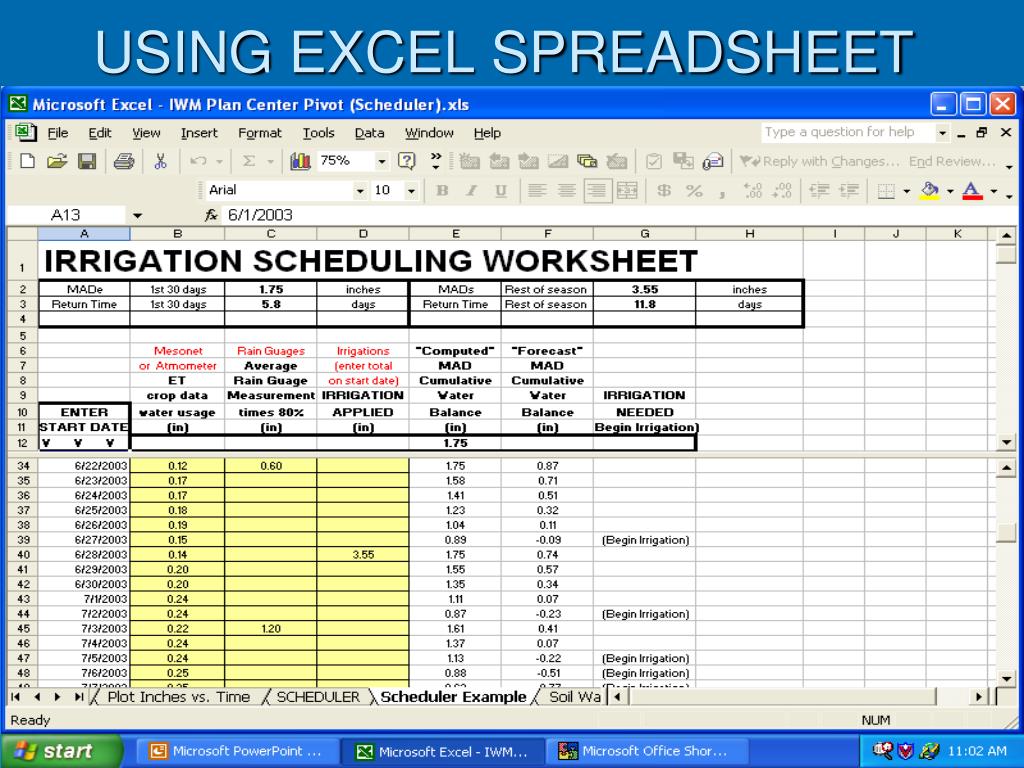
This approach is called the Water Budget Method. Think of the soil's root zone as a bank account for water:
- Balance: The amount of water currently in the soil.
- Withdrawal: Daily water use by the plants (
ETc). - Deposit: Irrigation or rainfall.
You don't need to make a deposit every day. You can let the plant "withdraw" water for a few days until the "account balance" hits a minimum level, and then you make one larger "deposit" (irrigation) to refill it. This minimum level is known as the Maximum Allowable Depletion (MAD).
A professional way to track this is with a simple spreadsheet.
Irrigation System Assessment Guide
The 'Irrigation System Assessment Guide' provides an excellent overview of this water budget method, including worked examples for both sprinkler and trickle (drip) systems. Understanding this concept elevates your design from basic to professional.
Please read the following sections: Start at 'Sprinkler Irrigation Scheduling Using a Water Budget Method' (page 70) to understand the checkbook analogy. Skim 'Example 4.2' (page 73) to see how the budget is applied daily for a sprinkler system. Read the introduction to 'Trickle Systems' (page 73-74) to understand the different goal for drip. Review 'Example 4.4' (page 76-77) to see the water budget method applied to a trickle system, paying attention to how the operating time is calculated in step (c).
Applying the Concept to Our Lawn Zone
- Our lawn needs 5 mm/day.
- For lawns, a typical MAD is 50%. Let's say our soil can hold 30 mm of available water in the root zone. This means we can let the plants use up to 15 mm before we must irrigate.
- At a rate of 5 mm/day, it will take 3 days to use 15 mm of water (
15 mm ÷ 5 mm/day = 3 days). - So, instead of watering for 11 minutes every day, a better schedule would be to water for 33 minutes (3 days × 11 minutes/day) once every three days.
This approach saves water by reducing evaporation from constantly wet soil surfaces and builds stronger, deeper-rooted turf.
Conclusion
You can now calculate the precise runtime for any irrigation zone you design, whether it uses sprinklers or drip. This is the final piece of quantitative analysis required for our project.
Key Takeaways:
- Sprinkler Runtime is based on replenishing a depth of water (mm). It's calculated by dividing the required depth (
ETc) by the system's Precipitation Rate (mm/hr). - Drip Runtime is based on replenishing a volume of water (Liters). It's calculated by dividing the required volume by the system's total Flow Rate (L/h).
- Watering deeply and infrequently (e.g., every 2-3 days) is generally better for plant health than shallow, daily watering. The Water Budget Method provides a professional framework for implementing this strategy.
In our next lesson, we will put all of this together. We will use these runtimes and watering frequencies to develop a complete weekly schedule for an automatic controller. After that, we will be ready to produce the final project deliverables: the fully annotated irrigation plan and the Bill of Quantities (BOQ).