In our previous lesson, we established a clear framework for classifying numbers. This foundational knowledge is crucial as we now shift our focus from what numbers are to what we can do with them and what properties they hold. Today, we delve into the relationship between numbers by exploring a concept fundamental to number theory: the Highest Common Factor.
Our learning outcome is to define the Highest Common Factor (HCF) and find it by listing common factors for small numbers. This lesson will equip you with the core understanding of HCF, providing both the formal definition and the intuition needed to explain it effectively. We'll start with the most straightforward method, which, while simple, is key to grasping the concept before we move on to more efficient algorithms.
What Exactly is a "Factor"?
Before we can find the highest common factor, we need to be precise about what a factor is. While the term is likely familiar, distinguishing it from related concepts like "divisor" and "multiple" is essential for a clear understanding.
This article from HelpingWithMath.com provides excellent, clear-cut definitions that will be very useful. It distinguishes between factors, divisors, and multiples.
Please read the first two main sections of the article: Start with the section that clarifies the difference between a factor and a divisor. The key takeaway is that a factor must divide a number exactly, with no remainder. Then, read the next section, which explains the difference between a factor and a multiple. This is a common point of confusion, and the explanation here is very direct.
To summarize the key ideas:
- A factor of an integer is an integer that divides without leaving a remainder. For example, 4 is a factor of 12.
- A multiple of an integer is the result of multiplying by another integer. For example, 12 is a multiple of 4.
- Factors are the "building blocks" of a number, while multiples are the results of "scaling up" a number. As the mnemonic from one of our resources suggests, think of a factory making a product from parts (factors).
Defining the Highest Common Factor (HCF)
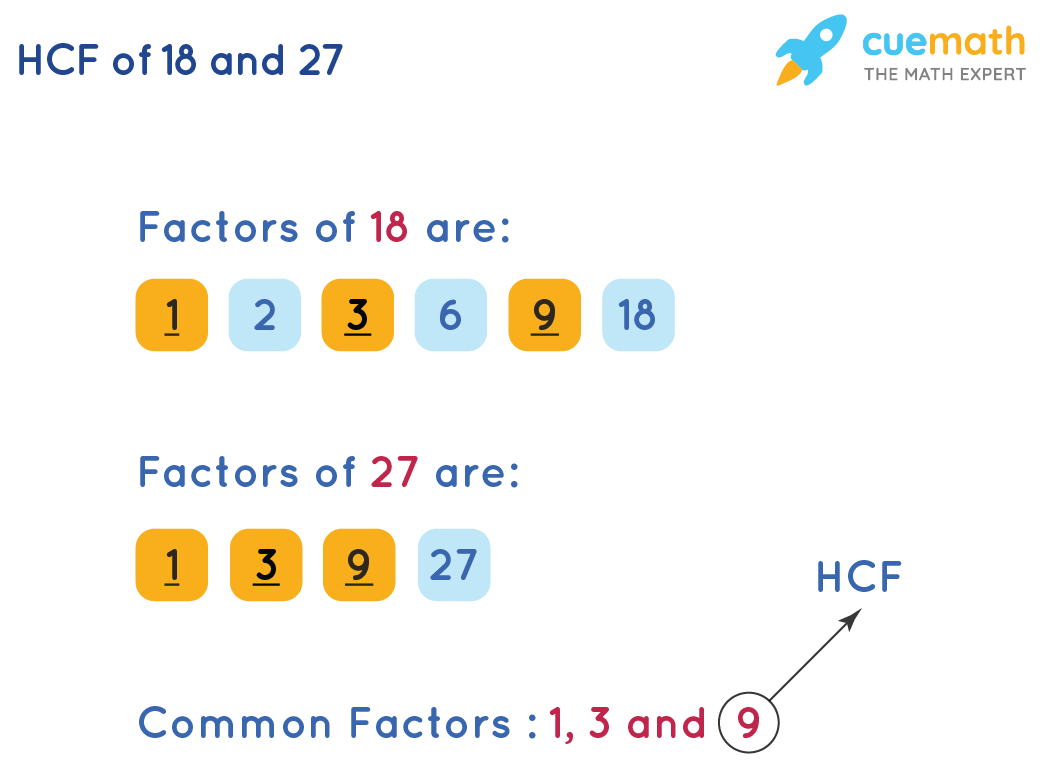
Now that "factor" is clearly defined, let's build on it. If we take two numbers, say 18 and 27, we can list their factors:
- Factors of 18: {1, 2, 3, 6, 9, 18}
- Factors of 27: {1, 3, 9, 27}
The "common factors" are simply the numbers that appear in both lists: {1, 3, 9}.
The Highest Common Factor (HCF) is the largest number in this list of common factors. In this case, the HCF of 18 and 27 is 9. It's also known as the Greatest Common Factor (GCF).
This concept has practical applications in problems involving distribution or division into equal groups. For a fun, intuitive way to think about this, watch the beginning of the following video, which sets up a problem that HCF can solve.
Understanding HCF - The Highest Common Factor Explained with Fun Example | Math for Kids
This video from Bhanzu uses a birthday party scenario to introduce the need for finding the HCF. It's a great example to keep in mind for explaining the "why" behind this concept.
Watch the setup of the problem from the beginning of the video. You'll see how distributing 30 sweets and 42 juice packets equally among friends naturally leads to the question of finding the HCF.
Finding the HCF by Listing Factors
The method we just used for 18 and 27 is the most direct way to find the HCF for small numbers. It involves three simple steps:
- List all the factors for each number.
- Identify the common factors.
- Select the highest (greatest) one.
For a more detailed walkthrough of this process, the following video provides a very clear explanation.
GCF: Greatest Common Factor - Math Antics Extras
This video from the Math Antics channel is excellent for reinforcing these foundational ideas. It's clear, well-paced, and builds the concept from the ground up.
Watch the first three minutes to see a complete explanation: What is a factor? This section provides a great recap of the definition of a factor. Common factors: Here, the video explains how to find common factors by comparing the factor lists of two different numbers (12 and 42). Greatest Common Factor: This part defines the GCF (HCF) and shows how to pick it from the list of common factors.
A Practical Application and an Important Constraint
One of the most common uses of the HCF in arithmetic is simplifying fractions. If you can find the HCF of the numerator and the denominator, you can simplify the fraction in a single step.
The Math Antics video you just started explains this well.
GCF: Greatest Common Factor - Math Antics Extras
Continue watching the Math Antics video to see a practical application of HCF.
Watch the section on simplifying fractions. It shows how dividing the numerator and denominator by their HCF reduces the fraction to its simplest form immediately.
Finally, it's crucial to remember that the concepts of factors and HCF are defined for integers. Your engineering background emphasizes the importance of understanding the domain in which an operation is valid. Applying the HCF process to non-integers without adjustment can lead to incorrect results. The following article presents an interesting problem that highlights this very point.
This article from Resourceaholic includes a great example of a common pitfall. It demonstrates why you can't directly apply standard HCF methods to decimal numbers.
Read the section titled "Integers". Pay close attention to the problem about the dandelion survey. Note how the student's initial attempt fails and how converting the decimal measurements to integers (by changing units from meters to centimeters) makes the problem solvable.
This example reinforces that HCF is a tool for working with whole numbers.
Check Your Understanding
Let's apply the listing method one more time. Find the HCF of 24 and 36.
- List the factors of 24.
- List the factors of 36.
- Identify the common factors.
- What is the HCF?
Click to see the solution
- Factors of 24: {1, 2, 3, 4, 6, 8, 12, 24}
- Factors of 36: {1, 2, 3, 4, 6, 9, 12, 18, 36}
- Common Factors: {1, 2, 3, 4, 6, 12}
- Highest Common Factor (HCF): 12
The image below confirms this result and also gives a preview of other methods we'll explore later.

Conclusion
In this lesson, we have formally defined the Highest Common Factor and practiced the foundational method of finding it by listing factors. This approach, while best suited for smaller numbers, provides a clear, intuitive understanding of what HCF represents.
Key Takeaways:
- A factor is a whole number that divides another whole number without a remainder.
- Common factors are factors shared by two or more numbers.
- The Highest Common Factor (HCF) is the largest of these common factors.
- The listing method (listing all factors and finding the largest one in common) is a direct way to understand and calculate the HCF.
- The concept of HCF applies to integers, and care must be taken when dealing with problems involving non-integers.
While the listing method is excellent for building intuition, it quickly becomes cumbersome and prone to error with larger numbers. Imagine finding the HCF of 960 and 432 by listing all their factors! We need a more systematic and efficient approach.
In our next lesson, we will explore precisely that: Euclid's division lemma, an elegant and powerful algorithm for finding the HCF of any two positive integers, no matter how large.