Welcome to the start of your journey into Class 10 mathematics. This first lesson is designed to build a solid foundation, ensuring you have a clear and structured understanding of the very things we'll be working with: numbers. Your goal is to not only solve problems but also to understand the "why" behind the concepts so you can explain them effectively. With your background in engineering, you're already familiar with applying these numbers, and this lesson will focus on formalizing their classification and relationships—a crucial first step for teaching.
Our learning outcome for this session is to classify numbers as natural, whole, integer, rational, or irrational with examples. We will build the number system from the ground up, starting with the simplest numbers used for counting and expanding the system step-by-step to address new mathematical needs.
The Evolution of Numbers
Mathematics often progresses by asking simple questions that lead to profound discoveries. The development of our number system is a perfect example of this process. Let's trace this evolution to understand why each type of number exists.
A great way to begin is by reading through a short history of how our modern number system came to be. This narrative approach helps clarify the purpose of each number set.
This article from MathsIsFun.com tells the story of numbers, starting from the most basic counting numbers and building up to the comprehensive set of real numbers. It explains the motivation behind the "invention" of each new number type.
As you read, focus on the question that led to each new set of numbers. Start from the beginning with The Counting Numbers. Understand the introduction of zero and how it led to the set of Whole Numbers. See how asking "what if we count backwards" leads to Negative Numbers and the set of Integers. Follow the logic of sharing and division that necessitates Rational Numbers. Grasp the problem (the diagonal of a square) that revealed numbers which are not rational, leading to Irrational Numbers. Finally, see how these all come together to form the Real Numbers.
Deconstructing the Number System
As you've just read, our number system is a hierarchy of sets, each one expanding upon the last to solve a new kind of problem. Let's formalize these definitions.
-
Natural Numbers ()
These are the positive "counting numbers" that we first learn. -
Whole Numbers ()
This set is simply the natural numbers with the addition of zero. The concept of zero was a major leap, moving from a mere placeholder (like in "101") to a number in its own right. -
Integers ()
Integers expand the whole numbers to include negative values. They are essential for representing concepts like debt, temperatures below freezing, or coordinates on a grid. The symbol comes from the German word Zahlen, meaning "numbers". -
Rational Numbers ()
This set includes any number that can be expressed as a ratio of two integers, , where . The symbol comes from "quotient". This set encompasses all integers (since any integer can be written as ) as well as fractions and decimals that either terminate (e.g., ) or repeat in a pattern (e.g., ). -
Irrational Numbers ( or )
These are numbers that cannot be expressed as a simple fraction of two integers. Their decimal representations are non-terminating and non-repeating. Famous examples include (the ratio of a circle's circumference to its diameter) and the square roots of non-perfect squares like or .
The Big Picture: Real Numbers ()
The set of Real Numbers is the union of the rational and irrational numbers. Essentially, if a number can be placed on the number line, it is a real number. This is the primary set of numbers we will be dealing with in Class 10.
To hear these concepts explained and see a helpful analogy, watch the following video.
Classification of Numbers (Natural, Whole, Integers, Rational, Irrational, Real) - Nerdstudy
This Nerdstudy video provides a concise summary of the different classifications of numbers, using clear visuals and an excellent analogy to explain the relationships between the sets.
Watch the definitions for Natural Numbers, Whole Numbers, and Integers. Pay close attention to the explanation of Rational Numbers. The core concept of how these sets are nested is explained beautifully in the Tokyo/Japan analogy. This is a great way to think about the hierarchy. Finally, understand the distinction of Irrational Numbers and how they combine with rationals to form the Real Numbers.
Visualizing the Hierarchy
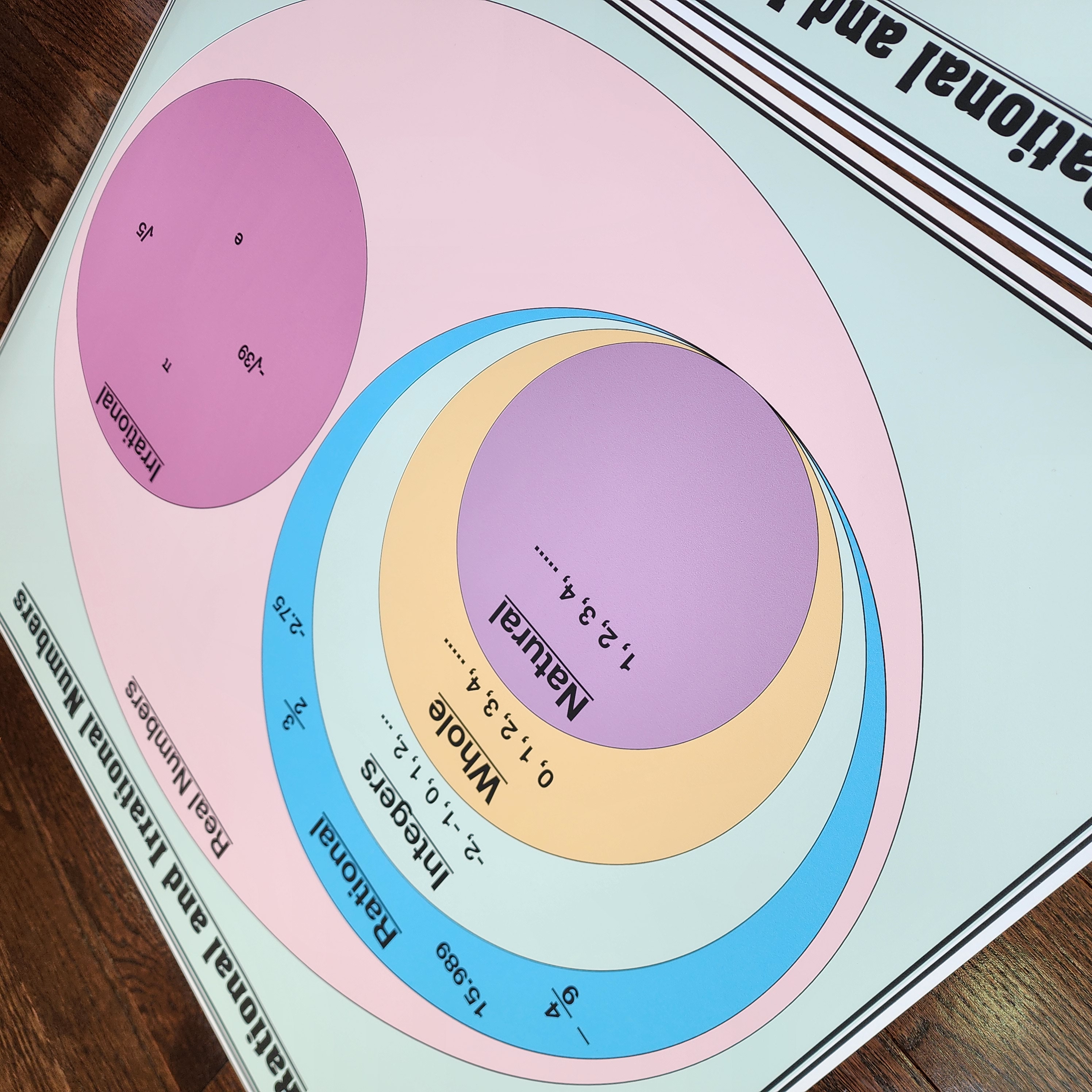
Visual diagrams are often the clearest way to understand set relationships. Your engineering background values structured information, and these two diagrams present the number system's structure in different ways.
This first diagram uses a Venn diagram to show the nested "subset" relationship. Notice how the Natural numbers are completely inside the Whole numbers, which are inside the Integers, and so on. The Irrational numbers are shown as a separate, distinct group.
This second diagram uses a tree structure. It highlights the fundamental split in the Real Number system: every real number is either Rational or Irrational.
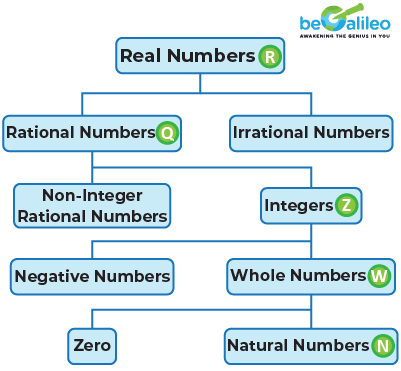
Both diagrams convey the same information but emphasize different aspects of the classification. The Venn diagram emphasizes inclusion, while the tree diagram emphasizes partitioning.
Check Your Understanding
Let's put this into practice. For each number in the list below, determine all the sets to which it belongs (Natural, Whole, Integer, Rational, Irrational, Real). This is a common type of question and a great way to solidify the definitions.
Numbers:
- 7
- -12
- 0
Take a moment to classify them before revealing the answers.
Click to see the solutions
- 7: Natural (), Whole (), Integer (), Rational (), Real ().
- -12: Integer (), Rational (), Real ().
- : Rational (), Real ().
- 0: Whole (), Integer (), Rational (), Real ().
- : First, simplify it. . So, it is Natural (), Whole (), Integer (), Rational (), Real ().
- : Irrational (), Real (). (3 is not a perfect square).
- -3.5: This can be written as , so it is Rational (), Real ().
- : Irrational (), Real ().
Conclusion
In this lesson, we have systematically organized the number system into distinct categories. You can now confidently classify any given number as natural, whole, integer, rational, or irrational and understand its place within the overarching set of real numbers.
Key Takeaways:
- The number system is a hierarchical structure, with each set building upon the last: .
- Real numbers () are divided into two mutually exclusive groups: Rational () and Irrational ().
- A number is rational if it can be written as a fraction . This includes terminating and repeating decimals.
- A number is irrational if it cannot be written as a fraction. Its decimal form is non-terminating and non-repeating.
This foundational understanding of what numbers are is the bedrock for the rest of this chapter. With this classification in place, we can now begin to explore the properties of these numbers and the operations we can perform on them.
In the next lesson, we will begin this exploration by looking at a powerful algorithm for finding the Highest Common Factor (HCF) of two positive integers: Euclid's division lemma.