Hello! Welcome back to your system design course.
In our last lesson, we built a playbook for reacting to performance bottlenecks. We learned how to diagnose issues with CPU, memory, I/O, or the database, and then map those problems to specific mitigation patterns. Today, we're shifting from a reactive to a proactive stance. We'll focus on a critical pattern designed to prevent system overload and ensure stability: rate limiting.
Our learning outcome for this lesson is to apply rate limiting and throttling patterns to protect system resources. Imagine you've identified that your service is vulnerable to being overwhelmed by a single, aggressive client—the "noisy neighbor" problem. Rate limiting is your primary defense. It's a fundamental tool for building resilient, scalable backend systems and a very common topic in senior-level system design interviews.
We'll approach this like a real interview problem: first understanding the 'why', then exploring architectural choices, comparing core algorithms, and finally, designing a complete, distributed solution that meets the demands of a large-scale system.
1. Why Do We Need Rate Limiting?
Before designing a solution, it's essential to articulate the problem it solves. Rate limiting isn't just a technical curiosity; it addresses core business and operational needs. It's about ensuring fairness, stability, and security for your services.
To understand the core motivation, let's explore the "noisy neighbor problem" and why common solutions like auto-scaling aren't always enough.
System Design Interview - Rate Limiting (local and distributed)
This video from System Design Interview provides an excellent introduction to the 'noisy neighbor problem' and explains why rate limiting is a necessary protection layer, even in scalable, cloud-native architectures.
Please watch the first 3 minutes and 40 seconds of the video. Focus on the arguments presented for why auto-scaling and simple load balancer limits are insufficient for protecting a service from targeted overload.
As the video explained, the key reasons for implementing a rate limiter are:
- Preventing Resource Starvation: Protects backend services from being overwhelmed by a single malicious or misbehaving client, ensuring fair resource access for all users.
- Cost Reduction: Limiting traffic reduces the infrastructure needed to handle peak loads and can control costs associated with third-party API calls.
- Security: Thwarting Denial of Service (DoS) and brute-force attacks by limiting the number of login attempts, password resets, etc.
Now that we have a firm grasp on the 'why', let's move on to the 'how'.
2. Designing a Distributed Rate Limiter: A Walkthrough
For the rest of this lesson, we will follow a structured walkthrough of designing a distributed rate limiter, guided by an ex-Meta Staff Engineer. This approach mirrors the process you'd follow in a real system design interview, moving from requirements to a high-level design, and then into deep dives on scalability and fault tolerance.
Design a Distributed Rate Limiter - Hello Interview
This article from Hello Interview, which accompanies the video we'll be watching, provides a comprehensive text-based breakdown of the problem. It's an excellent resource to reference.
Begin by reading the 'Understanding the Problem' section, which covers both functional and non-functional requirements. This sets the stage for the design by clearly defining the scope and goals, a critical first step in any system design interview.
Let's start the video walkthrough.
Design a Distributed Rate Limiter w/ a Ex-Meta Staff Engineer: System Design Breakdown
This video, from the same author as the article, will be our primary guide. We'll watch it in segments, pausing to reflect on key design decisions.
Watch from the beginning up to 07:49. This section introduces the concept of a rate limiter and establishes the functional and non-functional requirements for our system, including the scale we're designing for (1M requests/second). Pay close attention to how specific the non-functional requirements are (e.g., latency < 10ms).
Step 1: Architectural Placement
A crucial first decision is where the rate limiter should live in your architecture. This choice has significant implications for latency, flexibility, and the information available to make limiting decisions.
Let's examine the trade-offs between three common placements: in-process, as a dedicated service, or at the API Gateway.
Design a Distributed Rate Limiter w/ a Ex-Meta Staff Engineer: System Design Breakdown
Now let's explore the different architectural placements for our rate limiter and the strategies for identifying clients.
Watch the segment from 14:33 to 22:40. The video discusses the pros and cons of implementing the rate limiter within a microservice, as a separate service, or at the API Gateway. It also covers how clients are identified (user ID, IP, API key), which is directly tied to the placement decision.
The consensus in modern systems, and the path we'll take, is to place the rate limiter at the edge, typically within the API Gateway. This provides centralized control and protects downstream services without adding extra network latency to every internal service call.
Step 2: The Core Patterns - Rate Limiting Algorithms
With our placement decided, we now need to choose an algorithm to enforce the limits. This is the heart of the "patterns" in our learning outcome. There are several standard algorithms, each with different characteristics regarding accuracy, memory usage, and how they handle bursts of traffic.

Let's dive into the specifics of four key algorithms.
Design a Distributed Rate Limiter w/ a Ex-Meta Staff Engineer: System Design Breakdown
This next segment details the four most common rate limiting algorithms you're expected to know in an interview: Fixed Window Counter, Sliding Window Log, Sliding Window Counter, and Token Bucket.
Watch from 22:40 to 30:06. Focus on understanding the trade-offs of each algorithm. Why is 'Fixed Window Counter' simple but prone to boundary issues? Why is 'Sliding Window Log' accurate but memory-intensive? Why is 'Token Bucket' often the preferred choice?
As discussed, the Token Bucket algorithm provides an excellent balance. It handles both sustained load (via the refill rate) and temporary bursts (via the bucket capacity) efficiently. For the rest of our design, we'll proceed with this algorithm.
Step 3: Distributed Implementation with Redis
Knowing the algorithm isn't enough. In a distributed system with multiple API gateway instances, how do you share the state of the token buckets? A simple in-memory implementation on each gateway won't work, as it leads to inconsistent enforcement.
The standard solution is to use a centralized, fast, in-memory data store like Redis. However, this introduces its own challenges, most notably race conditions.
Design a Distributed Rate Limiter w/ a Ex-Meta Staff Engineer: System Design Breakdown
This is a critical section for a senior engineering interview. It covers the practical implementation of the Token Bucket algorithm using Redis and, crucially, how to solve the inherent race condition in a read-modify-write pattern.
Watch from 30:06 to 35:43. Pay close attention to the explanation of the race condition and how using a Redis Lua script creates an atomic operation to prevent it. This demonstrates a deep understanding of concurrency issues.
Step 4: Finalizing the High-Level Design
To complete the basic flow, we must define how the system communicates with the client when a request is throttled. A well-designed rate limiter provides clear feedback.
Design a Distributed Rate Limiter w/ a Ex-Meta Staff Engineer: System Design Breakdown
Let's cover the correct way to respond to a client when a rate limit is exceeded.
Watch this short segment from 35:43 to 38:43. The key takeaways are the standard HTTP status code (429 Too Many Requests) and the informative headers (X-RateLimit-*) that allow well-behaved clients to implement backoff strategies.
3. Deep Dive: Scaling and Fault Tolerance
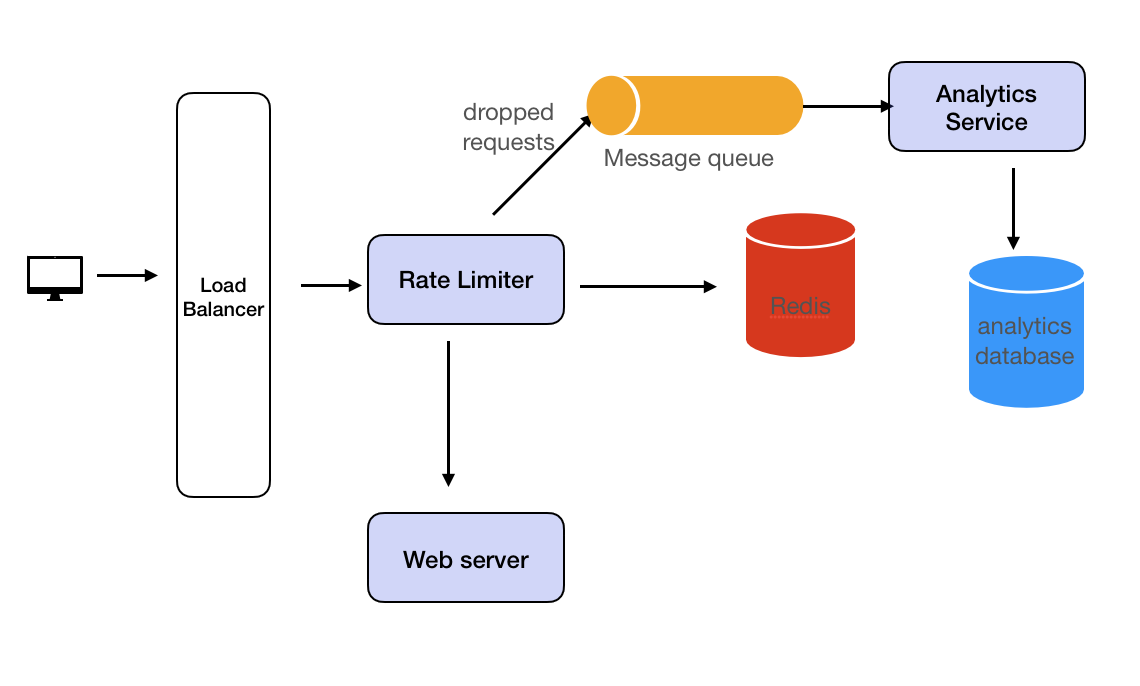
Our design now works, but can it handle 1 million requests per second? And what happens when parts of it fail? In an interview for a senior role, this is where you distinguish yourself by proactively addressing non-functional requirements.
Scaling to 1M RPS
A single Redis instance will become a bottleneck long before 1M RPS. The solution is to partition, or shard, the data across multiple Redis instances.
Design a Distributed Rate Limiter w/ a Ex-Meta Staff Engineer: System Design Breakdown
Let's address the scalability requirement. How do we get from a single Redis instance to a cluster that can handle our target load?
Watch from 38:43 to 42:54. This segment explains the need for sharding and how you can use a client identifier (like a user ID) with consistent hashing to route requests to the correct Redis shard. The mention of Redis Cluster is a practical, real-world detail.
Ensuring High Availability
With multiple Redis shards, each one is a potential point of failure. What happens if the shard holding a user's token bucket goes down? This leads to a critical design choice: fail-open vs. fail-close.
Design a Distributed Rate Limiter w/ a Ex-Meta Staff Engineer: System Design Breakdown
Now, let's tackle fault tolerance. We'll discuss failure modes and how to prevent a single point of failure using replication.
Watch from 42:54 to 46:43. Understand the business and system implications of failing open (allowing all traffic) versus failing close (blocking all traffic). Also, note how standard master-slave replication is used to make each shard fault-tolerant.
Your experience leading projects and making technical trade-offs is highly relevant here. The choice between fail-open and fail-close isn't purely technical; it's a risk assessment based on the service's function. For a social media app, failing open during a viral event could cause a cascading failure, making fail-close the safer (though more disruptive) option.
Minimizing Latency
Our final non-functional requirement was to keep latency under 10ms. A network call to Redis, even if fast, adds overhead.
Design a Distributed Rate Limiter w/ a Ex-Meta Staff Engineer: System Design Breakdown
Let's quickly cover two key optimizations for meeting our strict latency budget.
Watch from 46:43 to 49:22. The two main techniques discussed are connection pooling (to avoid TCP handshake overhead) and geographic distribution (co-locating gateways and Redis instances near users).
Conclusion
In this lesson, you've learned how to apply rate limiting patterns to protect system resources, a crucial skill for any backend engineer. We've gone from the fundamental "why" to a complete, distributed design ready for a senior-level interview.
Key Takeaways:
- Start with Why: Frame rate limiting as a solution to the "noisy neighbor problem," ensuring stability, security, and fairness.
- Placement Matters: Placing the rate limiter at the API Gateway is a strong, common pattern that protects your entire backend.
- Know Your Algorithms: The Token Bucket algorithm is a versatile and efficient choice, but you should be able to discuss the trade-offs of others like Fixed/Sliding Window.
- Design for Distribution: A scalable rate limiter relies on a centralized data store like Redis. You must address concurrency (with atomic operations like Lua scripts), scale (with sharding), and fault tolerance (with replication and clear failure modes like fail-close).
- Communicate Clearly: A good design includes returning the
429status code and helpfulX-RateLimit-*headers to clients.
This lesson touched on several concepts related to distributed data stores—sharding, replication, and consistency. This serves as a perfect bridge to our next module, "Data Storage and Database Design". Our first lesson there will dive deep into one of the most fundamental data storage decisions: articulating the trade-offs of SQL vs. NoSQL databases.