Hello! Welcome to the first lesson in your course on cracking interviews at top companies. We'll be starting with the System Design Interview Fundamentals module.
Given your extensive experience as a backend engineer, you've likely designed and built complex systems. The challenge in an interview setting isn't your technical ability, but rather demonstrating it within a very specific, structured, and time-constrained format. This first lesson is designed to demystify that format.
Our goal today is to describe the typical structure and expectations of a system design interview at top companies. By the end of this lesson, you will have a clear mental map of what a system design interview looks like, what interviewers are evaluating, and, most importantly, the higher bar set for senior candidates like yourself.
What is a System Design Interview?
At its core, a system design interview is a collaborative discussion where you and an interviewer design a large-scale system to solve a real-world problem. Unlike coding interviews, you won't be writing executable code. Instead, you'll be on a whiteboard (physical or virtual), drawing boxes and arrows to represent system components and discussing the architectural choices and trade-offs involved.
To get a feel for this, let's watch a short clip from a Meta Staff Engineer who explains the fundamentals.
How to Prepare for System Design Interviews w/ Meta Staff Engineer
This video provides a concise overview of what a system design interview is and the types of problems you might encounter.
Please watch from 01:19 to 02:33.
As the video explains, these interviews assess your ability to architect complex, scalable systems. The problems generally fall into two categories:
- Product/Application Design: Designing user-facing systems like a URL shortener (TinyURL), a social media feed (like Twitter's), or a ride-sharing app (like Uber).
- Infrastructure Design: Designing the underlying components that power applications, such as a rate limiter, a message queue, or a distributed key-value store.
The Anatomy of a System Design Interview
A 45-minute interview flies by. Going in without a plan is a common mistake. Successful candidates navigate the interview using a structured framework. This ensures you cover all the critical aspects of the problem, manage your time effectively, and make it easy for the interviewer to follow your thought process.
This next video introduces a simple but powerful 4-step framework and, crucially, suggests how to allocate your time across these steps.
System Design Interview: A Step-By-Step Guide
The ByteByteGo channel offers a clear, step-by-step guide that we will use as the foundation for our approach. Pay close attention to the suggested time allocation for each step.
Please watch from 00:39 to 01:32.
Let's formalize this structure. Think of it as your roadmap for every system design interview:
A 4-Step Framework
-
Step 1: Understand the Problem & Establish Scope (5-10 mins)
- This is the most critical phase. Don't jump into solutions.
- Ask clarifying questions to understand the functional requirements (what the system must do, e.g., "users can upload photos") and non-functional requirements (how the system must perform, e.g., "uploads should be fast," "the system must be highly available").
- Define the scope. You can't design all of Twitter in 45 minutes. Prioritize the core features with the interviewer.
-
Step 2: Propose a High-Level Design (10-15 mins)
- Sketch out a "bird's-eye view" of the system.
- Identify the main components (e.g., clients, load balancers, web servers, databases, caches) and the connections between them.
- Define the core APIs.
- The goal here is a simple, working design that satisfies the core functional requirements.
-
Step 3: Design a Deep Dive (15-20 mins)
- This is where you address the non-functional requirements like scalability, availability, and latency.
- Identify potential bottlenecks in your high-level design. For example: "The database will be a bottleneck under heavy write load."
- Discuss specific solutions and, most importantly, their trade-offs. This is where your seniority really shows. You might discuss database sharding, caching strategies, or using a message queue to decouple components.
-
Step 4: Wrap Up (5 mins)
- Briefly summarize your design, highlighting the key decisions you made and the trade-offs involved.
- Mention potential future improvements or how the system might evolve.
- Leave time for any final questions from the interviewer.
This framework is the backbone of the first module of this course. In the upcoming lessons, we will explore each of these steps in detail.
Expectations: What Interviewers Are Looking For
Knowing the structure is only half the battle. You also need to know the grading rubric. What distinguishes a good answer from a great one?
Let's return to the video from the Meta Staff Engineer, who outlines the key evaluation criteria.
How to Prepare for System Design Interviews w/ Meta Staff Engineer
This clip details the four main pillars that interviewers use to evaluate candidates.
Please watch from 04:34 to 05:47.
To summarize, you are being evaluated on:
- Problem-Solving: Can you break down a vague problem, identify the core challenges, and prioritize what matters?
- Solution Design: Can you create a coherent high-level design that meets the requirements? Do you thoughtfully consider trade-offs?
- Technical Excellence: Can you go deep into specific areas? Can you discuss technologies, protocols, and failure modes with precision?
- Communication & Collaboration: Can you explain complex ideas clearly? Do you treat the interview as a collaborative design session with a colleague?
The Senior Engineer Bar
With 10 years of experience, the expectations for you are significantly higher than for a junior or mid-level engineer. It's not just about getting a working design on the whiteboard; it's about demonstrating architectural maturity and leadership.
Let's look at a resource that breaks down these expectations by level.
System Design Interview Questions & Prep (from FAANG experts)
To understand how expectations change with experience, this article from 'I Got An Offer' breaks down what interviewers look for at different career stages. This will clarify the standards you'll be held to.
Please read the section titled '1.2 Types of questions and interview performance expectations per level'. Pay close attention to the description for 'Senior/staff engineer'.
This image provides a great visual summary of those levels.
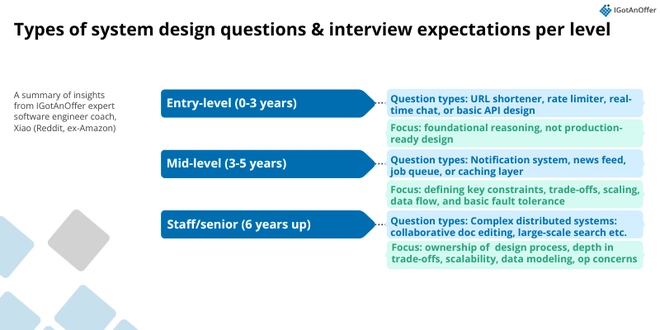
To drive this point home, let's read one more short piece that discusses the shift from purely technical evaluation to assessing leadership.
System Design Interview Guide: FAANG and Startups - Exponent
This article from Exponent further explains the crucial difference in expectations for senior candidates, especially regarding leadership and discussing trade-offs. This connects directly with your experience leading projects.
Please read the section titled 'Junior vs. Senior Engineers'. Focus on the expectations for senior roles and how you can demonstrate leadership skills during the interview.
Here are the key takeaways for you as a senior candidate:
- Depth over Breadth: A junior engineer might say, "I'll use a load balancer." You are expected to discuss why you'd choose a particular load balancing strategy (e.g., Round Robin vs. Least Connections vs. IP Hash) and articulate the trade-offs.
- Ownership and Leadership: You should drive the conversation. You are expected to ask insightful questions about business goals ("What does success look like for this system?") and collaborate with the interviewer as a peer.
- Focus on Trade-offs: Every design decision has consequences. Senior engineers are expected to proactively identify these trade-offs (e.g., consistency vs. availability, cost vs. performance) and justify their choices. The interview is less about finding a single "right" answer and more about exploring the design space.
Conclusion
This lesson provided the foundational blueprint for the system design interview. We've defined what it is, outlined a structured 4-step approach to tackle it, and, most importantly, clarified the high expectations for a senior engineer.
Key Takeaways:
- System design interviews are structured, collaborative conversations about building large-scale systems without writing code.
- A 4-step framework (Understand, High-Level Design, Deep Dive, Wrap-up) provides a reliable roadmap for the 45-minute session.
- As a senior engineer, your evaluation goes beyond a working design. You must demonstrate deep technical knowledge, a command of trade-offs, and leadership qualities throughout the interview.
In our next lesson, we will expand on the 4-step framework and transform it into a more detailed, systematic process that you can apply to any system design problem. This will be the core of your problem-solving toolkit for the rest of the course.