Hello! Welcome back to your system design course.
In our last lesson, you learned how to translate requirements into a high-level design (HLD) diagram and a corresponding API. You now have the skills to lay out the architectural blueprint of a system on the whiteboard. This is a critical milestone, but the interview doesn't stop there. Once the HLD is up, the real discussion begins.
This lesson focuses on the next phase of the interview, the "deep dive," and addresses the learning outcome: Identify key areas for deep dive based on the problem and interviewer cues. This is arguably the most important part of the interview for a senior engineer. It’s your opportunity to move beyond just drawing boxes and demonstrate the depth of your technical expertise by analyzing your design, identifying its weaknesses, and proposing thoughtful solutions.
The Deep Dive Phase: From Blueprint to Engineering
You've spent the first 15-20 minutes of the interview establishing the scope and sketching a high-level design that meets the core functional requirements. Now, the focus shifts. The "deep dive" phase, which can take up 10-25 minutes, is where you and the interviewer zoom in on specific parts of your design to tackle the non-functional requirements: scalability, availability, latency, and consistency.
A Framework For System Design Interviews - ByteByteGo
The 'ByteByteGo' framework provides a clear definition of this phase. Pay attention to how it's framed as a collaborative effort with the interviewer to prioritize which components to explore further.
Read the section 'Step 3 - Design deep dive' to understand the purpose of this phase. Then, review 'Time allocation on each step' to see how it fits into the overall interview timeline.
As the article mentions, this is where you'll discuss system performance, bottlenecks, and specific component designs. For a senior candidate like yourself, the expectation is that you can proactively identify these areas and lead the discussion, rather than waiting for the interviewer to prompt you for every step.
Signaling Your Intent: The Breadth-First Approach
A great strategy to manage the flow of the interview is to signal your awareness of complex issues while you are creating your high-level design, without getting sidetracked. This is a breadth-first approach. You can briefly mention potential optimizations or challenges and state that you'll come back to them later.
For example, while drawing your HLD, you might say:
- "I'm placing a single database here for now to complete the main user flow. Given the write traffic we estimated, we'll definitely need to discuss sharding strategies, which I'll come back to."
- "For the news feed, a simple database query won't be fast enough. I'll start with this, but we'll need to explore a more robust solution with caching or pre-computation in the deep dive."
This technique shows the interviewer that you have a broad understanding of the problem space, even before you dive into the details.
System Design Interviews: 10 Key Principles (with ex-Google EM)
This video with an ex-Google EM explains this 'breadth-first vs. depth-first' strategy perfectly. It's about signaling your knowledge without derailing your initial design process.
Watch the segment from 09:14 to 13:11. The speaker discusses the importance of getting to a working solution first and then mentioning, but not immediately detailing, areas for optimization like caching or storage tiering.
Identifying Areas for a Deep Dive
Once your HLD is complete, it's time to put on your engineering hat and critique your own design. Where are the weak points? What assumptions need to be challenged? You can identify deep dive topics by looking for two things: inherent system challenges and interviewer cues.
1. Proactive Identification (Senior-Level Signal)
As a senior candidate, you should be able to look at your diagram and immediately spot areas that require more detailed discussion. This is where your 10 years of experience come into play. You're not just drawing a diagram; you're mentally stress-testing it.
System Design Delivery Framework
The Hello Interview 'Delivery Framework' explains this well. It notes that while junior candidates might be led by the interviewer, senior candidates are expected to identify these areas themselves.
Read the section 'Deep Dives'. Focus on the distinction between junior and senior expectations and the examples of how to lead a discussion on scaling or latency.
Here are common triggers for deep dives based on your HLD and NFRs:
- High Traffic/QPS: Look at the back-of-the-envelope calculations you did earlier.
- High Read QPS: The immediate topic is caching. Where do you put a cache (CDN, application-level, database)? What's the caching strategy (e.g., read-through)? What's the cache invalidation plan?
- High Write QPS: This points to bottlenecks in your persistence layer. Topics include database sharding, using message queues for asynchronous processing, and batching writes.
- Low Latency Requirements: For user-facing features like a social media feed or search autocomplete, you can't afford slow responses. This leads to deep dives on:
- Pre-computation/Fan-out strategies: Do you generate a news feed on-the-fly (fan-out-on-read) or pre-compute it when a user posts (fan-out-on-write)?
- Specialized Data Structures/Databases: For search autocomplete, you might discuss using a Trie or a search index like Elasticsearch.
- High Availability: What happens if a component fails?
- This leads to discussions about replication (e.g., master-slave for databases), load balancing, and eliminating single points of failure (SPOFs).
- You might discuss patterns like leader election for stateful services or the circuit breaker pattern for service-to-service communication.
- Large Data/Storage: If your system stores terabytes or petabytes of data (e.g., photos, videos, analytics events).
- Deep dive topics include the choice between SQL vs. NoSQL, data partitioning/sharding, and object storage (like S3) vs. block storage.
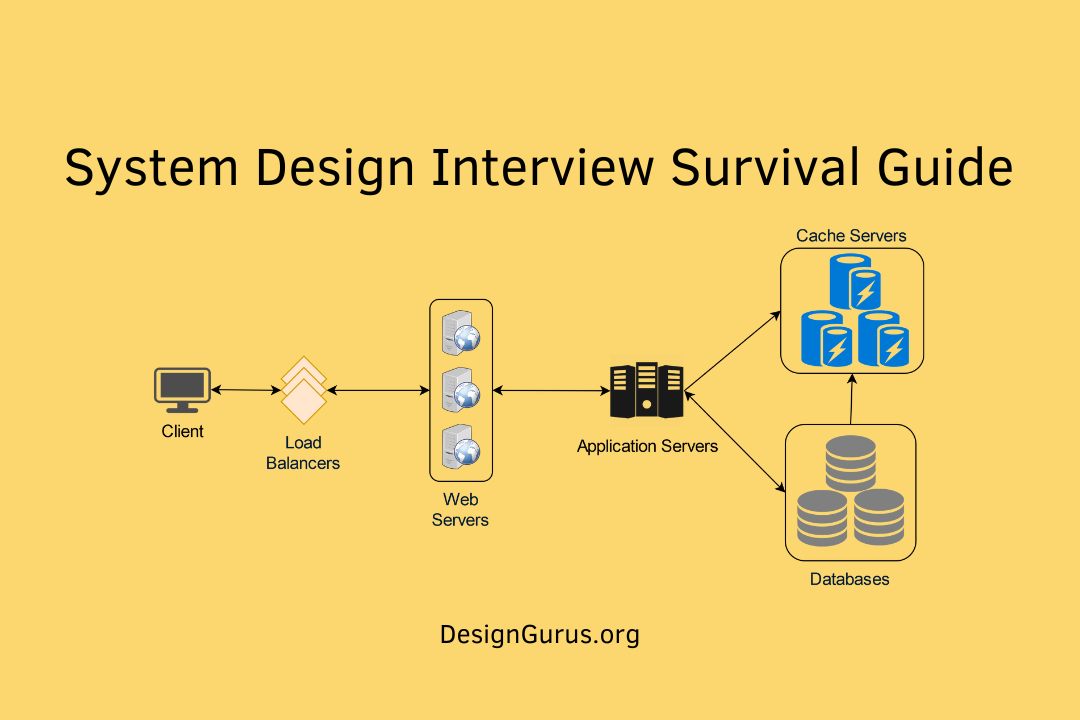
2. Reacting to Interviewer Cues
Your interviewer is your partner in this process. Their questions are signals guiding you toward what they find important. Paying close attention to these cues is critical.
Interviewer cues can be:
- Direct Probes: "That's a lot of writes to a single database. How are you going to handle that?" This is an explicit invitation to discuss database scaling.
- "What If" Scenarios: "What if traffic triples during the World Cup final?" This is a cue to talk about auto-scaling, rate limiting, and ensuring your system can handle load spikes.
- Changing Requirements: "Okay, that works. Now, how would you add real-time comments to this design?" This tests your ability to adapt your design and might lead to a discussion on WebSockets or long-polling.
When an interviewer asks a question, pause and think. Don't rush to a solution. First, understand the problem they're pointing to. Then, structure your response.
Example in Action: Deep Diving on a "Top K" Problem
Let's watch how these concepts are applied in a realistic interview scenario. The following video breaks down the design for a "Top K" service (e.g., top 10 most viewed videos on YouTube).
Top-K System Design Interview Breakdown w/ Ex-Meta Senior Manager
This video from Hello Interview is a masterclass in moving from an HLD to deep dives. First, the speaker sets the context for how deep dives fit into the overall framework.
Watch from 04:06 to 06:32. The speaker explains that after establishing a working high-level design, the deep dive is where you address non-functional requirements like latency and scaling.
Now, let's see the deep dives themselves. The speaker identifies two main problems with the initial design: poor read performance (high latency) and poor write performance (inability to handle the write volume).
Top-K System Design Interview Breakdown w/ Ex-Meta Senior Manager
First, watch the deep dive on optimizing read performance. Notice how the discussion revolves around two potential solutions—caching and pre-computation—and their trade-offs.
Watch the segment from 32:06 to 37:44. This is a perfect example of a deep dive into a latency-critical path.
Top-K System Design Interview Breakdown w/ Ex-Meta Senior Manager
Next, watch the even more detailed deep dive on write performance. The speaker uses back-of-the-envelope calculations to quantify the problem (700k writes/sec!) and then systematically explores solutions like sharding, partitioning, batching, and using a stream processing framework like Flink.
This is a long but incredibly valuable section. Watch from 37:44 to 01:00:35. Pay close attention to how each solution is introduced to solve a specific problem and the trade-offs involved. This is exactly what a senior-level discussion looks like.
As a final point, the video also touches on more advanced topics that might come up in a staff-level interview, such as approximation algorithms (Count-Min Sketch). While you don't need to master these, being aware of them shows the breadth of your knowledge.
Structuring Your Deep Dive Discussion
When you are in a deep dive, avoid just naming a technology. Instead, demonstrate your technical judgment by articulating your thought process clearly. A good structure is:
- Identify the specific problem: "Our read latency for the news feed is too high because we're querying and joining multiple tables on every request."
- Propose a solution: "To address this, I propose we pre-compute the feed and store it in a cache, like Redis."
- Explain the mechanics: "When a user posts, we'll use a fan-out-on-write approach. A background worker will push the new post's ID to the Redis sorted sets of all their followers. When a user requests their feed, we just need to read a single list from Redis, which is extremely fast."
- Discuss the trade-offs: "This approach makes reads very fast, but it increases write-time work. It's also more complex, and we need to consider the 'thundering herd' problem for celebrities with millions of followers. We could mitigate that by not fanning out for celebrities and instead fetching their posts at read time—a hybrid approach."
This structure demonstrates that you're not just reciting patterns but are actively weighing engineering trade-offs, which is the core skill being evaluated.
Conclusion
You've now learned how to navigate the crucial deep dive phase of a system design interview. This is where your experience truly shines.
Key Takeaways:
- The deep dive phase is for addressing non-functional requirements like scalability, latency, and availability.
- Be proactive: As a senior candidate, you are expected to identify bottlenecks and areas for improvement in your own design.
- Use the breadth-first approach: Signal your awareness of complex topics early on, but save the detailed discussion for the deep dive phase.
- Listen to the interviewer: Their questions are a guide to what they consider important.
- Structure your discussion: For each deep dive, articulate the problem, propose a solution, explain its mechanics, and most importantly, discuss the trade-offs.
In our next lesson, we will focus entirely on that last point: "Articulate trade-offs clearly for key design decisions." While we touched on it today, the next lesson will provide a dedicated framework for comparing different technical options and justifying your choices—a skill that is absolutely essential for passing a senior-level system design interview.