Hello! Welcome back to your interview preparation.
In our last lesson, we focused on how senior engineers act as "force multipliers" by mentoring and growing their colleagues. We practiced structuring those stories using the STAR method. Today, we're tackling another crucial leadership and influence topic, one that is almost guaranteed to come up in your interviews: handling disagreements.
Your goal for this lesson is to learn how to frame and deliver a compelling story about a time you disagreed with a stakeholder or team member. As a senior engineer with a decade of experience, you've navigated many such situations. This lesson will help you select the most impactful examples and articulate them in a way that demonstrates the judgment and professionalism top companies expect.
1. The "Why" Behind the Conflict Question
First, let's be clear: when an interviewer asks about conflict, they aren't looking for someone who avoids it. In fact, it's the opposite. Top tech companies believe that constructive disagreement is essential for innovation and finding the best solutions. They want to hire "thought partners," not just executors.
A great way to understand this is through Amazon's Leadership Principles, which are highly influential across the industry.
Ace the Amazon Leadership Principles Interview
The article 'Ace the Amazon Leadership Principles Interview' provides excellent context for this topic. Pay close attention to the principle related to disagreement.
First, review the list of 16 Leadership Principles and find the one that directly addresses conflict. Then, read the section titled 'Step 4. Avoid dealbreakers, red flags, and risks.' Note what it says about failing to provide a good story for this principle.
As you saw, "Have Backbone; Disagree and Commit" is a core principle. Not having a story about a disagreement is considered a dealbreaker. This question is a direct test of your ability to challenge decisions respectfully, use data and reason to make your case, and then fully align with the final decision, regardless of the outcome.
For your level of experience, the expectation is high. Interviewers want to hear about conflicts with significant stakes that affect project roadmaps, architecture, or cross-functional teams—not minor squabbles over coding style.
2. Choosing and Structuring Your Story
To answer this question effectively, you need to select a story that showcases your professional maturity and then structure it clearly.
Let's watch a video where ex-Meta and Amazon senior managers break down exactly what they're looking for.
Behavioral Interview: Common Questions Broken Down by Ex-Meta & Amazon Senior Managers
This video, 'Behavioral Interview: Common Questions Broken Down,' offers a masterclass on the conflict question. It covers what interviewers are assessing, how to choose a story, and how to structure your answer.
Please watch these three key segments: What interviewers are assessing and how to choose a story (01:56 - 06:49): Pay attention to the criteria for a good story (high stakes, deep involvement) and how the scope of the conflict reflects your seniority. How to structure the response (07:32 - 12:21): This part details the ideal breakdown of your story (STAR/CARL format) and gives a checklist of actions to include, like seeking to understand, showing empathy, and using data. Disagreeing with your manager (19:20 - 25:30): This section is highly relevant for a senior role. It explains what makes a good vs. bad story about disagreeing with a manager.
Let's synthesize those key points into a framework for your story.
Story Selection
As the video and your experience suggest, a strong story for a senior candidate should be:
- High-Stakes: The outcome mattered to the business, the project, or the team's direction.
- Cross-Functional: The disagreement was with a product manager, a designer, another team's lead, or your own manager.
- Data-Driven: Your position was based on evidence, not just personal preference.
The STAR(L) Structure
We'll use the STAR method you're familiar with, but add an 'L' for Learnings, which is a powerful signal of seniority.
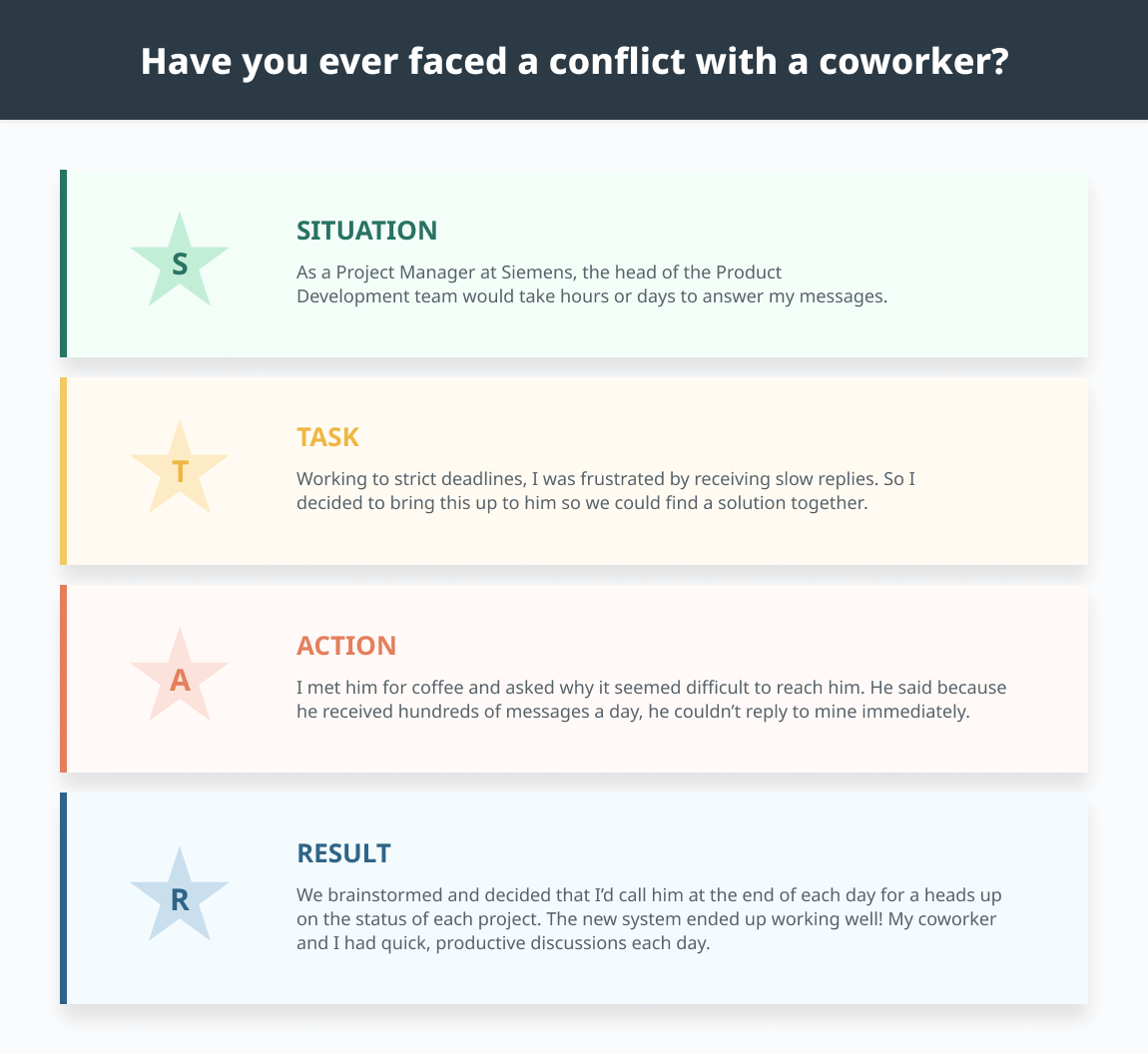
- S - Situation: Briefly set the context. What was the project? Who was the disagreement with? (e.g., "On a project to refactor our authentication service, my product manager and I had different views on the Q3 roadmap.")
- T - Task: What was the core of the disagreement? What was the decision that needed to be made? (e.g., "The PM wanted to prioritize new features to drive user engagement, while I argued we needed to prioritize paying down critical tech debt to improve system reliability before Black Friday.")
- A - Action: This is the most important part (about 60% of your story). Detail the steps you took to resolve the disagreement. Your actions should demonstrate:
- Seeking to Understand: "I scheduled a 1-on-1 with the PM to listen and truly understand the business pressure behind the feature requests."
- Empathy: "I acknowledged the validity of their goals and the importance of user growth."
- Data Gathering: "I then partnered with our SRE team to pull metrics on system latency and error rates during peak loads from the previous year. I created a projection of the potential downtime risk if we didn't address the debt."
- Presenting Your Case: "In our next meeting, I presented the data, framing it not as 'my idea vs. your idea,' but as a shared risk to the business. I proposed a compromise: a smaller, high-impact feature could proceed in parallel while a dedicated part of the team tackled the most critical tech debt."
- Choosing the Right Channel: Notice how the action moved from a group setting to a 1-on-1 and back, using the appropriate forum for each step.
- R - Result: Describe the outcome for both the project and the relationship.
- Project Outcome: "The PM agreed with the data-driven approach. We re-prioritized the roadmap to tackle the P0 tech debt, which resulted in zero downtime during the Black Friday peak—a first for our service. We still managed to ship one of the smaller features, so the business goals were also partially met."
- Relationship Outcome: "This process actually strengthened my relationship with the PM. They began including me earlier in the roadmap planning process, and our collaboration became much more proactive."
- L - Learnings: Briefly reflect on the experience. (e.g., "I learned that framing technical needs in terms of business risk is far more effective than just talking about 'tech debt.' It created a shared language with my PM.")
3. A Real-World Senior Engineer Example
Let's analyze a complete story from a mock interview with a FAANG tech lead. This example perfectly demonstrates the principles we've discussed.
This transcript from Interviewing.io shows a candidate navigating the 'disagreed with a manager' question. It's a fantastic, unscripted example of a senior-level response.
Read the first question and the interviewee's response (starting 'Yes. So the situation that I can think of...'). As you read, identify the STAR components. Pay close attention to the specific actions the candidate took: involving a data scientist, gathering feedback from the team and stakeholders, and formally presenting the case to different levels of leadership.
The story you just read is excellent because the candidate:
- Took on a complex, ambiguous problem (optimizing a workflow).
- Disagreed with their manager on a high-stakes decision (project prioritization).
- Didn't just state their opinion; they gathered quantitative data (10% reduction), qualitative data (team interest, user research), and built a coalition with stakeholders.
- Managed communication carefully, having informal check-ins with their manager and a formal presentation for skip-level leadership.
- Drove a positive outcome that was backed by metrics.
4. The "And Commit" Principle
What happens if you don't "win" the argument? This is where the "and Commit" part comes in. Your ability to fully support a decision you initially disagreed with is just as important. In the same mock interview, the candidate was asked a follow-up question that addresses this exact scenario.
Let's continue with the same mock interview transcript. The next question is a perfect illustration of the 'commit' principle.
Read the second question ('tell me about a time that you needed to share a decision with your team that you disagreed with') and the candidate's response. Notice how they communicated the difficult news to their team: acknowledging disappointment, clearly explaining the rationale without blame, and committing to the final decision.
Having a story like this is crucial. It shows you're a team player who prioritizes the company's success over being "right."
5. Exercise: Draft Your Disagreement Story
Now, it's your turn. Think back through your 10 years of experience. Identify a significant disagreement you were part of. Aim for one involving a manager, a PM, or another team.
Using the STAR(L) framework, outline your story. Spend most of your time on the Action section.
- Situation: What was the project and who was involved?
- Task: What was the point of disagreement?
- Action: What specific steps did you take? (Listen, show empathy, gather data, build consensus, communicate effectively).
- Result: What was the outcome for the project? What happened to the working relationship?
- Learning: What was your key takeaway from the experience?
Take 15-20 minutes to write down the bullet points for your story.
Conclusion
Handling disagreements is not about winning arguments; it's about making better decisions. Your interview stories must show that you can engage in conflict constructively, use data and empathy to influence others, and commit fully to the team's direction. For a senior engineer, these stories are a primary vehicle to demonstrate your leadership, maturity, and judgment.
Key Takeaways:
- Answering the "disagreement" question well is critical for senior roles; failing to do so can be a dealbreaker.
- Choose a high-stakes, cross-functional story where your position was backed by data.
- Use the STAR(L) framework to structure your answer, dedicating the most time to your Actions.
- The Result must address both the business outcome and the state of the relationship.
- Be prepared with stories where you convinced others, and also stories where you were convinced and had to "disagree and commit."
Next Lesson Preview:
In our next lesson, we will explore a closely related topic: "Describe situations where you made difficult trade-off decisions." Many disagreements are fundamentally about differing opinions on trade-offs, and showing you can analyze and articulate these decisions is another hallmark of a top-tier engineer.