Hello! Welcome back to our series on preparing for your senior engineering interviews.
In our last lesson, we focused on how to articulate your leadership in situations of ambiguity, using the CARL (Context, Actions, Results, Learnings) framework to structure your stories. This set the stage for demonstrating your ability to create clarity and drive projects forward.
Today, we'll build directly on that foundation by tackling another crucial senior-level competency: describing situations where you influenced without authority. This is the art of getting things done when you can't just tell people what to do. It's a skill you've undoubtedly used throughout your 10-year career when driving technical decisions across teams, and now we'll focus on how to articulate it effectively in an interview.
Your goal for this lesson is to learn how to identify, structure, and narrate a compelling story about influencing peers, stakeholders, or leadership to achieve a better outcome.
1. The Core Shift: From Engineering Logic to Human Leverage
As an experienced engineer, you're an expert in logic. However, in a large organization, the best technical argument doesn't always win. Influence isn't about having the best idea; it's about framing that idea so others understand its value and want to adopt it. This is a fundamental shift from debugging code to debugging perception.
To dig into this concept, which is tailor-made for senior engineers, let's start with an article that lays out several powerful frameworks.
Influence Without Authority: How Senior Engineers Lead When ...
This LinkedIn article by Geison Flores, 'Influence Without Authority,' is written specifically for senior engineers. It provides excellent case studies and mental models for influencing others in a tech environment.
Please read the first section, 'The Core Shift: From Logic to Leverage.' Pay close attention to the case study about Lucía and the feature flags. Notice how she didn't change her technical proposal; she changed the story she told about it, connecting it to business impact. This is the essence of influence.
As the article highlights, you move from simply stating facts ("We need feature flags for technical reasons") to creating a narrative that aligns with others' goals ("With feature flags, we can move from unpredictable releases to controlled delivery, letting you ship features to specific users with confidence").
2. The Four Pillars of Influence
To effectively influence others, you need a foundation of trust and understanding. Without it, even the best-framed arguments can fall flat. A helpful way to think about building this foundation is through four key traits.
Let's watch a video that breaks these down. While it's aimed at product managers, the principles are universal for any role that requires cross-functional collaboration.
Influencing others without authority (How to)
The video 'Influencing others without authority' by PM Diego Granados provides a clear and memorable framework based on four key traits.
Watch the segment from 01:25 to 05:26. As you watch, think about how these four traits manifest in an engineering context: Context: Understanding your stakeholders' motivations and frustrations. (e.g., Why is the Ops team pushing back on this change? What pressure are they under?) Breadth: Seeing the bigger picture and connecting the dots between different teams. Choice: Making decisive calls and saying 'no' when necessary to maintain focus. Connection: Building genuine relationships and investing in others' success.
These four pillars—Context, Breadth, Choice, and Connection—are not abstract ideals. They are the building blocks for the "social capital" you need to call upon when you want to persuade a colleague or change the direction of a project.
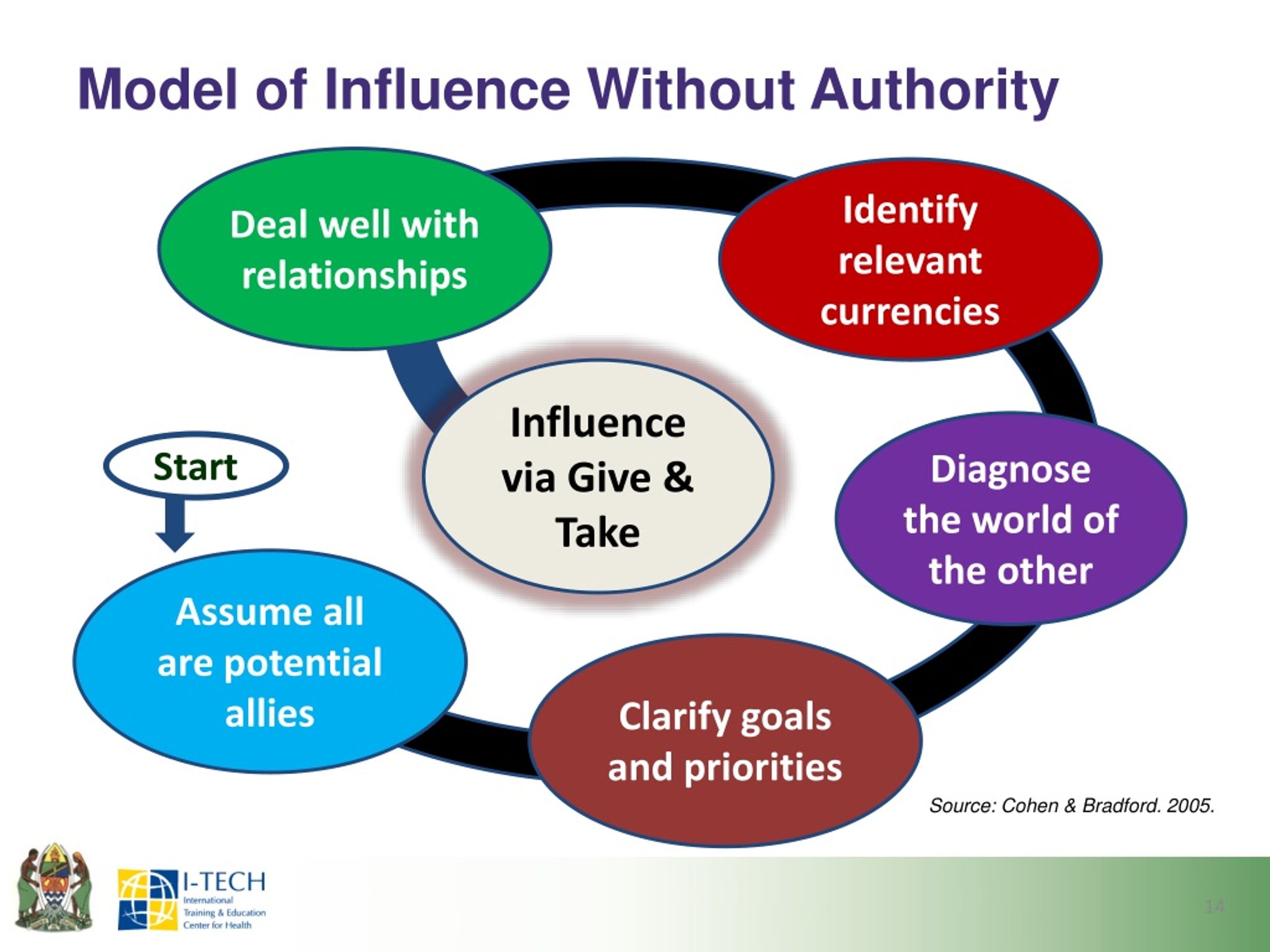
The image below shows a classic model of influence that centers on this same idea of understanding others and creating a "give and take" dynamic.
3. Frameworks and Tactics for Persuasion
Once you have a foundation of trust, you can employ specific frameworks and communication tactics to make your case persuasively.
The Trust Equation and the 3Cs
Let's return to the article on influencing without authority for two immediately applicable frameworks.
Influence Without Authority: How Senior Engineers Lead When ...
Let's continue with the same LinkedIn article to learn about the 'Trust Equation' and the '3Cs of Persuasive Communication.'
Read the sections titled 'Framework #1: The Trust Equation,' 'Framework #2: The 3Cs of Persuasive Communication,' 'Framework #4: Influence Up, Across, and Down,' 'Framework #6: The Influence Ladder,' and the 'Real-World Story' about Ravi. These sections provide a complete toolkit for diagnosing trust gaps, structuring your arguments, and tailoring your message to different audiences (executives, peers, juniors).
To summarize the key takeaways:
- Trust Equation: Is the pushback you're getting due to a gap in Credibility (they doubt your expertise), Clarity (they don't understand), or Connection (they don't feel safe with your idea)?
- 3Cs (Context, Contrast, Call to Action): Structure your pitch this way. "Here's where we are" (Context). "Here's the problem/opportunity" (Contrast). "Here's what we should do next" (Call to Action).
- Influence Ladder: If your pitch fails, are people stuck on Information (don't get it), Interpretation (don't see why it matters), or Incentive (what's in it for them)? The Ravi case study is a perfect example of closing an incentive gap by reframing tech debt as a direct benefit to the PM.
A Powerful Communication Tactic
Sometimes, influence comes down to a single, well-phrased question. Let's look at a powerful tactic for situations where you need a commitment from someone you don't manage.
Influence Without Authority: Leading When You're Not the Boss
This video from career coach Andrew LaCivita demonstrates a subtle but powerful shift in language that can transform a request into a collaborative problem-solving exercise.
Watch from 01:56 to 05:52. The key takeaway is the shift from asking 'Can you do this?' (a yes/no question) to asking 'What would it take to get this done?'. This re-frames the conversation, invites collaboration, and gives the other person a sense of agency while keeping the focus on the shared goal.
This tactic is incredibly useful when dealing with dependencies on other teams—a constant reality in senior backend roles.
4. Structuring Your Interview Story
Now, let's synthesize these concepts and package them into a compelling interview answer. You'll use the same CARL structure from our last lesson, but the "Actions" will be filled with the influence techniques we've just discussed.
Here is a template answer that shows what a concise, effective story looks like.
Behavioral Interview Mastery: STAR Answers for the 25 Most ...
This resource, 'Behavioral Interview Mastery,' provides a bank of common questions and sample answers. We'll look at the specific example for influencing without authority.
Read question #2, 'A time you led without authority.' Notice how the STAR answer is structured. The 'Action' section is a series of influence-based activities: organizing communication, creating alignment tools (RACI), and negotiating with stakeholders. The 'Result' is clear and demonstrates the success of these actions.
5. Exercise: Draft Your Influence Story
It's time to build your own story. Think back on your 10 years of experience. Find a situation where you had to persuade others to adopt your idea or change course.
Good scenarios often involve:
- Convincing a product manager to prioritize a major refactor or address tech debt.
- Persuading a sister team to change their API for a better system-wide design.
- Getting buy-in from your manager or director for a new technology or architectural pattern.
- Aligning multiple teams on a standardized process or tool.
Now, outline your story using the CARL framework.
- Context (Situation + Task): What was the business situation? Who did you need to influence, and why was it necessary? What was the initial resistance or inertia? (e.g., "Our team was blocked by a legacy service owned by the platform team, which had a different set of priorities.")
- Actions: This is the most critical part. Detail the steps you took, weaving in the concepts from this lesson.
- How did you build trust and connection? (e.g., "I scheduled a 1:1 with the other team's lead, not to make demands, but to understand their roadmap and pressures.")
- How did you frame your proposal? (e.g., "Instead of focusing on our team's pain, I used data to show how the legacy service's high latency was impacting the end-user experience, which was a shared company goal.")
- What specific communication did you use? (e.g., "I wrote a concise one-page document using the Context-Contrast-Call to Action format and presented it in their team meeting.")
- How did you create alignment? (e.g., "I proposed a phased approach, offering to have one of my team members help them with the initial migration to de-risk the effort for them.")
- Result: What was the outcome? Did they adopt your proposal? What was the business impact? (e.g., "The platform team agreed to prioritize the API change. After we implemented it, we reduced our p95 latency by 200ms and eliminated a whole class of race condition bugs.")
- Learnings: What did this experience teach you about influencing others? (e.g., "I learned that leading with empathy and aligning my proposal with the other team's incentives was far more effective than just presenting technical facts.")
Take 15-20 minutes to draft your bullet points for this story.
Conclusion
You now have a deep toolkit for both practicing and articulating influence. This skill is a hallmark of a senior engineer and a powerful signal to interviewers that you are a leader who can multiply the impact of your team and drive change across an organization.
Key Takeaways:
- Influence is about framing, not just facts. Connect your technical ideas to business impact and the goals of others.
- Build on a foundation of trust. Use the four pillars (Context, Breadth, Choice, Connection) to understand your audience and build relationships.
- Use structured communication. Frameworks like the 3Cs and tactical questions like "What would it take?" make your persuasion more effective.
- Weave these actions into your CARL story. Your interview answer should be a narrative of you strategically applying these principles to achieve a result.
Next Lesson Preview:
In our next lesson, we will explore another form of influence: "presenting examples of mentoring and growing other engineers." While today's lesson focused on influencing decisions, the next will focus on influencing people's growth and careers, another key expectation for senior talent.