Hello! Welcome to the final lesson in our module on interview execution.
In our last session, we focused on how to research a company's leadership principles and tailor your behavioral stories to them. This helps you speak the company's language and demonstrate your alignment with their culture. Today, we'll explore the other side of that coin: what you should be asking them.
This lesson is designed to help you ask insightful questions to interviewers that demonstrate senior-level thinking. For a candidate with your experience, the end of the interview isn't just a formality; it's a prime opportunity to solidify your position as a strategic thinker and a peer. The questions you ask signal what you value, how you think, and whether you're evaluating the opportunity with the same rigor they're using to evaluate you.
1. The Mindset Shift: From Interviewee to Mutual Evaluator
First, let's adjust our mindset. As a senior engineer with a decade of experience, you are not simply seeking a job. You are evaluating a potential long-term partnership. The interview is a two-way street. Your goal is not only to impress them but also to determine if the company, the team, and the role are the right fit for your skills and career ambitions.
Adopting a mindset of genuine curiosity can transform the dynamic from a stressful interrogation into a collaborative discussion.
Confessions from a Big Tech Hiring Manager: Tips for Software Engineering Interviews
In this video, 'Confessions from a Big Tech Hiring Manager', Gergely Orosz (The Pragmatic Engineer) discusses the mindset that successful candidates bring to interviews.
Please watch two key segments: From 07:59 to 11:46: Pay attention to the idea of treating the interview as a learning opportunity. Notice how curiosity changes the dynamic and how much interviewers value it. From 16:18 to 17:32: This part emphasizes that interviews are a 'two-way street'. It encourages you to ask honest questions about things that matter to you, like culture and work-life balance.
By approaching the interview with a desire to learn, you naturally start asking better questions, which signals confidence and a deeper level of engagement.
2. What Makes a Question "Senior-Level"?
At the end of an interview, you'll almost always hear, "So, what questions do you have for me?" A junior candidate might ask about the tech stack or perks. A senior candidate's questions should reflect a broader, more strategic perspective.
A generic question like, "What's a typical day like?" provides little value for you and signals a lack of preparation to the interviewer. In contrast, an insightful question demonstrates:
- Preparation: You've done your research on the company and its products.
- Strategic Thinking: You're thinking about business impact, team growth, and long-term challenges.
- Experience: You know what it takes to build and maintain complex systems and healthy teams.
Let's hear directly from an ex-Meta hiring committee member about the kinds of questions that make a candidate stand out.
Behavioral Interview Discussion with Ex-Meta Hiring Committee Member
In this segment from 'Behavioral Interview Discussion with Ex-Meta Hiring Committee Member', you'll learn what types of questions hiring managers appreciate.
Watch the clip from 36:41 to 39:13. The speaker contrasts low-value questions ('day in the life') with high-value questions about product direction, technology choices, and management style. Notice the advice on preparing multiple questions, especially for team-matching phases.
The key takeaway is that your questions should open a discussion about topics that matter for long-term success: strategy, technology evolution, team dynamics, and personal growth.
3. A Framework for "Reverse Interviewing"
To ask these kinds of questions systematically, you can use a technique called "reverse interviewing." This is the process of formally preparing to interview the company.
Reverse Interviewing—How to interview a company
The article 'Reverse Interviewing' from Adam Fishman's newsletter provides a fantastic framework for this process. It explains why it's important and how to prepare.
First, read the introduction and the section 'What is Reverse Interviewing?' to understand the concept. Then, read 'How to plan, structure and prepare questions'. The key idea here is to work from the inside out: start by identifying your own 'non-negotiables' and what you value, then group your questions into themes like Culture, Strategy, and Role. This structured approach will ensure you get the information you need while also signaling your own clarity and purpose.
The article suggests a powerful exercise: reflect on your past experiences to define what you truly want and need in your next role. Since you have 10 years of experience, you have a rich set of data points to draw from. Ask yourself:
- When was I most fulfilled in my work, and why?
- What kind of team culture helps me do my best work?
- What are my non-negotiable red flags? (e.g., lack of testing culture, on-call burnout)
Answering these questions for yourself is the foundation for crafting questions that are not only impressive but genuinely useful for your decision.
4. Your Senior Engineer Question Toolkit
Once you have your themes, you can build a toolkit of insightful questions. You won't ask all of them, but you should have them ready and choose the most relevant ones based on the interviewer (peer engineer, hiring manager, director) and the flow of the conversation.
Here is a curated list of powerful questions, drawn from the resources, that demonstrate senior-level thinking.
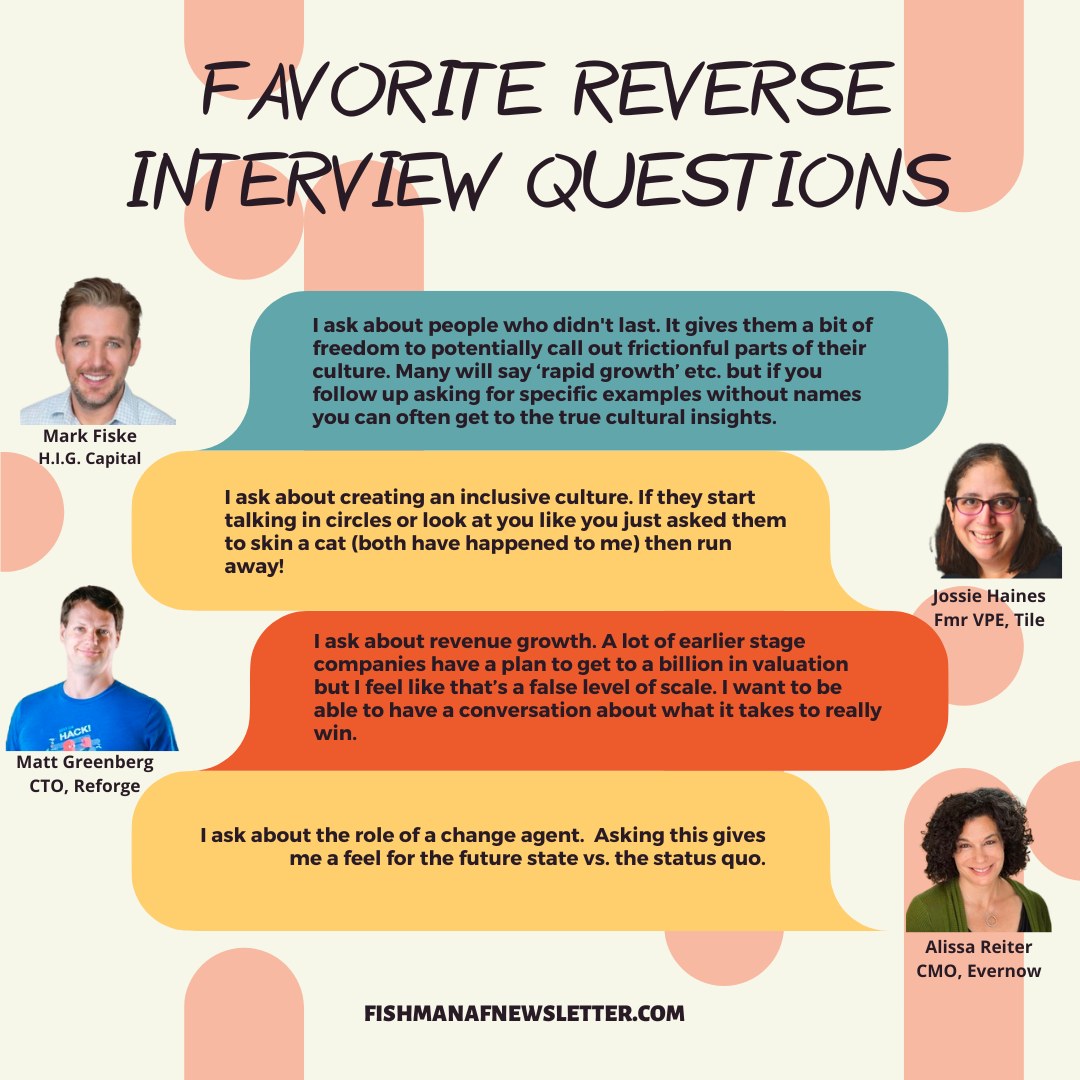
Let's expand on this with more examples, categorized by theme.
Reverse Interviewing—How to interview a company
The 'Reverse Interviewing' article provides an excellent, curated list of questions from various tech leaders.
Please review the lists of questions under the headings Culture, Strategy, Role & Expectations, Goal-setting, and Communication. Pick one or two from each category that particularly resonate with you.
To supplement this, here are more questions tailored to a senior backend engineer, drawn from the Tech Interview Handbook.
- On Technical Strategy & Engineering Excellence:
- "What is the biggest technical challenge the team is facing right now?"
- "How does the team handle technical debt? Is there a formal process for addressing it?"
- "Could you tell me about the process for major architectural changes? How are those decisions made and socialized?"
- On Role & Impact:
- "What would success look like for me in this role in the first 6-12 months?"
- "What is the typical career progression for a senior engineer on this team? What opportunities are there for mentorship and leadership?"
- "Why would someone fail in this role?" (A bold but very insightful question).
- On Team & Company Culture:
- "How does the team handle disagreements on technical or product direction?"
- "What are the characteristics of the most successful engineers at this company/on this team?"
- "What was the last major failure or outage, and what did the team learn from the post-mortem?"
5. When and How to Ask
The delivery of your questions is as important as the questions themselves.
1. Make it a Conversation:
Don't wait until the final five minutes to unload a list of questions. The best interviews feel like a natural conversation. If an interviewer mentions a recent project, it's a perfect opportunity to ask a follow-up question.
Confessions from a Big Tech Hiring Manager: Tips for Software Engineering Interviews
Let's revisit the 'Confessions from a Big Tech Hiring Manager' video for a great tip on conversational questioning.
Watch the short segment from 15:31 to 16:18. The speaker highlights how candidates who ask questions during the interview stand out. He gives a specific example of turning a question about testing back on the interviewer. This shows curiosity and turns the interview into a true dialogue.
2. Dig Deeper:
When you ask a question, don't settle for a generic, high-level answer. A key senior skill is the ability to probe for specifics.
Reverse Interviewing—How to interview a company
The 'Reverse Interviewing' article has a crucial piece of advice on how to follow up on your questions.
Read the short section titled 'A note on how to ask these questions'. The key is to ask for specific examples. If an interviewer says 'we value transparency,' you can follow up with, 'That's great to hear. Could you give me a recent example of how the team or leadership practiced transparency during a difficult situation?'
If they can't provide a concrete example, that's valuable information for you.
Exercise: Build Your Question Toolkit
It's time to prepare your own set of questions. Based on your career goals and what you've learned, create a list of 5-7 questions you could ask in your upcoming interviews.
- Categorize them: Group your questions by theme (e.g., Technical, Role, Culture, Strategy).
- Tailor them: For each question, note whether it's best for a peer engineer, a hiring manager, or a senior leader (Director/VP).
Example:
- Theme: Technical Strategy
- Question: "Looking at the system's architecture, what are you most proud of, and what part are you most looking to evolve or refactor in the next year?"
- Target: Hiring Manager or Senior IC on the team.
Take 15 minutes to build your list. This toolkit will be an invaluable asset you can bring to every interview.
Conclusion
Asking thoughtful questions is one of the most effective ways to demonstrate your seniority and experience. It proves you're not just looking for a place to code; you're looking for a place to make a significant impact, and you have the foresight to know what conditions are necessary for that to happen.
Key Takeaways:
- Adopt a "two-way street" mindset: You are interviewing the company as much as they are interviewing you.
- Ask questions that signal strategic thinking: Focus on culture, strategy, technical evolution, and role expectations.
- Prepare a structured toolkit of questions: Base them on your personal career non-negotiables and the specifics of the role.
- Turn the interview into a conversation: Weave your questions in naturally and ask for specific examples to get past generic answers.
Next Lesson Preview:
This concludes our module on behavioral interviews and interview execution. You now have a comprehensive framework for structuring your stories, tailoring them to company values, and engaging interviewers with insightful questions.
In our next lesson, we will transition to the technical side of your preparation, beginning with Module 1: System Design Interview Fundamentals. We'll start by breaking down the typical structure of a system design interview and establishing a systematic framework to solve any design problem you might face.