Hello! Let's dive into our next lesson in the Data Storage and Database Design module.
In our last session, we established a framework for choosing between SQL and NoSQL databases, focusing on high-level trade-offs related to data structure, query patterns, scale, and consistency. We concluded that your choice of database is just the first step. Today, we'll build directly on that foundation.
The learning outcome for this lesson is to compare schema design principles for read-heavy vs. write-heavy workloads. This is a crucial topic for a senior engineer because it moves beyond simply picking a tool and into the nuanced art of how to use that tool effectively. Your ability to articulate the trade-offs between optimizing for reads versus writes demonstrates a deep understanding of system performance and scalability.
1. The Fundamental Trade-off: Read Speed vs. Data Integrity
At the heart of schema design lies a fundamental conflict: do you optimize for fast data retrieval (reads) or for efficient data modification and consistency (writes)? The way you structure your data will almost always favor one over the other.
The two key concepts that represent this trade-off are normalization and denormalization.
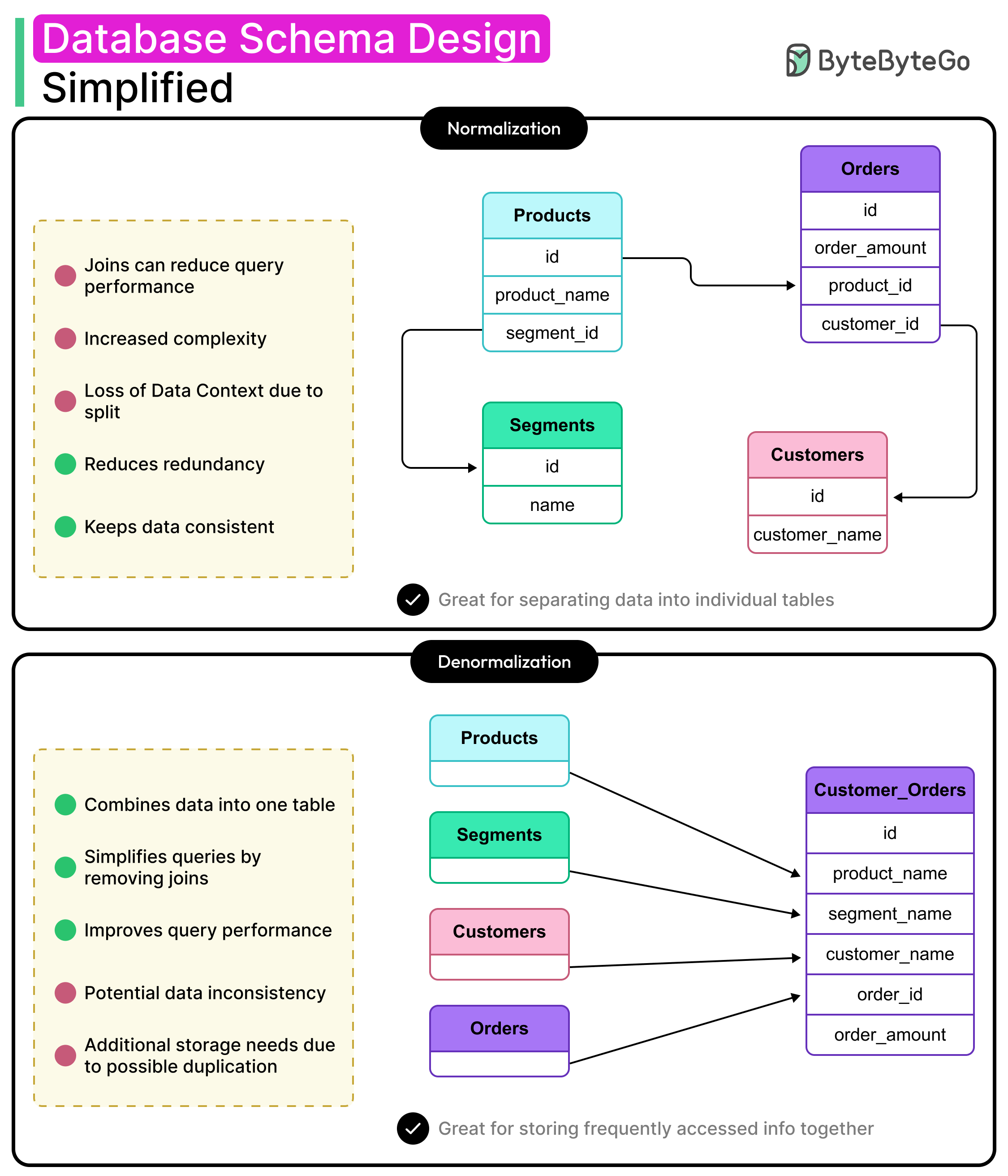
- Normalization: The process of organizing data to minimize redundancy. Each piece of information is stored in exactly one place. The primary goals are to ensure data integrity and save storage space.
- Denormalization: The process of deliberately adding redundant data to one or more tables. The primary goal is to improve read performance by avoiding costly joins.
As a backend engineer with a decade of experience, you've likely navigated this trade-off implicitly. Today, we'll formalize these concepts into a framework you can use to justify your design decisions in an interview.
This image provides a great visual summary of the two approaches.
Now, let's explore how these principles apply to specific workload types.
2. Designing for Read-Heavy Workloads
A read-heavy system is one where the number of read operations vastly outnumbers write operations. Think of a news website, a social media feed, or a product catalog. The primary goal is to serve data to users as quickly as possible.
To achieve this, you need to minimize the work the database does for each read request.
8 Most Important System Design Concepts You Should Know
Let's start with a quick overview of the challenge posed by high read volumes and the primary solution, from the ByteByteGo channel.
Watch the segment from 00:14 to 01:09. Notice how caching is presented as the go-to solution for read-heavy systems. We'll see how denormalization is a way of creating data structures that are perfectly suited for caching.
As the video suggests, speed is paramount. The main techniques to optimize for reads revolve around pre-calculating or pre-joining data so that it's ready to be served instantly.
Key Techniques for Read-Heavy Schemas:
-
Denormalization: This is the most powerful schema-level technique for read optimization. By duplicating data, you eliminate the need for
JOINoperations at query time, which are often a major source of latency. -
Indexing: Before you jump to denormalization, always consider indexing. An index is a data structure that improves the speed of data retrieval operations on a database table at the cost of additional writes and storage space. It's your first and most important tool for speeding up common queries. We will have a dedicated lesson on this topic soon.
-
Pre-aggregated Data & Materialized Views: For analytics and reporting dashboards, it's inefficient to calculate sums, averages, or counts from raw data on every page load. Instead, you can pre-calculate these values and store them in separate summary tables or materialized views.
The following resource provides an excellent, detailed comparison of normalization and denormalization, including a benchmark test that shows the dramatic impact on query performance.
Normalize vs. Denormalize Database: Key Differences
This article from SolarWinds provides a fantastic deep dive into the practical differences between normalized and denormalized databases. It includes clear examples and performance data.
Please read two sections from this article: 'Query performance and complexity': Pay close attention to the SQL examples and the benchmark table. It perfectly illustrates how an indexed, denormalized query can outperform a normalized one requiring joins. 'Data redundancy and storage efficiency': This section clarifies the storage trade-off you make when you denormalize for performance.
In summary, for read-heavy systems, your design mantra is: do the work upfront to make reads cheap. This might mean more complex write logic and higher storage costs, but it's a necessary trade-off for performance.
3. Designing for Write-Heavy Workloads
A write-heavy system is one that handles a massive volume of incoming data. Examples include logging systems, IoT sensor data ingestion, or event tracking for analytics. Here, the primary goal is to ingest data as quickly and reliably as possible without dropping any information.
8 Most Important System Design Concepts You Should Know
Now let's look at the opposite problem: handling massive amounts of writes. This video clip concisely explains the core strategies.
Watch the segment from 01:09 to 02:06. Note the two main approaches discussed: asynchronous writes using message queues, and using databases specifically designed for fast writes (LSM-Tree based).
The strategies for write-heavy systems are focused on making the write operation itself as fast as possible, often by deferring complex processing.
Key Techniques for Write-Heavy Schemas:
-
Normalization: Counter-intuitively, a normalized schema is often better for write performance. When you insert or update data, you only need to touch one specific table and row. In a denormalized schema, a single logical update might require updating multiple rows or documents, leading to slower writes and the risk of inconsistency.
-
Asynchronous Processing: As the video mentioned, a common pattern is to not write directly to the database. Instead, the application writes the event to a high-throughput message queue (like Kafka or RabbitMQ). Worker processes then consume from this queue and write to the database in a controlled, batched manner. This makes the initial write from the user's perspective feel instantaneous.
-
Choosing the Right Database: Some database technologies are built from the ground up for high write throughput. Wide-column stores like Apache Cassandra or ScyllaDB use a Log-Structured Merge-Tree (LSM-Tree) storage engine that is optimized for appends, making writes extremely fast.
Data Modeling in System Design Interviews w/ Meta Staff Engineer
Let's revisit the data modeling video from our last lesson. The speaker gives a great explanation of why wide-column databases are so well-suited for write-heavy scenarios.
Watch the segment from 11:18 to 13:30. Focus on the core idea: writes are fast because you are always just appending new data, not updating existing data in place.
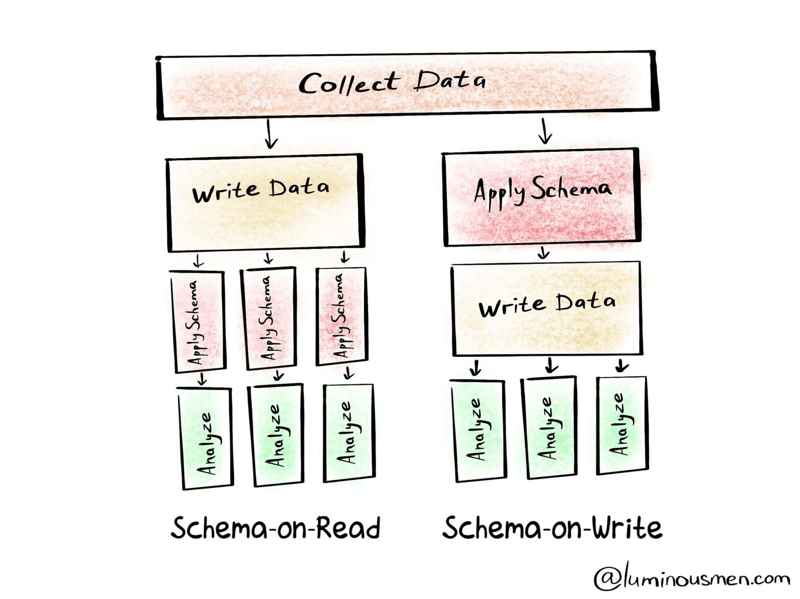
- Schema-on-Read: In many write-heavy systems, especially for analytics or logging, the structure of the incoming data might not be fully known or could change over time. Instead of enforcing a strict schema on write (Schema-on-Write), you can just dump the raw data (e.g., as a JSON blob) and apply a schema only when you need to read and analyze it. This makes the ingestion process very fast and flexible.
4. A Comparative Framework
To succeed in an interview, you need to be able to clearly and concisely articulate the trade-offs.
Normalize vs. Denormalize Database: Key Differences
The article we looked at earlier contains a fantastic summary table comparing normalization and denormalization across several key dimensions. This is an excellent study guide.
First, review the main comparison table at the beginning of the article. Then, read the 'Use cases' section, which provides concrete examples of systems where you would apply each approach. This will help you connect the theory to real-world problems.
Here's a summary of the key decision points:
| Consideration | Read-Heavy (Prioritize Speed) | Write-Heavy (Prioritize Integrity/Throughput) |
|---|---|---|
| Primary Goal | Fast data retrieval, low latency. | Fast data ingestion, high throughput, data consistency. |
| Key Schema Strategy | Denormalization. Duplicate data to avoid joins. | Normalization. Store data in one place to speed up writes and avoid anomalies. |
| Query Complexity | Simple. SELECT from a single (wide) table. |
Can be complex. Often requires JOINs to assemble data. |
| Write Performance | Slower. A single update may require changing data in multiple places. | Faster. A write operation touches a single, small table. |
| Data Integrity | Harder to maintain. Risk of inconsistency if updates are not handled carefully. | Easier to maintain. Single source of truth for each piece of data. |
| Storage | Higher. Redundant data takes up more space. | Lower. Minimal data duplication. |
| Typical Use Cases | Social media feeds, BI dashboards, product catalogs. | Banking systems, inventory management, logging services. |
Conclusion
You now have a structured way to think about and discuss schema design based on system workloads. This level of analysis is exactly what interviewers at top companies expect from a senior engineer. You're not just stating facts; you're evaluating trade-offs and making reasoned decisions based on requirements.
Key Takeaways:
- Schema design is a trade-off between read performance and write performance/data integrity.
- Read-heavy systems benefit from denormalization, pre-aggregation, and caching to make queries faster by avoiding
JOINs. The cost is higher storage and more complex write logic. - Write-heavy systems benefit from normalization to ensure fast, consistent writes. They often use patterns like message queues for asynchronous processing and may leverage specialized databases like wide-column stores.
- Always frame your choice in the context of the system's specific access patterns. There is no single "best" approach; it always depends on the requirements.
In this lesson, we frequently mentioned indexing as a critical tool for performance. In our next session, we will do a deep dive and explain database indexing strategies and their performance implications, exploring how indexes work under the hood and how to choose the right type of index for your queries.