Hello! Welcome to your next lesson on building resilient systems.
In our last lesson, we focused on health checks, which are the sensory system of a distributed application—they tell us when a service is unhealthy. This immediately raises the next logical question: what should happen when a service's dependencies are unhealthy?
If a client service continuously retries calls to a failing downstream service, it not only wastes its own resources (like threads and memory) but also risks overwhelming the struggling service, preventing it from recovering. This can trigger a domino effect, known as a cascading failure, where one service failure brings down an entire chain of dependent services.
Today's lesson addresses this precise problem. Your learning outcome is to apply the circuit breaker pattern to prevent cascading failures. This is a cornerstone resilience pattern and a common topic in senior backend engineering interviews, where you're expected to discuss system robustness and fault tolerance.
We will cover:
- The core concept of the Circuit Breaker pattern and its three states.
- How it prevents cascading failures by "failing fast."
- Practical implementation considerations and configuration.
- Crucial trade-offs and when not to use this pattern—a key discussion point for senior roles.
1. Understanding Cascading Failures
Before we dive into the solution, let's solidify our understanding of the problem. A cascading failure is a chain reaction of failures in a distributed system.
Imagine a microservices architecture for an e-commerce site:
Order ServicecallsPayment Service.Payment ServicecallsFraud-Check Service.
If the Fraud-Check Service becomes slow or unresponsive, the Payment Service's requests will start timing out. Its connection pool and threads will get exhausted waiting for responses. Soon, the Payment Service itself becomes unresponsive. Now, the Order Service, which depends on the Payment Service, also starts failing. The failure has cascaded upstream.
This video provides a great visual explanation of this problem.
Introduction to circuit breaker in microservices (for beginners)
This clip from the video 'Introduction to circuit breaker in microservices' effectively illustrates how a single point of failure can trigger a cascading failure across multiple services.
Please watch from 01:49 to 03:24. Focus on how the failure of one service's database impacts the entire call chain.
2. The Solution: The Circuit Breaker Pattern
The Circuit Breaker pattern prevents this chain reaction. The name is an analogy to a real-world electrical circuit breaker. When an electrical circuit is overloaded, the breaker "trips" (opens) to stop the flow of electricity and prevent damage.
In software, a circuit breaker acts as a proxy for operations that might fail, like network calls to another service. It monitors for failures and, if they reach a certain threshold, it "trips" and stops any further requests from being made for a set period. This has two key benefits:
- Fail Fast: The client service gets an immediate failure without waiting for a timeout, freeing up its resources.
- Allow Recovery: The struggling downstream service is given a "breathing room" to recover without being hammered by constant requests.
A circuit breaker operates in three distinct states.
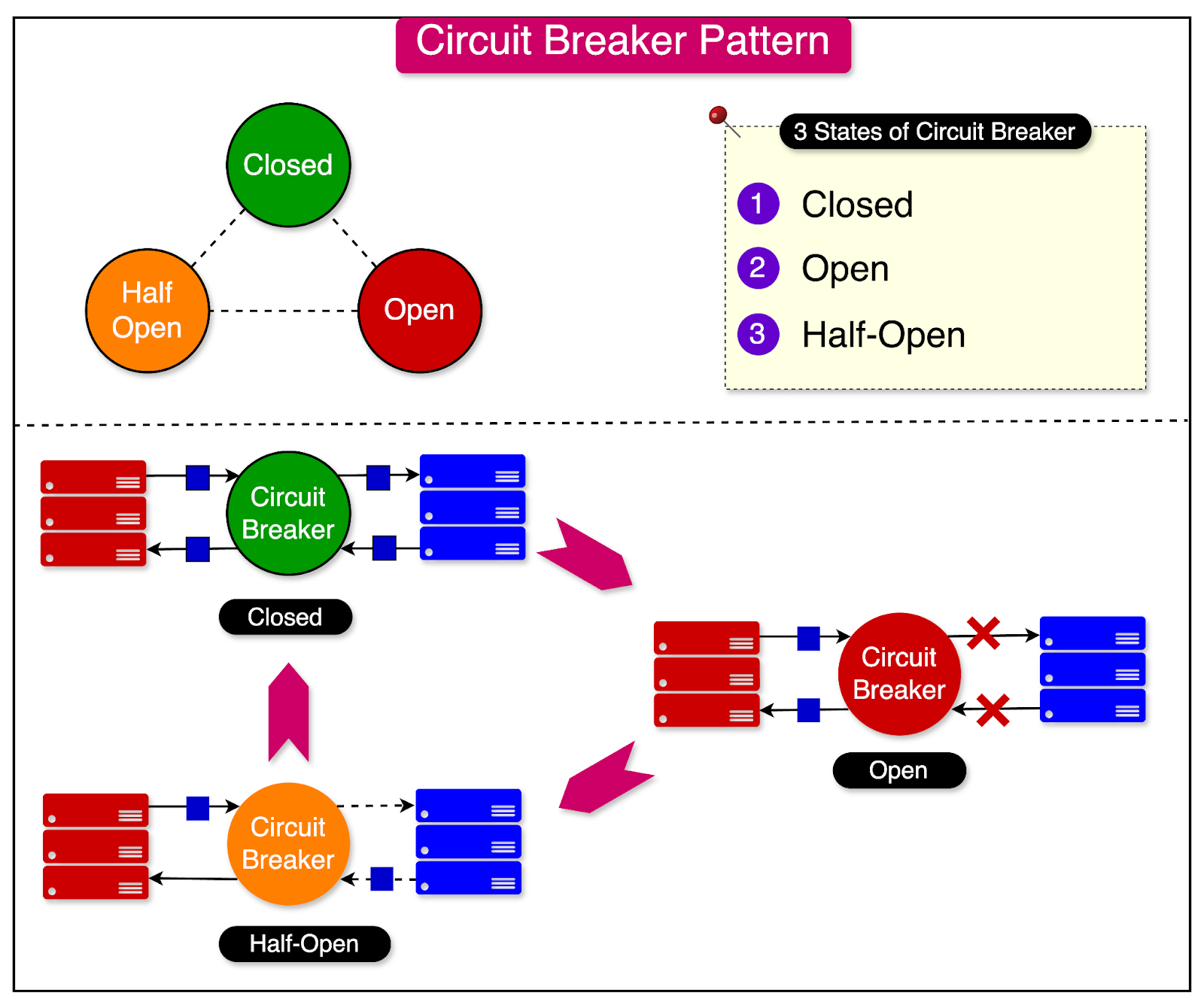
Let's define these states:
-
Closed: This is the default, normal state. All requests are passed through to the downstream service. The breaker monitors the number of failures. If the failure count exceeds a configured threshold within a time period, the breaker trips and moves to the Open state.
-
Open: In this state, the breaker immediately rejects all requests without attempting to call the downstream service. This is the "fail-fast" behavior. After a configured timeout period, the breaker moves to the Half-Open state.
-
Half-Open: The breaker is "cautiously optimistic." It allows a limited number of "probe" requests to pass through to the downstream service.
- If these probe requests succeed, the breaker assumes the service has recovered and transitions back to the Closed state.
- If any probe request fails, the breaker trips again and returns to the Open state, starting the timeout again.
3. How It Works: State Transitions and Implementation
Understanding the state machine is key to applying the pattern. Let's watch a video that walks through the state transitions and provides pseudocode for the logic in each state.
Introduction to circuit breaker in microservices (for beginners)
This video, again from sudoCODE, explains the state machine and provides pseudocode that clarifies the logic for transitioning between states.
Please watch from 04:07 to 07:37. Focus on: The visualization of how calls are handled in each state (Closed, Open, Half-Open). The state machine diagram showing the transitions. The pseudocode, which describes the counters and logic for each state.
From Theory to Practice
As a backend engineer, it's helpful to see how this is implemented. You would rarely build a circuit breaker from scratch; instead, you'd use a well-tested library. For a Java ecosystem, Resilience4j is a popular choice (it replaced Netflix's Hystrix).
The following article provides a clear explanation and a practical code example.
Circuit Breaker Design Pattern in Microservices
This LinkedIn article by Er Deepak Kumar Kesharwani provides a fantastic, concise overview, including a Java code example using the Resilience4j library.
Read the sections 'States of a Circuit Breaker' and 'Simple Java Example (Resilience4j)'. The code snippet demonstrates how to configure and apply a circuit breaker to a function call. Notice how configurable parameters like failureRateThreshold and waitDurationInOpenState directly map to the concepts we've discussed.
4. Senior-Level Discussion: Trade-offs and Nuances
In an interview, you'll be expected to go beyond the basic definition. The real discussion for a senior role lies in the trade-offs, design considerations, and knowing when not to use the pattern.
Fallback Strategies
When the circuit is open, what should your service do?
- Fail Fast: Simply return an error to the caller immediately.
- Return a Fallback Response: Provide a default response, such as data from a cache or a simplified, static response. For example, if a "personalized recommendations" service is down, you could fall back to showing "top 10 most popular items."
- Queue for Later: For non-critical operations, you could place the request in a queue to be processed later when the downstream service recovers.
Circuit Breakers vs. Other Resilience Patterns
A circuit breaker is part of a larger toolkit. It's often used in conjunction with:
- Timeouts: To prevent a single call from hanging indefinitely. A timeout is the first line of defense.
- Retries: To handle transient, intermittent failures. A common pattern is to retry a few times with exponential backoff. If retries consistently fail, that's a signal for the circuit breaker to trip.
When NOT to Use a Circuit Breaker
This is a critical point to raise in an interview. The pattern is not a silver bullet.
Circuit Breaker Trade Offs: When Not to Use Them
This article from System Overflow focuses specifically on the limitations and trade-offs, which is excellent material for a senior-level discussion.
Read the entire article, paying close attention to the three main scenarios where circuit breakers are inappropriate: When failures are expected (e.g., business logic errors like 'insufficient funds'). When fallbacks are impossible (atomic transactions). When ultra-low latency is paramount.
To summarize, avoid circuit breakers for:
- Business Logic Errors: A
400 Bad Requestis not a system failure. The circuit breaker should only monitor for unexpected infrastructure or service failures (e.g.,5xxerrors, timeouts). - Atomic Transactions: For operations that must either fully complete or not at all (like a financial transaction), a partially completed operation is often worse than a total failure. A circuit breaker could prevent the completion part of the transaction.
- Access to Local Resources: Using a circuit breaker for in-process communication is usually overkill.
Interview-Ready Insights
The LinkedIn article we looked at earlier also contains an excellent list of potential interview questions. Let's consider one:
"How do you tune the threshold values (failure rate, timeout, etc.) in a real-world system?"
This is a great question because the answer is "it depends."
- Failure Rate Threshold: Too low, and the breaker trips on minor hiccups. Too high, and it reacts too late. You need to baseline the normal error rate of the service.
- Open State Timeout (Cool-down period): This depends on the expected recovery time of the dependency. Too short, and you risk a "thundering herd" by probing a service that hasn't recovered. Too long, and you increase the duration of the outage.
- The Best Approach: In a mature system, these values are not static. They are dynamically configured and tuned based on live telemetry and observability data. Mentioning dynamic configuration and A/B testing different thresholds demonstrates senior-level experience.
Conclusion
You can now articulate how the Circuit Breaker pattern acts as a crucial defense mechanism in a distributed system. By failing fast and giving downstream services room to recover, it prevents localized failures from escalating into system-wide outages.
Key Takeaways:
- Core Purpose: Prevent cascading failures by isolating failing dependencies.
- Mechanism: It operates as a state machine with three states: Closed, Open, and Half-Open.
- Benefits: Provides fail-fast behavior for clients and allows failing services to recover.
- Implementation: Use robust libraries (e.g., Resilience4j) and focus on tuning key parameters like failure thresholds and timeouts.
- Senior-Level Nuance: A circuit breaker is one tool in a resilience toolkit. Knowing its trade-offs and when not to apply it is as important as knowing how it works. Discussing fallbacks and dynamic tuning shows advanced understanding.
Next Lesson Preview:
We have now covered several core infrastructure components related to service communication and reliability (API gateways, health checks, circuit breakers). In the next lesson, we will shift our focus to a different kind of fundamental component: storage. We will start by exploring blob/object storage systems and their use cases, a foundational element for handling unstructured data at scale.