Hello! Welcome back to our final module, "Communicating Neuromarketing Insights."
In our last lesson, we established a powerful three-step framework—Soften, Relate, and Summarize—for translating complex scientific concepts into clear, actionable explanations for business stakeholders. We saw how this structure helps break down communication walls and makes your insights resonate.
Today, we're going to zoom in on the heart of that framework: the "Relate" step. Your ability to create a compelling analogy or metaphor is perhaps the single most effective tool for making the invisible workings of the brain feel tangible and intuitive. For your goal of communicating neuromarketing to any audience, mastering this skill is non-negotiable.
This lesson is designed to help you create a simple analogy or metaphor to explain a brain function to a non-scientist. We will build a practical "toolkit" of analogies for the brain structures most relevant to marketing, so you can explain them vividly and persuasively in any professional setting.
1. The Art of a Good Analogy
Before we start collecting analogies, it's crucial to understand what makes one effective. A weak or confusing analogy can do more harm than good. The key principle is that an analogy is not for you; it's for your audience. It must connect an abstract idea to a concept that is already concrete and familiar in their world.
Let's explore these foundational principles.
Gain mastery of the analogy II
The article 'Gain mastery of the analogy II' by communications expert Anthony Sanni provides an excellent guide on how to choose and craft analogies that persuade. It emphasizes that the audience is the most important factor.
Please read the sections titled 'The most important factor: The Audience', 'Familiarity leads to acceptability', 'General beats specific', the various themes listed (like Cooking, Transportation, The human body), and the final section, 'The Key Question'. Focus on the core message: an analogy's power comes from its familiarity to the listener.
The article gives us a clear set of rules for building effective analogies:
- Audience First: Your choice is dictated entirely by what your audience knows and cares about. An analogy about software development might work for a tech startup, but an analogy about gardening might work better for a different group.
- Familiarity is Key: An analogy works by transferring understanding from a familiar concept (the 'source') to an unfamiliar one (the 'target'). If the source is also unfamiliar, the analogy fails.
- Ask "What is this like?": This simple question is the engine of creativity. When faced with a complex brain function, start by asking yourself what it resembles in everyday life.
2. A Portable Model of the Brain
To talk about the brain's parts, it helps to first have a map. One of the most effective ways to learn and teach the brain's layout is by using a physical analogy that you always have with you: your hands.
Memorize the Brain Without Studying
In this brilliant video, 'Memorize the Brain Without Studying,' psychologist Dr. Ali Mattu demonstrates how to use your hands to create a portable, memorable model of the brain and its major parts. This is a powerful communication tool in itself.
Watch the entire video. As you watch, physically follow along with your own hands to create the model. Notice how he uses this physical analogy to explain the location and function of the cortex, brain lobes, and deeper structures like the amygdala and hippocampus.
This hand model is an excellent example of a multi-layered analogy. It not only represents the physical structure but also provides a kinesthetic way to remember the functions, which you can easily use when explaining these concepts to others.
3. Your Toolkit of Brain Analogies
Now, let's build your go-to toolkit of analogies for the brain functions most critical to marketing and consumer behavior.
The Prefrontal Cortex (PFC): The Brain's CEO
The PFC is responsible for our most advanced cognitive abilities: rational thinking, long-term planning, willpower, and regulating emotions. Given your background in business, this first analogy should be particularly intuitive.
Unlocking the Neuroscience of Leadership
The article 'Unlocking the Neuroscience of Leadership' frames the Prefrontal Cortex in a business context, which is perfect for our purposes.
Please read the section 'The Prefrontal Cortex: The CEO of Your Brain.' Pay attention to how it aligns the PFC's functions—judgment, strategy, and emotional regulation—with the responsibilities of a chief executive.
- The Analogy: The Brain's CEO. Just like a CEO, the PFC analyzes data, sets long-term strategy, overrides short-sighted impulses from other "departments" (like the emotional amygdala), and makes reasoned decisions. When you explain to a client why consumers need a logical reason to justify an emotional purchase, you can say, "We need to give their inner CEO the data it needs to sign off on the deal."
The Limbic System: The Emotional Core
Deep inside the brain, the limbic system is the source of our emotions and a key player in memory formation. We'll focus on two of its most famous components: the amygdala and the hippocampus. A brief video will introduce them.
Emotions and the Brain: What is the limbic system?
To understand the parts of the emotional brain, let's watch a few short clips from the video 'Emotions and the Brain' by Science ABC.
Please watch the segment describing the amygdala (starting at 02:15) and the hippocampus (starting at 03:35). The video uses its own simple analogies for these structures.
1. The Amygdala
The amygdala acts as the brain's rapid-response emotional processing center, especially for threats, but also for other strong emotions like pleasure.
- Analogy 1: The Threat Detector / Smoke Alarm. This is its most famous role. The amygdala is constantly scanning for danger. Like a smoke alarm, it's fast, automatic, and values speed over accuracy—it's better to have a false alarm (getting startled by a coat rack in a dark room) than to miss a real fire. In marketing, this explains why fear-based messaging or surprising visuals can so powerfully grab attention.
- Analogy 2: The Emotional Sentinel. Drawing from the Vistage article again ("Unlocking the Neuroscience of Leadership", which you can refer back to), this frames the amygdala as a guard, constantly on watch, deciding what is emotionally important enough to pay attention to.
- Analogy 3: The Emotional Highlighter. This is my favorite for marketing. Think of the amygdala as holding a fluorescent highlighter. As you experience the world, it highlights moments of high emotion (fear, joy, surprise). These highlighted moments are a signal to the hippocampus, saying, "This is important! Remember this!" This is why emotional ads are so much more memorable.
2. The Hippocampus
The hippocampus is crucial for converting our immediate, short-term experiences into lasting long-term memories.
- Analogy: The Memory Librarian or Scrapbooker. Following the "highlighter" analogy, the hippocampus is the librarian who receives the highlighted experiences from the amygdala. It then carefully catalogs these moments and files them away into the vast library of long-term memory. Without the hippocampus, we couldn't form new conscious memories of facts or events, essentially living in a permanent present. For branding, the goal is to have the hippocampus file away positive brand experiences into the customer's life story.
The Reward System (Dopamine Pathways)
This system is not about happiness or pleasure itself, but about motivation and anticipation. It's the "I want" system, not the "I like" system.
- Analogy: The Engine of Desire. Dopamine is the fuel that drives you to seek a reward. It's the feeling of anticipation you get when you see a delicious-looking cake, not the feeling of eating it. A great modern example is the notification alert on your phone. The 'ping' itself isn't the reward; it's the dopamine-driven anticipation of what the message might be that creates the powerful, almost irresistible urge to check your phone. Marketers trigger this system by promising a future reward.
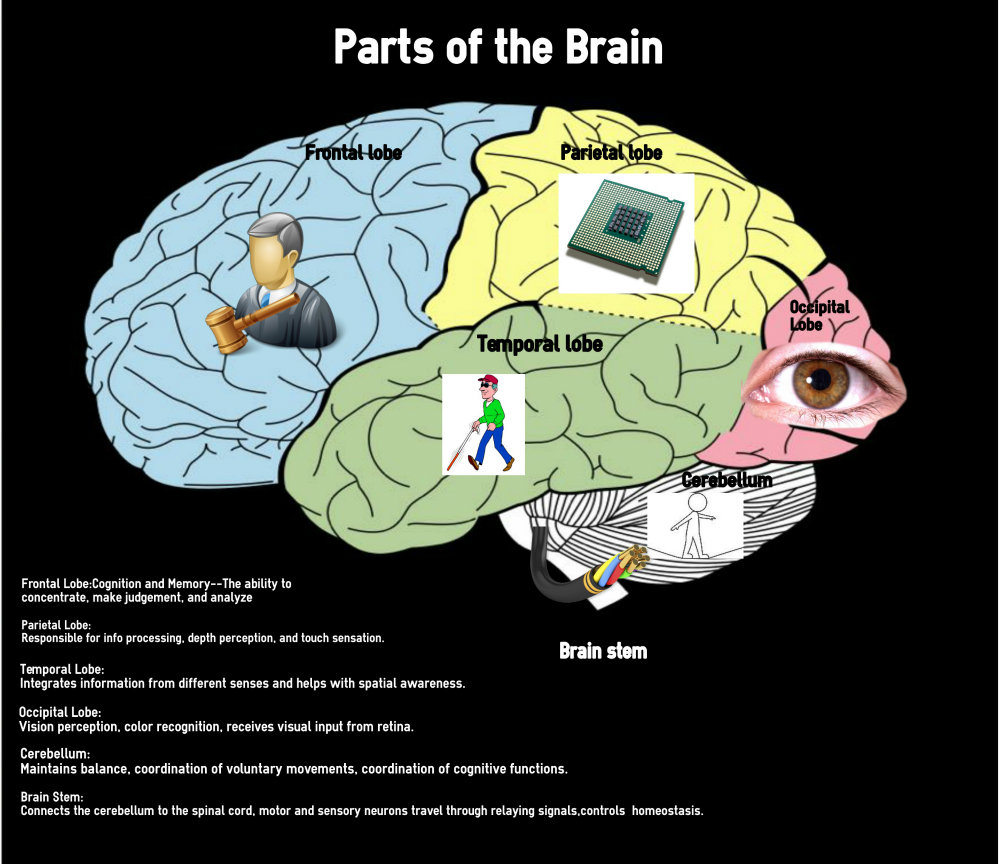
This infographic provides a nice visual summary, using simple icons as metaphors for the function of each brain lobe.
Test your understanding!
Now it's your turn to practice.
Scenario: You are in a sales meeting. Your client is launching a new luxury perfume. You want to explain why scent is such a powerful tool for creating an immediate, emotional connection with a consumer. Your explanation should focus on the olfactory bulb's unique neural pathway. (Hint: As we learned in a previous module, smell is the only sense that bypasses the thalamus—the brain's main 'relay center'—and has a direct line to the amygdala and hippocampus).
Your task: Create a simple analogy to explain this direct connection to a non-scientist client.
Show answer
Here's one possible approach:
"Think of the brain as a major corporation's headquarters. Most incoming information—everything we see, hear, and touch—has to go through the main reception desk, the thalamus, to be sorted and redirected. But scent is different. It has a VIP security pass. It bypasses reception and takes a private elevator straight to the executive suite, where the centers for emotion (the amygdala) and memory (the hippocampus) are located. This is why a single whiff of a scent can trigger a powerful emotion or a vivid memory instantly, before you've even had a chance to think about it. Our goal is to make this new perfume's scent a positive, VIP message straight to your customer's emotional core."
Conclusion
You now have a foundational toolkit of analogies to explain the brain's most important functions in a way that is intuitive, memorable, and persuasive. By translating complex neuroscience into familiar concepts, you bridge the gap between science and strategy, empowering your clients and colleagues to make smarter, brain-aware decisions.
Key Takeaways:
- Analogies are bridges: They connect the unfamiliar territory of the brain to the familiar landscape of everyday life.
- The best analogies are audience-centric: Always choose concepts your listener already understands, whether from business, cooking, travel, or technology.
- Your Toolkit:
- Prefrontal Cortex: The Brain's CEO (strategy, decision-making).
- Amygdala: The Threat Detector or Emotional Highlighter (emotion, attention).
- Hippocampus: The Memory Librarian (files away important memories).
- Reward System: The Engine of Desire (drives motivation through anticipation).
- Always start with the creative question: "What is this like?"
Preview of the Next Lesson:
Having a great analogy is the first step. The next is to use it within a compelling argument that links a brain mechanism to a business result. In our next lesson, you will learn to structure a persuasive argument that connects a specific neural mechanism to a measurable business outcome (e.g., sales lift, brand loyalty). We'll move from simply explaining the science to applying it to build a case for action.