Hello! Welcome to the first lesson of our final module, "Communicating Neuromarketing Insights."
In our last module, we synthesized everything we've learned to develop marketing strategies, creative briefs, and a robust ethical framework. You now have a solid foundation in the principles of neuromarketing. This final module is dedicated to achieving a core part of your goal: mastering the art of communicating this science to others. Your success as a leader in this field depends not just on what you know, but on how effectively you can share that knowledge to inspire action and drive business decisions.
Today's learning outcome is to apply simplification principles by translating a complex neuroscience concept into a clear explanation for business stakeholders. We will use neuroplasticity—a concept we touched on early in the course—as our case study. This lesson will equip you with a structured approach to take a potentially dense scientific idea and make it clear, compelling, and relevant to a non-scientific audience, such as a CEO or a client.
1. The Foundation: Understand Deeply, Explain Simply
Before you can simplify a concept for someone else, you must first understand it thoroughly yourself. It's a common trap to use complex jargon not because you're an expert, but because you haven't yet mastered the topic well enough to distill its essence. True expertise is demonstrated by the ability to convey profound ideas in simple terms.
This principle is the foundation of persuasive communication, which is essential in your sales and business development career. Let's start by hearing this idea articulated by a communication expert.
109. Simplify! How to Communicate Complex Ideas Simply and Effectively
In this clip from the Stanford Graduate School of Business, titled 'Simplify! How to Communicate Complex Ideas Simply and Effectively,' Matt Abrahams and Frances Frei discuss why simplicity is a hallmark of deep understanding and a prerequisite for broad influence.
Please watch the segment from 14:44 to 16:23. Pay close attention to the distinction between simplifying from a place of deep understanding versus superficial knowledge, and why only the former moves people to action.
As the video highlights, the goal is to describe something simply so that others can take action. This is the core of communicating with business stakeholders. They don't need a neurobiology lecture; they need to understand the implications of the science for their strategy, team, or bottom line.
2. A Framework for Simple, Powerful Explanations
So, how do we systematically break down a complex topic? We can use a simple, three-step framework. This approach is designed to tear down the "communication wall" that people often build when they hear technical terms.
A helpful article, "Simplify Technical Concepts," lays out this process, which we can adapt for our needs.
Simplify Technical Concepts: A 3-Step Framework for Non- ...
Let's explore a practical framework for simplification from the article 'Simplify Technical Concepts: A 3-Step Framework for Non-Technical Audiences' by David Gates. It uses a great analogy about a car mechanic to show the difference between confusing and clear communication.
First, read the section starting with the car mechanic example to understand the 'communication wall'. Then, study the 3-step process: Softening language, Relatable example, and Summarize. Finally, see how it's applied to explain the concept of 'regression' using a taxi fare analogy.
Let's formalize our framework based on that reading:
- Soften & Frame the Context: Start by using inclusive language that connects the topic to the listener's own experience. Phrases like, "You've probably noticed how..." or "Think about a time when..." prime the audience, making them receptive rather than defensive. Frame why this concept is relevant to them.
- Use a Relatable Analogy or Example: Abstract concepts become concrete when attached to something familiar. The taxi fare analogy for "regression" is a perfect example. This is where you build the bridge from the unknown to the known.
- Connect to Business Value & Summarize: After explaining the concept through an analogy, you must connect it directly to a business outcome. This is the "so what?" of your explanation. Finally, provide a concise summary sentence that they can walk away with.
While this framework gives us the structure, another resource provides the qualities our language should have.

The article "Unlocking New Frontiers for Success" advises that our communication should be Succinct, Specific, and Generous.
- Succinct: Use as few words as possible.
- Specific: Give concrete details that illustrate your point.
- Generous: Speak for the listener's benefit, not to show off your own knowledge.
We will combine these two models to create our explanation.
3. Our Case Study: Explaining Neuroplasticity
Now, let's apply this. Our complex concept is neuroplasticity. To explain it simply, we must first ensure our own understanding is solid.
The video 'Neuroplasticity Explained' from The Perth Brain Centre gives a fantastic and simple overview of the concept. It also provides a powerful analogy that we can borrow.
Please watch the entire video (it's less than 2 minutes). Pay close attention to the 'city with roads' analogy used to describe how neural pathways are formed and strengthened. This is a model of great simplification.
The key ideas from the video are:
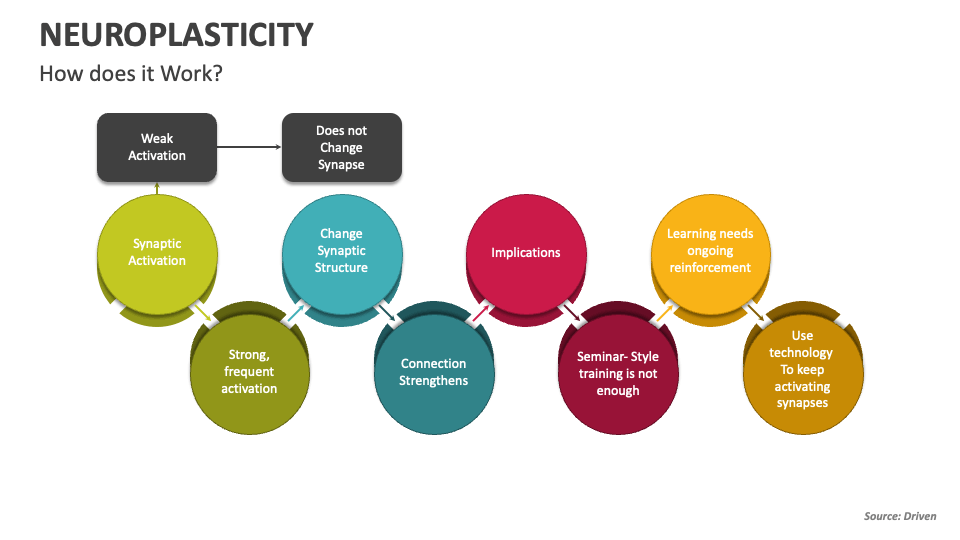
- The brain is not fixed; it is "plastic" or changeable.
- Thinking, feeling, or doing something repeatedly strengthens a neural pathway, like a well-traveled road.
- Neglected pathways weaken, while new pathways can be formed.
- This process is neutral—it can form good habits or bad ones.
This flowchart provides a simple visual summary of the process and, importantly, its implications.
4. Putting It All Together: Translating for a Business Stakeholder
Imagine you're in a meeting with a Marketing Director. You want to convince them to shift budget from a one-off product launch event to a sustained, multi-channel campaign over several months. You can use neuroplasticity to justify this.
Here’s how you could structure your explanation using our framework:
Step 1: Soften & Frame the Context
(You could say): "You know how some brands just become second nature to us, like grabbing the same coffee every morning? That automatic behavior isn't an accident; it's a result of something called neuroplasticity. Understanding this can fundamentally change how we build lasting brand loyalty, moving beyond one-off spikes in attention."
Step 2: Use a Relatable Analogy (Be Specific)
"Think of a consumer's brain as a city map. Every time they have an experience with a brand, they create a 'road.' A single big ad campaign is like building a temporary dirt path—it gets some traffic, but it fades quickly.
But, if we consistently show them our message across their social feed, in stores, and on TV over time, we're not just building a path. We're paving it, widening it, and turning it into a multi-lane highway. Eventually, taking our 'road' becomes the fastest, easiest, and most automatic route for their brain to take when they need to make a purchase."
Step 3: Connect to Business Value & Summarize (Be Succinct & Generous)
"By shifting to a sustained campaign, we are literally rewiring our customers' habits to make our brand the default choice. This means higher lifetime value and a stronger defense against competitors.
So, in short, neuroplasticity tells us that brand loyalty isn't built in a day; it's paved over time through consistent reinforcement."
This explanation avoids scientific jargon (synapses, neurons), uses a familiar analogy (roads), and directly ties the concept to a business outcome (brand loyalty and lifetime value). It is succinct, specific, and generous.
Test your understanding!
Now, it's your turn. Use the same principles to translate another neuroscience concept.
Scenario: You need to explain the "Orienting Response" (the brain's automatic reflex to pay attention to novel or unexpected stimuli, which we covered in Module 1) to a creative team designing a new digital ad.
Your task: Write a brief, one-paragraph explanation for the creative team using the Soften-Relate-Summarize framework.
Show answer
Here is an example answer:
"(Soften) You know how you immediately look up when you hear an unexpected noise or see a flash of movement in your peripheral vision? That automatic reaction is a hardwired brain reflex called the Orienting Response. (Relate) It's like our brain's built-in 'What was that?!' system, designed to instantly focus our attention on anything new or surprising in our environment. (Summarize & Connect) For this ad, we need to trigger that reflex in the first two seconds with something visually unexpected—a sudden color change, an unusual animation, or a surprising sound—to break through the clutter and ensure our message gets seen before they scroll past. Our goal is to be that 'What was that?!' moment on their feed."
Conclusion
Mastering the skill of simplification is what elevates you from a knowledgeable practitioner to an influential leader. It allows you to bridge the gap between science and business, turning complex neural insights into actionable strategies that people understand and buy into.
Key Takeaways:
- Simple is smart: The ability to explain a complex topic simply is a sign of deep understanding, not a lack of knowledge.
- Use a structured approach: The Soften-Relate-Summarize framework provides a reliable path to guide your listener from confusion to clarity.
- Focus on business value: Never explain a scientific concept for its own sake. Always connect it to a tangible business problem or opportunity. Your explanation must answer the question, "Why should I care?"
- The best analogies are familiar: Use examples from everyday life—like city maps, roads, or automatic reflexes—to make abstract ideas concrete and memorable.
Preview of the Next Lesson:
Today, we practiced translating an entire concept. We saw how powerful a well-chosen analogy can be in this process. In our next lesson, we will focus specifically on this powerful tool. The learning outcome will be to create a simple analogy or metaphor to explain a brain function (e.g., the amygdala as a 'threat detector') to a non-scientist. We will build a "toolkit" of these metaphors that you can use to make your explanations even more vivid and effective.