Hello! Welcome to the final lesson in our module on "Memory and Building Brand Associations."
In our previous lessons, we've covered how to encode brand messages, make them emotionally salient, and use spaced repetition to build them into a consumer's long-term memory. We've essentially learned how to build a strong memory trace for a brand. But what good is a memory if it can't be accessed when it matters most?
Today, we'll focus on that final, critical step: retrieval. Your learning outcome is to analyze how a brand successfully uses retrieval cues in its marketing to trigger brand recall at the point of purchase. We'll explore the science behind why certain triggers work and then dive into a powerful framework that marketers use to strategically link their brands to the moments in our lives when we make buying decisions.
The Science of Triggering Memories
Have you ever walked into a room and completely forgotten why you went in there, only to return to your original spot and have the reason come flooding back? This common experience is a perfect illustration of context-dependent memory. The environment where you formed the intention (your "original spot") contains cues that help you retrieve that memory.
To understand the science behind this, let's watch a short video that explains how our brains link memories to their surrounding context.
What is Context-Dependent Memory?
This video, 'What is Context-Dependent Memory?' from SciToons, clearly explains the foundational concept of how contextual information gets encoded along with our memories.
Please watch from the beginning to 03:21. Pay close attention to how the brain encodes not just the primary information, but also the surrounding context, and how that context can later serve as a 'retrieval cue.'
The key idea is that when our brain encodes a memory, it doesn't just store the core information; it also captures incidental details from the environment—sights, sounds, locations, and even our internal feelings at that moment. When we encounter those same details later, they act as keys, unlocking the associated memory.
This isn't just a quirk of the mind; it's a powerful mechanism that marketers can leverage. Watch this very short clip from a TEDx talk that shows a classic example of this in action.
Neuromarketing: The new science of consumer decisions | Terry Wu | TEDxBlaine
In his talk 'Neuromarketing: The new science of consumer decisions,' Dr. Terry Wu opens with a striking example of a retrieval cue at the point of purchase.
Watch the first minute of the video (00:04 to 01:17). Notice how a single, subtle sensory cue—the background music—unconsciously triggered specific brand choices.
The wine store experiment is a perfect marketing example of context-dependent memory. The French music acted as a powerful retrieval cue, bringing memories and associations related to France to the forefront of shoppers' minds, which in turn influenced them to choose French wine.
The Different Flavors of Retrieval Cues
Marketers have a whole palette of cues they can use to trigger brand recall. While context is a major one, we can categorize them more broadly.

Let's break these down with marketing examples:
-
1. Contextual Cues: These are related to the environment or situation.
- Time of day: Seeing an ad for coffee in the morning.
- Location: A billboard for a hotel as you approach a city.
- Event: A beer ad that airs during a major sports game.
-
2. Sensory Cues: These trigger memory through the five senses. As the article "Activating Brand Memory" explains, the sense of smell is particularly potent because it has a direct neural pathway to the brain's memory and emotion centers (the limbic system).
- Sound (Auditory): The "I'm Lovin' It" jingle for McDonald's or the distinctive boot-up sound of an Apple computer.
- Smell (Olfactory): Singapore Airlines' signature scent used in their cabins and on their flight attendants.
- Sight (Visual): The iconic shape of a Coca-Cola bottle or the golden arches.
-
3. Emotional Cues: A specific feeling can trigger a memory of a brand associated with that feeling.
- Feeling hungry and irritable: Triggers the thought of a Snickers bar, thanks to their famous "You're not you when you're hungry" campaign.
- Feeling nostalgic: Might bring to mind brands that were part of your childhood.
-
4. Semantic Cues: These are related words or concepts. The brain organizes information in networks of related ideas. Activating one node in the network can activate others.
- The word "Thirst" might automatically bring "Coke" or "Gatorade" to mind.
- Thinking about a "celebration" might trigger thoughts of "Champagne."
-
5. Mnemonic Cues: These are memory aids, often deliberately created. While less common for direct point-of-purchase triggers, they are used to build strong recall. Jingles are a form of mnemonic.
The most effective marketing doesn't just rely on one type of cue; it builds a rich web of associations so that the brand can be triggered by many different keys.
The Marketer's Playbook: Category Entry Points (CEPs)
Now, let's move from the science to the strategy. How do marketers systematically identify and use these retrieval cues? A leading framework for this is called Category Entry Points (CEPs).
CEPs are the various situations, needs, and moments that cause a consumer to think about a product category. The goal for a brand is to build strong mental links so that when a consumer experiences a CEP, their brand is the first one that comes to mind.
This article provides an excellent and practical overview of CEPs.
What Are Category Entry Points? CEP Guide & Examples
The article 'What Are Category Entry Points?' from quantilope explains how marketers use this concept to build 'Mental Availability'—making their brand easy to recall in buying situations.
Please read the introduction under 'What are Category Entry Points?', the section 'Category Entry Point examples', and 'The 7W framework'. Focus on how CEPs are defined and the practical framework for identifying them.
As the article describes, you can think of CEPs as the "metaphorical doors" through which a consumer enters a category. A brand that is strongly linked to many of these doors is more likely to be chosen.
The 7W framework mentioned in the article is a fantastic tool for brainstorming these cues.
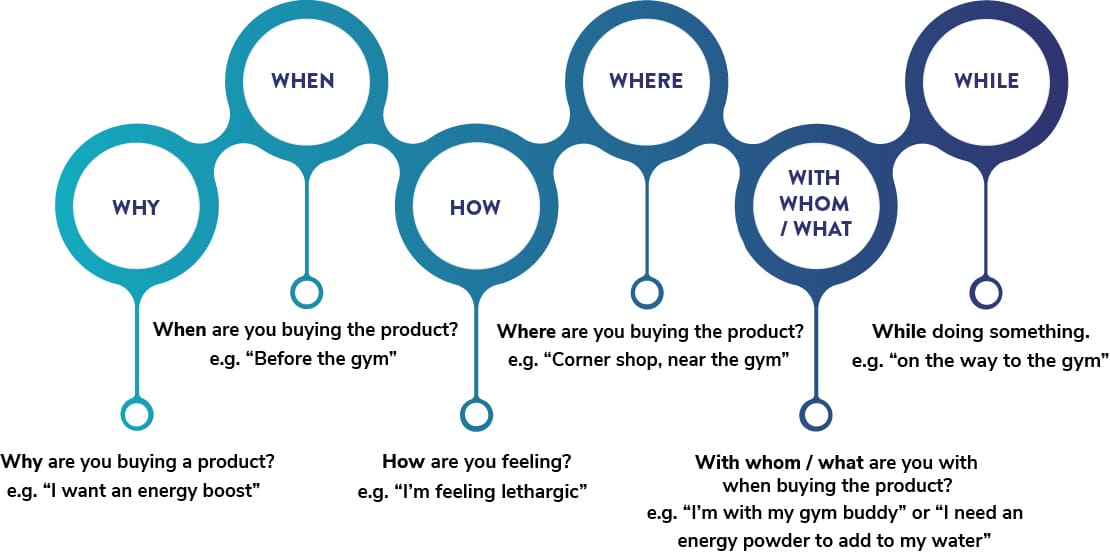
By asking these questions, a brand can map out all the potential retrieval cues it could try to "own."
- Corona beer, for example, has masterfully linked itself to the CEP of "relaxing on a beach" (Where/While).
- Snickers has built its brand around the CEP of "feeling hungry and needing a quick fix" (Why/HoW feeling).
- Kit Kat famously associated itself with "taking a break" (When/Why).
These brands have spent years using consistent messaging (which you learned about in the previous lesson on spaced repetition) to build a strong neural link between a specific cue (the CEP) and their brand (the memory). When you find yourself in that situation, their brand is the one that pops into your head.
Test your understanding!
You are the marketing manager for a new brand of premium, high-caffeine coffee. Your target audience is busy professionals.
Using the 7W framework, brainstorm three distinct Category Entry Points (CEPs) you could try to associate with your brand. For each one, mention which "W" it primarily relates to.
Show answer
Here are some possible answers. Your own ideas are valid as long as they are distinct and link to the framework.
-
CEP: "To get focused before a big presentation."
- Primary 'W': Why (the motivation is to improve performance) and When (a specific event).
-
CEP: "When you have to work late to meet a deadline."
- Primary 'W': When (time-related) and HoW feeling (likely feeling stressed or tired).
-
CEP: "That first cup of the day to kickstart your morning."
- Primary 'W': When (as part of a daily routine).
By identifying these CEPs, you could then design advertising creative that shows professionals in these exact situations, building the crucial link between the situation (the cue) and your coffee (the solution).
Conclusion
Today we've closed the loop on the memory process, moving from building memories to strategically triggering them. By understanding the science of retrieval and using practical frameworks like Category Entry Points, marketers can ensure their brand isn't just remembered, but remembered at the exact moment it counts.
Key Takeaways:
- Retrieval cues are environmental or internal triggers that help us access memories. They work because our brain encodes the context along with the memory itself.
- Marketers use a variety of sensory, emotional, and contextual cues to make their brands more memorable and easily recalled.
- Category Entry Points (CEPs) are the specific needs or situations that make a consumer think about a product category.
- The ultimate goal of brand-building is to create strong, automatic links between relevant CEPs and your brand, achieving high "mental availability."
As you work on communicating these concepts, here’s a simple analogy you can use:
"Think of a person's memory as a giant library. A brand is like a book on a shelf. Just knowing the book exists isn't helpful if you can't find it. Retrieval cues—like a specific time of day, a sound, or a feeling—are like entries in the library's card catalog. Smart marketing is about creating as many clear, relevant 'catalog entries' as possible, so that whenever someone has a need, your brand's 'book' is the easiest one to find."
This concludes our module on Memory and Building Brand Associations. You now have an end-to-end understanding of how brands earn a space in our minds.
In our next module, "The Psychology of Decision-Making," we'll explore what happens after a brand is recalled. Once a brand has our attention, how does it persuade us? We'll begin by examining the Elaboration Likelihood Model, which explains the two fundamental routes to persuasion.