Hello! Welcome to your second lesson.
In our first session, we built a foundational map of the consumer brain, identifying the key "hardware" involved in decision-making: the rational Prefrontal Cortex, the emotional Limbic System, and the motivational Reward System.
Today, we'll build on that by exploring the "software" that runs on this hardware. The goal for this lesson is to explain the difference between conscious ('System 2') and unconscious ('System 1') processing in decision-making. This framework, popularized by Nobel laureate Daniel Kahneman, is one of the most powerful tools for understanding why consumers behave the way they do. Grasping this concept is crucial for your goal of translating complex science into clear, persuasive business arguments.
The Two Minds We Decide With
Imagine you see an ad for a product. In a split second, you have a gut feeling about it—you either like it or you don't. That's one part of your brain at work. Then, you might start consciously thinking about the price, the features, and whether you really need it. That's another part. These two modes of thinking are what we call System 1 and System 2.
To get a feel for how different they are, let's watch a short, engaging video that illustrates the concept with simple examples.
Mastering Both Your Brains | System 1 vs System 2
The video 'Mastering Both Your Brains' introduces System 1 and System 2 in a very conversational way. It uses the examples of instantly recognizing an emotion on a face versus solving a math problem to highlight the contrast between these two modes of thinking.
Please watch the first 4 minutes and 16 seconds of the video (0:00 - 4:16). Pay close attention to the descriptive words used for each system: fast, automatic, and unconscious for System 1, versus slow, effortful, and conscious for System 2.
As the video explains, our brain isn't a single, unified mind. It operates using two very different systems:
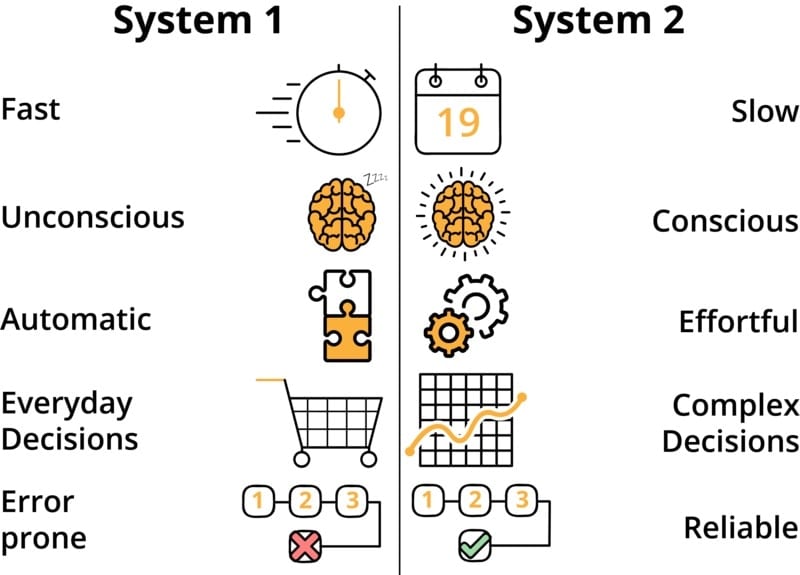
- System 1: This is your fast, automatic, intuitive, and unconscious mind. It's always on, processing the world around you effortlessly. It handles things like recognizing faces, getting a "vibe" from a person, or driving a familiar route.
- System 2: This is your slow, deliberate, analytical, and conscious mind. It requires effort and attention. This is the system you engage when you solve a complex problem, compare different products, or learn a new skill.
This image provides a great visual summary of the key differences.
A Deeper Dive into the Two Systems
Now that we have the basic idea, let's explore the characteristics of each system in more detail, especially in a marketing context.
Lessons from Thinking, Fast & Slow: System 1 and System 2
The article 'Lessons from Thinking, Fast & Slow' from Greenbook provides an excellent, concise comparison of the two systems. It's a perfect reference for clarifying the distinctions.
Please read the section under the heading 'What is the difference between System 1 and System 2?'. Focus on the comparison table, which clearly lays out the definition, examples, and control mechanisms for each system.
As you saw in the table, the two systems are almost polar opposites. Let's connect them back to the brain structures from our last lesson:
-
System 1 is the domain of the Limbic System and the Reward System. It's driven by emotion, instinct, and ingrained habits. When you feel an immediate pull toward a product because of attractive packaging or a "feel-good" ad, that's your System 1 at work. It's responsible for brand loyalty that feels almost automatic and impulse buys that defy logic.
-
System 2 relies heavily on the Prefrontal Cortex (the "CEO"). It's the voice of reason that analyzes facts, figures, and long-term consequences. When you spend time reading customer reviews, comparing feature lists, or calculating the total cost of ownership for a software product, you are using System 2.
The Uneasy Partnership: How the Systems Interact
System 1 and System 2 don't operate in isolation. They are constantly interacting, with System 1 acting as the fast, impulsive advisor and System 2 as the slower, more cautious executive.
However, System 2 is "lazy." It consumes a lot of mental energy, so the brain prefers to rely on the effortless System 1 whenever possible. System 1 constantly proposes impressions, feelings, and intentions to System 2, which often just accepts them without much scrutiny.
This is where things get interesting for marketing.
Dual Process Theory: Analyzing Our Thought ...
The article 'Dual Process Theory' from the CXL blog offers a great example of how this interplay can be exploited, using a simple study about cognitive load and dessert choices.
Please read the section titled 'Kahneman’s systems and cognitive biases.' Focus on the example about choosing between chocolate cake and fruit salad while trying to remember a list of digits. It's a classic demonstration of what happens when System 2 is busy.
The chocolate cake example is powerful. When System 2 is occupied with a demanding task (remembering numbers), the impulsive, pleasure-seeking System 1 gets its way. This has huge implications for consumer behavior:
- A customer shopping online with a crying baby in the background is more likely to make an impulsive purchase.
- A business executive rushing between meetings might be more easily swayed by a simple, emotionally resonant sales pitch than a complex data sheet.
- Checkout pages designed to be confusing or cluttered can tax System 2, making customers more susceptible to last-minute add-ons (suggested by System 1).
Test your understanding!
You are in a sales meeting pitching a new accounting software to a potential client. Identify whether the following parts of your pitch are designed to appeal primarily to System 1 or System 2.
- "Our software reduces invoicing errors by an average of 34%, with a 95% confidence interval, based on a study of 500 small businesses."
- Showing a clean, simple dashboard with a testimonial from a happy, stress-free-looking business owner who says, "It just works. I finally have my weekends back."
- "Thinking about this will take some time, but we only have this introductory price available until the end of the week."
Show answer
- System 2: This is a direct appeal to the analytical mind. You're providing hard data, percentages, and statistical terms that require conscious evaluation by the client's prefrontal cortex.
- System 1: This is a classic System 1 appeal. The simple dashboard is easy to process (processing fluency), the face of the happy customer triggers a positive emotional response, and the quote "I finally have my weekends back" taps into a powerful, emotional desire for work-life balance, not a logical feature.
- System 1: This tactic works by creating urgency and scarcity, which trigger an emotional response in the amygdala (part of the limbic system). It's designed to prompt a fast, intuitive decision ("I might miss out!") to bypass a slower, more deliberate System 2 evaluation ("Should I check competitors? Do I need this right now?").
Marketing to Two Minds at Once
Great marketing doesn't choose between System 1 and System 2; it addresses both. It creates an emotional desire with System 1 and then provides the logical justification for System 2 to approve the decision.
Think of a car advertisement.
- System 1 sees: A sleek car driving on a beautiful, winding road, maybe with an attractive, successful-looking person behind the wheel. The feeling is one of freedom, status, and excitement.
- System 2 hears: A voiceover listing the car's fuel efficiency, safety ratings, and warranty information.
The decision to want the car is often made by System 1 in a split second. The information given to System 2 is there to help the conscious brain rationalize the emotional decision it has already made. As a salesperson, you know that a customer often decides emotionally and then looks to you for the logical reasons to support that decision.
Conclusion
Today we've uncovered the two "operating systems" of the consumer brain. Let's recap the key takeaways:
- System 1 is our unconscious autopilot: fast, intuitive, emotional, and effortless. It governs most of our day-to-day judgments and decisions.
- System 2 is our conscious pilot: slow, analytical, logical, and effortful. It's used for complex tasks but is "lazy" and easily bypassed.
- Most decisions are a collaboration, where System 1 makes a quick proposal and System 2 either approves, rejects, or analyzes it further.
- Effective marketing creates an emotional pull for System 1 while providing rational reasons for System 2 to agree.
You now have a framework for analyzing almost any consumer behavior. When you see a decision being made, you can ask: Was that a fast, intuitive choice, or a slow, reasoned one? What part of the marketing message spoke to which system?
In our next lesson, we will get even more fundamental. We'll explore how these experiences, processed by System 1 and 2, physically change the brain. We'll answer the question: How do neurons form connections to create brand associations and learned behaviors? This will bridge the gap between the cognitive models we've discussed and the biological reality of how memories and habits are formed.