Welcome back! In our first lesson, we established the two fundamental postulates of special relativity: the laws of physics are the same in all inertial frames, and the speed of light in a vacuum, , is constant for all inertial observers.
Today, we'll explore the first strange and profound consequence of these seemingly simple rules. Our everyday intuition tells us that time is absolute—if two things happen at the same moment, they are simultaneous for everyone, everywhere. Einstein showed this is wrong. Your goal for this lesson is to explain, using a thought experiment, why simultaneity is relative. This is a crucial step in abandoning classical notions of space and time and embracing the relativistic worldview necessary for high-energy physics.
The Train Paradox: A Classic Thought Experiment
The relativity of simultaneity is best understood not through abstract equations at first, but through a story—a Gedankenexperiment, or thought experiment. One of the most famous versions involves a train, a platform, and a flash of light.
To see how this works, let's watch a video by physicist Brian Greene, who provides a very clear and animated walkthrough of this exact scenario.
Your Daily Equation #4: Relativity of Simultaneity
In this video, Brian Greene uses an engaging thought experiment involving a peace treaty signed on a train to demonstrate why observers in relative motion disagree on simultaneity.
Watch the segment from 01:32 to 09:26. Pay close attention to the reasoning from the two different points of view: that of the presidents on the train, and that of the observers on the platform.
Let's break down the logic presented in the video. The conclusion hinges entirely on the two postulates we learned last time.
-
The View from the Train (Frame S'):
- An observer is in the exact middle of a train car.
- A light bulb flashes at their location.
- From this observer's perspective, they are stationary. The front and back walls of the train car are at a fixed, equal distance from them.
- Since the speed of light is constant in all directions (Postulate 2), the light pulses reach the front and back walls at the exact same time.
- Conclusion: For the observer on the train, the two events (light hitting the front wall and light hitting the back wall) are simultaneous.
-
The View from the Platform (Frame S):
- An observer stands on the platform as the train moves by at high speed, .
- The light flashes just as the middle of the train passes the platform observer.
- During the time it takes for the light to travel, the train itself has moved. The back wall of the train has moved towards the point where the light was emitted, while the front wall has moved away from it.
- The platform observer sees two light pulses traveling outwards at speed (Postulate 2). However, the pulse going towards the back of the train has a shorter distance to cover to catch up to the moving wall. The pulse going to the front has a longer distance to cover.
- Conclusion: For the observer on the platform, the light hits the back wall first, and the front wall second. The events are not simultaneous.
The revolutionary insight of relativity is that both observers are correct. There is no "true" answer. Simultaneity is not an absolute property of events; it depends on the observer's frame of reference.
The image below illustrates a very similar thought experiment, conceived by Einstein himself, involving lightning strikes. The logic is identical.

A Crucial Clarification
It's easy to mistakenly think this effect is simply due to the time it takes for a signal (light) to reach an observer's eyes. This is a common confusion. In classical physics, we account for signal delay all the time. The relativity of simultaneity is a much deeper concept.
To make sure this point is clear, please read the following short text. It emphasizes that this effect is due to the constancy of the speed of light, not just its finiteness.
This excerpt from David Tong's lecture notes on Special Relativity addresses a common point of confusion and clarifies the meaning of an 'observer' in relativity.
Please read the two subsections titled 'A Train Story' and 'A Potential Confusion'. They provide a concise summary of the thought experiment and an essential clarification.
As the notes explain, an "observer" in relativity isn't a single person but rather the entire reference frame, filled with a synchronized grid of clocks and rulers. The disagreement isn't about when you see the events, but about when the events actually happen in your coordinate system.
Visualizing Relativity: Spacetime Diagrams
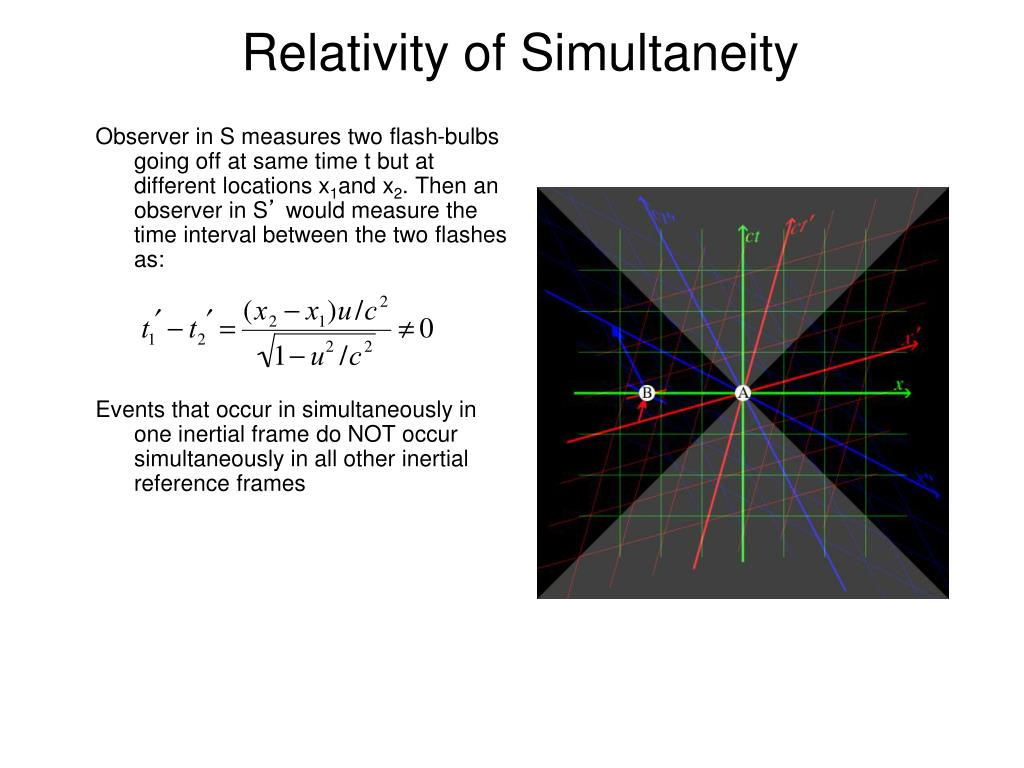
Since you have a strong background in physics and mathematics, you'll appreciate a more geometric way to represent these ideas. We can visualize events and the motion of objects using spacetime diagrams (also called Minkowski diagrams).
In these diagrams:
- The vertical axis represents time (, or often to give it units of distance).
- The horizontal axis represents one dimension of space ().
- An "event" is a single point () in spacetime.
- The path of an object through spacetime is its worldline.
- Since for light, light rays always travel at a 45-degree angle.
The following video shows how to use these diagrams to visualize the relativity of simultaneity. It powerfully demonstrates how different reference frames correspond to different coordinate systems on the same spacetime.
Spacetime Diagrams: Wish I Was Taught Relativity This Way!
This video introduces spacetime diagrams and uses them to re-examine the relativity of simultaneity, providing a powerful geometric intuition for the concept.
Please watch from the beginning up to the 07:36 mark. The video will build the spacetime diagram for the moving train scenario and show why the 'line of simultaneity' is different for the two observers.
The key takeaway from the video is this:
- For the observer on the platform (frame S), the set of all events that are simultaneous with the origin () lies on the horizontal x-axis. This is the line where .
- For the observer on the train (frame S'), the line of events that they consider simultaneous with the origin is a tilted line. This is their x'-axis.
This tilting of the "line of simultaneity" is a geometric representation of the relativity of simultaneity.
A Preview of the Mathematics
In our next lesson, we will derive the Lorentz transformations—the mathematical heart of special relativity. For now, let's peek at the result for the time coordinate to see how it formally captures the relativity of simultaneity.
The time in a moving frame S' is related to the time and position in a stationary frame S by the equation:
where is the relative velocity and .
Now, consider two events, 1 and 2, that are simultaneous in frame S. This means they happen at the same time , so the time interval is . Let's also say they happen at different locations, and , so .
What is the time interval between these two events as measured in the moving frame S'? We apply the transformation:
Since , this simplifies to:
Because and , we find that . The two events that were simultaneous in frame S are not simultaneous in frame S'. The term is the mathematical reason for the relativity of simultaneity.
Conclusion
Today we've taken a major step away from classical intuition and into the relativistic world.
Key Takeaways:
- Simultaneity is relative: Events that are simultaneous in one inertial frame are generally not simultaneous in another frame that is in motion relative to the first.
- This is a direct and unavoidable consequence of Einstein's two postulates, especially the constancy of the speed of light.
- Thought experiments, like the train and platform scenario, provide a powerful conceptual tool for understanding this phenomenon.
- Spacetime diagrams offer a geometric visualization, where different observers have different, tilted axes of simultaneity (their x-axes).
In the next lesson, we will get our hands dirty with the algebra of relativity. We will derive the Lorentz transformation equations, which you just saw a preview of. These equations are the mathematical framework that allows us to precisely relate measurements of space and time between different inertial frames.