Hello! Welcome to your first lesson in our course on high energy physics.
The journey into the world of fundamental particles and forces begins with a radical rethinking of space and time. Over the next few modules, we'll build the necessary foundation by studying Einstein's Special Theory of Relativity. It's the language of high-energy physics, and mastering it is the essential first step.
Today's goal is to understand and state the two foundational postulates of special relativity. As a physics student, you're familiar with two great pillars of classical physics: Newtonian Mechanics and Maxwell's Electromagnetism. In the late 19th century, these two theories appeared to be in conflict, particularly around the nature of light and motion. Einstein's postulates, which we will cover today, brilliantly resolved this conflict and, in doing so, completely changed our understanding of the universe.
The Stage for a Revolution
Before we dive into the postulates, let's watch a short video that sets the scene. It connects the classical ideas of Galileo to the problems Einstein tackled. Pay close attention to how it contrasts our everyday experience of relative speeds with the strange behavior of light.
Special Relativity Part 1: From Galileo to Einstein
This video from the Professor Dave Explains channel provides an excellent introduction to why special relativity was needed and what its two postulates are.
Please watch from the beginning until the timestamp 04:18. Focus on the distinction between Galilean relativity (for cars) and the new principle Einstein proposed for light.
As the video highlighted, the core issue was a clash of principles. Let's break down how Einstein resolved it.
Postulate 1: The Principle of Relativity
Einstein's first postulate is an extension of an idea you've encountered in classical mechanics, often called Galilean relativity.
Postulate I: The laws of physics are the same in all inertial reference frames.
Let's unpack this:
- An inertial reference frame is a system that is not accelerating—it's either at rest or moving with a constant velocity. Imagine yourself in a perfectly smooth, windowless train car. If the train is moving at a constant velocity, there is no experiment you could perform inside the car (throwing a ball, observing a pendulum, testing an electric circuit) to determine whether you are moving or standing still.
- The laws of physics refer to all fundamental principles and equations—Newton's laws, Maxwell's equations of electromagnetism, the laws of thermodynamics, etc.
This postulate states that the fundamental rules governing the universe are democratic; they don't depend on your state of uniform motion. The logical consequence is that there is no "absolute" rest frame in the universe. All inertial motion is relative.
Postulate 2: The Constancy of the Speed of Light
This is the truly revolutionary postulate. It breaks sharply from our everyday intuition and from Galilean relativity.
Postulate II: The speed of light in a vacuum, denoted by c, has the same value for all observers in inertial reference frames, regardless of the motion of the source or the observer.
Consider the baseball analogy mentioned in one of our resources. If someone on a moving skateboard (at 1 m/s) throws a baseball (at 3 m/s), a stationary observer would measure the ball's speed as 4 m/s. Velocities simply add up.
The second postulate says light does not behave this way.
- If you are standing still and measure the speed of a light beam, you get m/s.
- If you are in a spaceship moving at 99% of the speed of light (0.99c) and you measure the same light beam, you still get c, not .
- If a light source is moving towards you at 0.99c and emits light, you will measure that light's speed to be c, not .
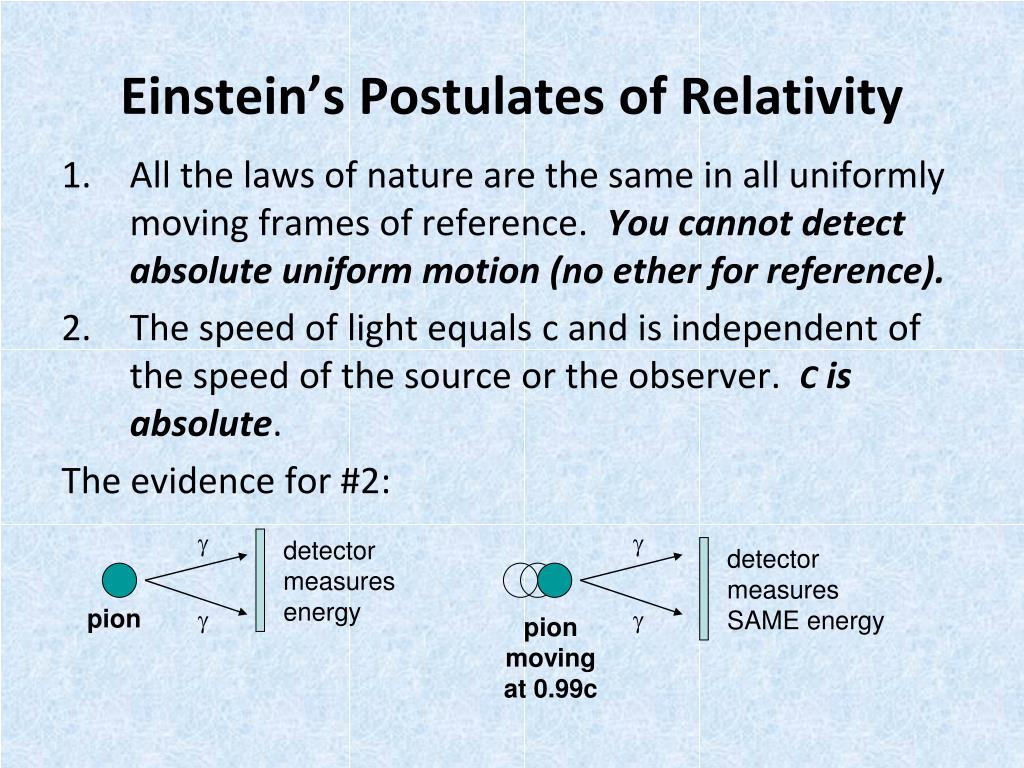
This is a fundamental law of nature, confirmed by countless experiments. The image below illustrates this counter-intuitive fact.

This principle isn't just a strange quirk; it's a direct consequence of the first postulate when applied to electromagnetism. Maxwell's equations predict a single, constant value for the speed of light. If the speed of light were not constant for all inertial observers, you could use this fact to identify a special, absolute rest frame (e.g., the frame where Maxwell's equations are simplest). This would violate the first postulate—The Principle of Relativity. Therefore, for the laws of physics to be the same in all inertial frames, the speed of light must also be the same.
Your own research area of particle physics provides direct evidence for this. For example, when a high-energy particle like a pion decays into photons (light particles), the speed of those photons is measured to be c, regardless of how fast the original pion was moving.
Formal Statements
To solidify your understanding, let's look at how these postulates are presented in a more formal academic context. Please read the short selections from these two sets of lecture notes. They state the postulates concisely and are typical of how you would see them in a university physics textbook.
This first resource, from a set of university lecture notes, provides a clear and formal statement of the two postulates.
Please read the section titled '3.1 The Special Theory Of Relativity'. It's very short and located just after the discussion of the Michelson-Morley experiment. Focus on the numbered list stating the two postulates.
Chapter 11. Special Relativity
This second set of notes offers a slightly different wording, which can help in fully grasping the concepts.
Please find the section titled '11.2 The Lorentz Transformation'. Read the two fundamental postulates listed as I and II at the beginning of this section.
These two postulates form the entire foundation of special relativity. As we saw briefly in the first video, every surprising conclusion of the theory—time dilation, length contraction, and the equivalence of mass and energy ()—can be derived directly from them.
Conclusion
In this lesson, we have laid the groundwork for our study of high-energy physics.
Key Takeaways:
- Special relativity was born from a conflict between classical mechanics and electromagnetism.
- Postulate 1 (The Principle of Relativity): The laws of physics are identical in all inertial (non-accelerating) reference frames. There is no absolute motion.
- Postulate 2 (The Constancy of the Speed of Light): The speed of light in a vacuum, c, is the same for all inertial observers, independent of the source's or observer's motion.
- For both postulates to be true, our common-sense notions of absolute space and time must be abandoned.
The seemingly simple statements of these postulates have profound consequences. In our next lesson, we will explore the very first and perhaps most mind-bending of these consequences: the relativity of simultaneity. We will see that two events that appear to happen at the same time for one observer may not be simultaneous for another observer in motion.