Hello! Welcome to the first lesson of our new module on Continuum and Fluid Mechanics.
In previous modules, we have largely treated objects as either point particles or ideal rigid bodies. This was a necessary simplification. In reality, all materials deform when forces are applied. The study of how continuous, deformable materials—solids, liquids, and gases—respond to forces is the domain of continuum mechanics. Your interest in engineering applications makes this a particularly relevant and powerful field to study.
Today, we will build the fundamental mathematical language needed to describe the internal state of a deformable body. This lesson addresses the learning outcome: Define the stress and strain tensors to describe the state of a deformable continuous medium. We will introduce two crucial concepts:
- Stress: A measure of the internal forces acting within a material.
- Strain: A measure of the material's internal deformation.
We will find that both of these quantities are best described by mathematical objects called tensors. Mastering these concepts is the first step toward analyzing everything from the structural integrity of a bridge to the flow of air over a wing.
1. The Stress Tensor: Describing Internal Forces
Imagine an arbitrary solid body in equilibrium, subject to external forces. If we were to make a hypothetical cut through the body, what would we find? To maintain equilibrium, the material on one side of the cut must be exerting forces on the material on the other side. Stress is the quantity that describes the intensity of these internal forces.
1.1 An Intuitive Picture: The Stress Cube
A common way to visualize stress is to consider an infinitesimally small cubic element of material within the body. Forces act on each of the six faces of this cube.
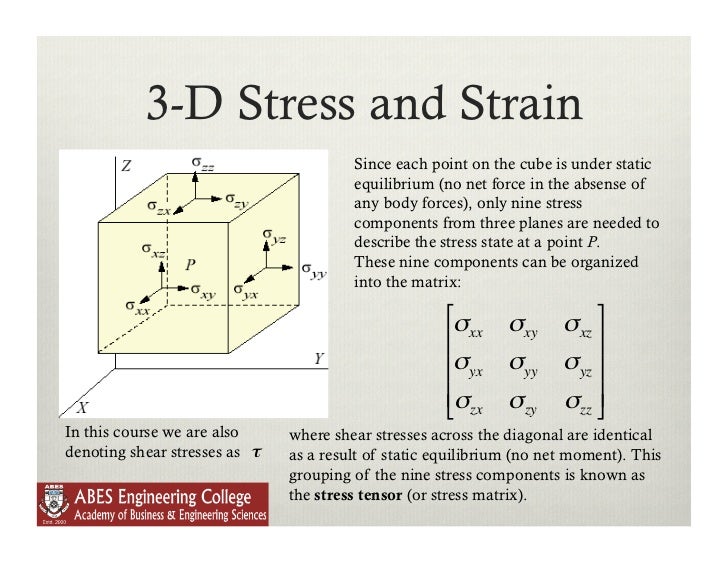
We can resolve the force on each face into three components. For a face whose outward normal points in the -direction, the force component acting in the -direction, per unit area, is denoted .
- Normal Stresses: Components where the force is perpendicular to the face (). These are , , and . They represent tension or compression.
- Shear Stresses: Components where the force is parallel to the face (). These are , , , etc. They represent shearing or twisting.
This gives us 9 components in total, which we can organize into a 3x3 matrix called the stress tensor, :
For the cube to be in rotational equilibrium (i.e., not spinning), the torques must balance. This requires that . Therefore, the stress tensor is symmetric, and we only need 6 independent components to fully describe the state of stress at a point.
The following brief reading formalizes this intuitive picture.
Mechanical Behaviour Continuum Mechanics (Stress Tensors)
This document, 'Mechanical Behaviour Continuum Mechanics' by David Dye, provides a clear and direct introduction to the concept of stress using the infinitesimal element.
Read the section '1.1 States of Stress: Definitions' (pages 2-4). Focus on the subscript convention for stress components and the argument for why the stress tensor must be symmetric.
1.2 The Cauchy Stress Tensor: A Rigorous Definition
The cube is a great intuitive tool, but what if we want to know the forces on a plane that is not aligned with our coordinate axes? This requires a more general and mathematically rigorous formulation.
First, we define the traction vector, , as the force per unit area acting on an arbitrary internal surface with a unit normal vector . A fundamental result, known as Cauchy's Theorem, states that this traction vector is a linear transformation of the normal vector, with the stress tensor being the transformation matrix.
The derivation of this theorem is a classic example of the power of continuum mechanics, and it's something you will appreciate given your preference for rigor. It involves analyzing the equilibrium of an infinitesimal tetrahedron.
The following video provides an excellent, step-by-step derivation.
Solid Mechanics Theory | The Cauchy Stress Tensor
This video, 'The Cauchy Stress Tensor' by Dr. Clayton Pettit, provides a formal derivation of Cauchy's stress theorem, which is central to continuum mechanics.
Please watch from the beginning to 14:33. Pay close attention to these key steps: (0:00 - 2:50) The definition of the traction vector on a cut surface. (2:50 - 14:33) The derivation using the 'Cauchy Tetrahedron'. Follow the logic of applying Newton's second law (sum of forces = 0 for equilibrium), relating the areas of the faces, and taking the limit as the tetrahedron shrinks to a point. This rigorously establishes the relationship between traction, the normal vector, and the stress tensor.
The final result from the video is the cornerstone equation for stress analysis:
Or, in component form:
This equation tells us that if we know the six independent components of the stress tensor at a point, we can calculate the internal force vector on any plane passing through that point, simply by knowing the plane's normal vector .
(Note: The convention is common in engineering. Some physics texts define the stress tensor as the transpose of this, leading to . The physics is the same, but it's important to be aware of the convention being used.)
Test your understanding!
Consider a point in a material where the state of stress is given by the following tensor (in MPa):
Calculate the traction (force per unit area) vector on a plane whose unit normal vector is .
Show answer
We use Cauchy's theorem: .
First, we note that the given stress tensor is symmetric, so .
The normal vector in component form is .
Now, we perform the matrix-vector multiplication:
So, the traction vector is MPa.
2. The Strain Tensor: Describing Deformation
Now that we can describe internal forces, we need a way to describe the material's response: deformation. Strain is the measure of this deformation.
2.1 Displacement and Deformation
Consider a body that moves and deforms. We can describe this by a displacement field , which is a vector that specifies the displacement of every point in the initial (undeformed) body.
A crucial insight is that rigid body motion (translation and rotation) does not induce stress. Strain is only concerned with the relative displacement between neighboring points, which leads to stretching, compressing, or changing angles. Therefore, strain must be related to the gradients (spatial derivatives) of the displacement field.
The following video introduces the necessary concepts of reference and deformed configurations, and the distinction between rigid body motion and true deformation.
Intro to Continuum Mechanics Lecture 6 | The Green and Small Strain Tensors
This lecture segment, also by Dr. Pettit, clearly lays out the kinematic foundations for defining strain. It distinguishes between a body's initial and final configuration and introduces the essential concepts of position and displacement functions.
Watch from 3:50 to 19:45. Focus on understanding: The reference configuration (undeformed) and deformed configuration. The position function \vec{x}(\vec{X}, t) vs. the displacement function \vec{u}(\vec{X}, t) = \vec{x} - \vec{X}. Why rigid body translation and rotation must be separated from true deformation.
2.2 The Infinitesimal Strain Tensor
From the video, we see that the change in shape is captured by the derivatives of the displacement field. We can define the displacement gradient tensor, , with components .
This tensor contains all the information about the local deformation. However, as shown in the video, a pure rotation also produces non-zero displacement gradients. To isolate the pure deformation, we split the tensor into its symmetric and antisymmetric parts.
- The antisymmetric part describes local rigid body rotation.
- The symmetric part describes the actual strain.
This symmetric part is defined as the infinitesimal strain tensor, :
In component form, this is:
The diagonal components () represent normal strains (stretching or compression along the axes), while the off-diagonal components () represent shear strains (changes in the angles between initially orthogonal lines). Like the stress tensor, the strain tensor is symmetric and has 6 independent components.
Mechanical Behaviour Continuum Mechanics (Stress Tensors)
This short section from the same notes by David Dye provides a very concise definition of the strain tensor as the symmetric part of the deformation tensor.
Read Section 4.1 'Strains'. This will reinforce the idea of splitting the displacement gradient into a symmetric strain tensor and an antisymmetric rotation tensor.
2.3 A Note on Finite Strain
The infinitesimal strain tensor is only valid for small deformations. For large deformations (e.g., in rubber or soft biological tissues), a more general definition is needed. The Green-Lagrange finite strain tensor is used, defined as:
where is the deformation gradient tensor. For small displacement gradients, this rigorous definition reduces to the infinitesimal strain tensor . We will primarily use in our initial studies, but it is important to know that this more general formulation exists.
Test your understanding!
A 2D deformation is described by the displacement field , where are small constants. Calculate the infinitesimal strain tensor at the point (1, 2).
Show answer
First, identify the components of the displacement field: and .
Now, we calculate the components of the strain tensor using .
- Normal strain in x-direction:
- Normal strain in y-direction:
- Shear strain:
The strain tensor is:
Now, evaluate at the point (1, 2):
Conclusion
In this lesson, we have laid the mathematical groundwork for continuum mechanics. We have moved beyond simplistic models and developed a rigorous framework for describing the internal state of a deformable body.
Key Takeaways:
- Stress Tensor (): A symmetric, second-rank tensor that describes the state of internal forces at a point. It linearly relates the traction vector on any surface to the surface's normal vector via Cauchy's Theorem ().
- Strain Tensor (): A symmetric, second-rank tensor that describes the local deformation (stretching and shearing) of a material. For small deformations, it is defined as the symmetric part of the displacement gradient: .
Preview of the Next Lesson:
We have defined the "cause" (stress) and the "effect" (strain). The next logical step is to connect them. In our next lesson, we will investigate the material-specific relationship between stress and strain for elastic materials, leading us to the generalized version of Hooke's Law and the concept of elastic moduli.