Hello! Welcome to your fourth lesson in our course on calculus-based mechanics.
In our last lesson, we derived the powerful Work-Energy Theorem by integrating Newton's second law with respect to position. This gave us a relationship between the net work done on an object and its change in kinetic energy. Today, we'll explore the consequences of integrating Newton's second law with respect to time. This will lead us to the equally fundamental concepts of impulse and momentum.
This lesson is designed to meet the learning outcome: Apply the principles of impulse and momentum to analyze collisions and variable mass systems like rockets. We will see how these principles provide an indispensable framework for situations involving brief, intense interactions (collisions) or systems whose mass is changing (rockets), where applying directly can be difficult.
1. The Impulse-Momentum Theorem
Let's begin, as always, with Newton's second law, .
We can rewrite acceleration as the time derivative of velocity, . For a constant mass , we can bring it inside the derivative:
Physicists define the quantity as the linear momentum, denoted by .
So, Newton's second law can be stated in what is actually its more general form: The net force on an object is equal to the rate of change of its linear momentum.
Now, let's integrate this equation with respect to time from an initial time to a final time :
The integral on the right, by the Fundamental Theorem of Calculus, is simply the total change in momentum, .
The integral on the left is called the impulse, denoted by . It represents the total effect of the force acting over the time interval.
This brings us to the Impulse-Momentum Theorem:
The net impulse delivered to an object is equal to its change in momentum.
2. Conservation of Momentum
The Impulse-Momentum Theorem leads directly to one of the most important conservation laws in physics. If the net external force on a system of particles is zero (), then:
This implies that the total momentum of the system, , is constant. This is the Principle of Conservation of Linear Momentum.
This principle is particularly powerful for analyzing collisions. During the brief moment of a collision, the internal forces between the colliding objects are often enormous compared to external forces like gravity or friction. These large, short-lived forces are called impulsive forces. The external forces are called non-impulsive. By ignoring the non-impulsive external forces, we can treat the total momentum of the colliding objects as being conserved just before and just after the collision.
The following video provides an excellent summary of these concepts, including the crucial distinction between impulsive and non-impulsive forces.
Conservation of Momentum & Collisions | Complete REVISION for JEE Physics | Mohit Sir (IITKGP)
To solidify your understanding of impulse and its role in collisions, watch this section from the video 'Conservation of Momentum & Collisions' by Mohit Goenka.
Watch the segment from 39:04 to 42:28. Focus on the definitions of impulse, the impulse-momentum relation from the F-t graph, and the practical distinction between impulsive and non-impulsive forces.
3. Analyzing Collisions
With the principle of momentum conservation in hand, we can analyze different types of collisions.
3.1. Classifying Collisions: The Coefficient of Restitution
While momentum is conserved in collisions (assuming negligible external forces), kinetic energy is not always conserved. The degree to which kinetic energy is conserved is characterized by the coefficient of restitution, .
Course Notes: Collision Theory
These course notes from MIT provide a formal and rigorous classification of collisions based on the change in kinetic energy and the coefficient of restitution.
Please read Section 18.3, 'Characterizing Collisions'. This section formally defines the coefficient of restitution, e, and uses it to classify collisions as elastic, inelastic, totally inelastic, and superelastic.
As you read, here is a summary of the collision types:
- Elastic Collision (): Kinetic energy is conserved. .
- Inelastic Collision (): Kinetic energy is lost, usually as heat, sound, or permanent deformation. .
- Perfectly (or Totally) Inelastic Collision (): The objects stick together after the collision, resulting in the maximum possible loss of kinetic energy (while still conserving momentum).
- Superelastic Collision (): Kinetic energy increases. This happens if there's a release of stored potential energy, like in an explosion.
The coefficient of restitution is defined for a one-dimensional collision as:
This is a practical, kinematic quantity that describes the "bounciness" of the collision.
The following video segment provides a very clear, practical explanation of how to apply the formula for in different scenarios.
Conservation of Momentum & Collisions | Complete REVISION for JEE Physics | Mohit Sir (IITKGP)
Now, let's see how the coefficient of restitution is used in practice. This segment from Mohit Goenka's video builds intuition for using the formula.
Watch from 42:28 to 50:10. This part explains the concept of 'e', its values for different collision types, and how to apply it to head-on collisions and a ball bouncing off the floor. Pay attention to how velocities are handled with signs.
3.2. One-Dimensional Collisions
For any 1D collision between two masses and , we can solve for the two unknown final velocities, and , by setting up a system of two equations:
- Conservation of Momentum:
- Coefficient of Restitution:
A famous special case is an elastic (), head-on collision between two equal masses. In this case, the particles simply exchange their velocities.
Test your understanding!
A 2 kg block moving at 5 m/s collides head-on with a 3 kg block moving at 2 m/s in the opposite direction. The collision is inelastic with a coefficient of restitution . Find the final velocities of both blocks.
Show answer
Let's define the initial direction of the 2 kg block as positive.
Given: kg, m/s. kg, m/s. .
-
Momentum Conservation:
-
Coefficient of Restitution:
Now, substitute Eq. 2 into Eq. 1:
Now find using Eq. 2:
The 2 kg block rebounds and moves at 1.3 m/s, and the 3 kg block reverses direction and moves at 2.2 m/s.
3.3. Two-Dimensional (Oblique) Collisions
For collisions that are not head-on, momentum is conserved as a vector quantity. This means we must apply the conservation principle independently to each component (e.g., x and y).
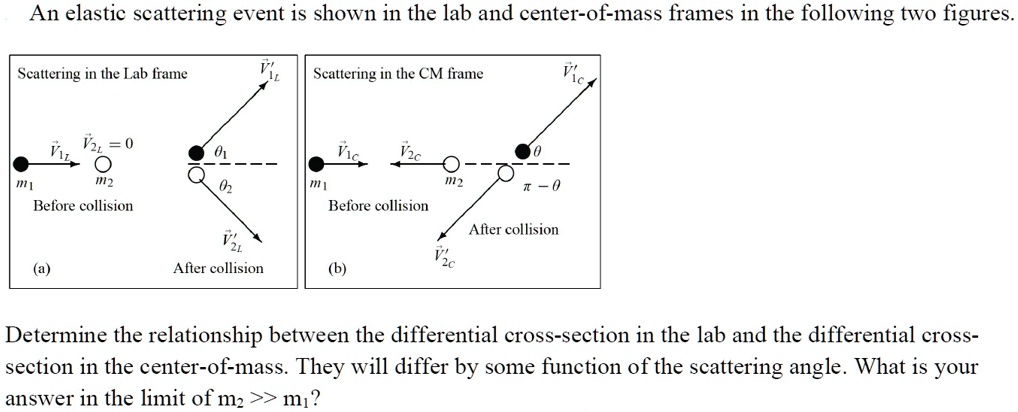
For a 2D collision, the equations become:
- x-momentum:
- y-momentum:
- Kinetic Energy (if elastic):
An interesting result for a 2D elastic collision between two equal masses, where one is initially at rest, is that the angle between their final velocity vectors is always 90°. For a rigorous proof of this, which you might find interesting, you can refer to section 18.5.4 in the MIT "Collision Theory" notes (LINK) you looked at earlier.
4. Variable Mass Systems: Rocket Propulsion
We now turn to a classic engineering application where the mass of the system itself changes: a rocket. A rocket accelerates forward by expelling exhaust gases backward at high velocity. We can't apply directly because is not constant. Instead, we must return to the more fundamental form, .
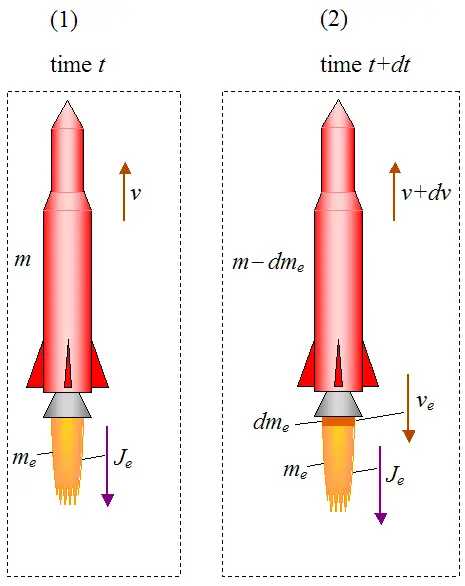
Let's derive the equation of motion for a rocket. Consider a rocket of mass moving at velocity at time . In a time interval , it ejects a small mass of fuel with an exhaust velocity relative to the rocket. The rocket's mass decreases by , and its velocity increases to .
The following video provides a clear, step-by-step derivation of the resulting thrust force using the conservation of momentum.
Class 11 Physics | System of Particles | #32 Mass Variation Cases | For JEE & NEET
The video 'Mass Variation Cases' from Physics Galaxy offers a very clear, calculus-based derivation of the rocket equation, starting from the principle of momentum conservation over an infinitesimal time step.
Please watch the segment from 2:19 to 9:39. Follow the argument for conserving the momentum of the 'rocket + expelled fuel' system between time 't' and 't+dt'. This leads to the fundamental expression for thrust.
The derivation shows that the expelling of gas creates a propulsive force, known as thrust (), on the rocket. If the mass is ejected at a rate with a relative velocity (often written as or ), the thrust is:
Note that since the rocket loses mass, is negative, making the thrust vector point in the same direction as the rocket's velocity (opposite to the exhaust velocity ).
The full equation of motion for the rocket, including an external force like gravity (), is:
This is the fundamental rocket equation.
For a more formal and comprehensive treatment, including how to integrate this equation and an interesting engineering application, please study the following notes.
Lecture D27 - Variable Mass Systems: The Rocket Equation
These MIT lecture notes, 'Variable Mass Systems: The Rocket Equation', provide a complete and rigorous derivation and analysis of the rocket equation.
Please read the following sections: The Rocket Equation (page 1-2): This section presents the formal vector derivation, matching the one we just discussed, and defines thrust. Integration Cases (page 2-3): This shows how to integrate the rocket equation to find the change in velocity (\Delta v) in two common scenarios: no gravity, and constant gravity. This leads to the famous Tsiolkovsky rocket equation. Single vs. Two Stage Rockets (page 4): This is a perfect example of an engineering application that you requested. It shows why multi-stage rockets are so much more effective for reaching orbit.
The key result from integrating the rocket equation in the absence of external forces is the Tsiolkovsky Rocket Equation:
This equation shows that the total change in velocity () depends only on the exhaust velocity () and the ratio of initial to final mass.
Conclusion
In this lesson, we have uncovered another deep principle derived from Newton's laws. By integrating with respect to time, we developed the impulse-momentum framework.
Key Takeaways:
- The Impulse-Momentum Theorem () relates the net impulse from a force to the change in an object's momentum.
- If the net external force on a system is zero, its total momentum is conserved. This is the key to analyzing collisions.
- Collisions are classified by the coefficient of restitution (), which quantifies the conservation of kinetic energy.
- Variable mass systems, like rockets, are analyzed by applying momentum conservation to a system comprising the main body and the ejected mass. This leads to the rocket equation, where acceleration is driven by thrust.
Preview of the Next Lesson:
We have now explored integrating Newton's laws with respect to both time and position. We will now return to applying directly but to more complex scenarios. In the next lesson, you will learn to solve constraint motion problems involving pulleys, strings, and inclined planes using Newtonian dynamics, which requires careful application of free-body diagrams and geometric constraints.