Hello! Welcome to your third lesson in our course on calculus-based mechanics.
In our previous lesson, we analyzed motion by setting up and solving differential equations derived from Newton's second law, . We focused on integrating with respect to time to find and . While powerful, this approach can be mathematically intensive, especially when the force depends on position, as we briefly saw with projectile motion.
Today, we will explore a different, and often more direct, method for analyzing motion. We will integrate Newton's second law with respect to position. This will lead us to two of the most fundamental concepts in physics: work and energy.
This lesson is dedicated to achieving the learning outcome: Derive the work-energy theorem from Newton's second law for a variable force. By the end, you will understand how this theorem provides an elegant bridge between the forces acting on an object and its change in speed, often allowing us to bypass detailed time-based analysis.
1. Work and Variable Forces
You are likely familiar with the definition of work for a constant force: . But what happens when the force is not constant, such as the force exerted by a stretching spring or the gravitational pull on a rocket leaving Earth?
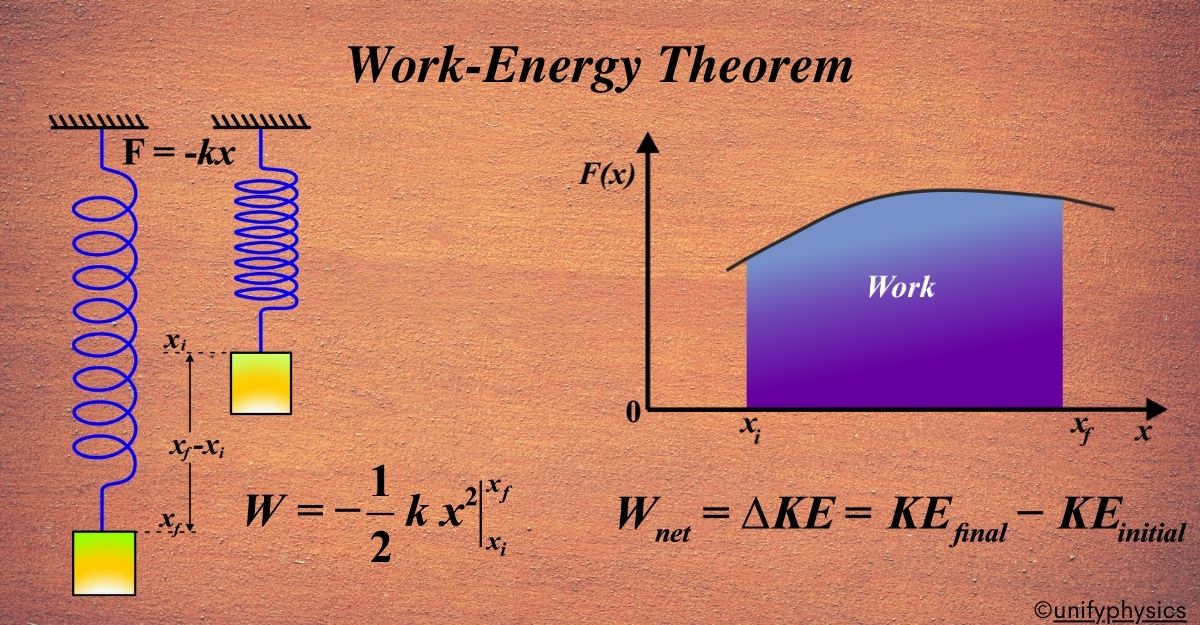
In such cases, we can't simply multiply force by distance. Instead, we must sum up the work done over many infinitesimally small displacements, , over which the force is approximately constant. This summation is, by definition, an integral.
For motion along a straight line (say, the x-axis), the work done by a variable force from position to is:
Graphically, this integral represents the area under the force-vs-position curve.
To familiarize yourself with this integral formulation, please read the short introductory section from the following resource.
CONTENTS - Rankers IIT JEE/NEET Coaching
This text from a JEE Advanced study guide, 'CONTENTS - Rankers IIT JEE/NEET Coaching', formally introduces the concept of work done by a variable force using the integral definition.
Please read the section titled 'Work done by a variable force'. Focus on understanding how the total work is constructed by summing infinitesimal contributions, leading to the integral definition.
2. Deriving the Work-Energy Theorem in One Dimension
Now, let's connect this concept of work directly to Newton's second law. Our goal is to transform into a statement about work and energy. The key is a clever application of the chain rule from calculus.
Consider an object of mass moving in one dimension, with a net force acting on it.
- Start with Newton's second law: .
- The force is a function of position , but acceleration is a derivative with respect to time . To relate them, we use the chain rule to rewrite acceleration:
- Substitute this back into Newton's law:
- Now, we can separate variables. Move the term to the left side:
- Finally, we integrate both sides from an initial state (position , velocity ) to a final state (, velocity ):
- Evaluating the integrals gives:
The left side is the net work done on the object. We define the quantity as the kinetic energy (K) of the object. Thus, we have derived the Work-Energy Theorem:
The following video provides a clear, step-by-step walkthrough of this exact derivation.
Deriving the Work-Energy Theorem using Calculus
The video 'Deriving the Work-Energy Theorem using Calculus' by Flipping Physics is an excellent tutorial that mirrors the derivation we just performed. It emphasizes the crucial chain rule step and clearly defines the resulting terms.
Please watch from the beginning up to the 5:47 mark. Pay close attention to how acceleration is rewritten using the chain rule to change the variable of integration from position to velocity.
The remainder of the video (after 5:47) discusses how the Work-Energy theorem is universally true, unlike some other energy principles that have specific conditions. This universality is what makes it so powerful.
Test your understanding!
A particle of mass kg moves along the x-axis under the influence of a single force (in Newtons). If the particle's speed at m is m/s, what is its speed at m?
Show answer
We use the work-energy theorem, .
First, calculate the net work done by the force from to :
Now, set this equal to the change in kinetic energy:
Notice we found the final speed without ever needing to find or . This is the power of the work-energy approach.
3. Generalization to Three Dimensions: The Line Integral
The 1D derivation is clear, but how does it work for a particle moving along a curved path in 3D space? We need a more general definition of work. The infinitesimal work done by a force over an infinitesimal displacement is given by the dot product:
The total work is the integral of this quantity along the particle's path, from an initial position to a final position . This is known as a line integral:
Now let's derive the work-energy theorem in this general vector form. This derivation uses a different, equally elegant mathematical technique.
- Start with Newton's second law in vector form: .
- Take the dot product of both sides with the velocity vector :
- Recall the product rule for the derivative of a dot product: . Since , we can write:
- Substitute this into our equation: This is a remarkable result in itself. The quantity is the instantaneous power delivered by the force, and it equals the rate of change of kinetic energy.
- To get the work-energy theorem, integrate both sides with respect to time from to :
- Using the definition of velocity, , we have . The left-hand integral becomes the line integral for work: .
- The right-hand integral, by the Fundamental Theorem of Calculus, is simply .
This gives us the general work-energy theorem, valid in three dimensions for any path:
The following video presents this exact vector-based derivation concisely and clearly.
Work-Energy Theorem | Lecture 38 | Vector Calculus for Engineers
In 'Work-Energy Theorem' from his Vector Calculus for Engineers series, Prof. Jeffrey Chasnov provides the rigorous 3D vector derivation. This connects Newton's law to work and kinetic energy via dot products and time integration.
Please watch this short video (about 4.5 minutes). Focus on how the dot product with velocity is used to introduce the derivative of kinetic energy, and how integrating with respect to time leads to the line integral for work.
For a more detailed textbook presentation of both the 1D and 3D derivations, you can refer to the following resource. It also provides worked examples that apply the theorem.
The chapter on 'ENERGY' from Kleppner and Kolenkow's textbook is a classic, rigorous treatment of the subject. It builds the work-energy theorem from the ground up.
I recommend skimming through these sections to reinforce what you've learned. Focus on: Section 4.2: 'Integrating the Equation of Motion in One Dimension' (This is the 1D derivation we did first). Section 4.3: 'The Work-energy Theorem in One Dimension' (Formal definitions). Section 4.4 & 4.5: These sections cover the generalization to several dimensions and the formal statement of the theorem using the line integral, matching our second derivation.

Conclusion
In this lesson, you've derived one of the most fundamental principles in mechanics. By integrating Newton's second law with respect to position instead of time, we have developed a new and powerful tool for analyzing motion.
Key Takeaways:
- Work done by a variable force is calculated by integrating the force over the path of displacement: .
- Kinetic energy is the energy of motion, defined as .
- The Work-Energy Theorem states that the net work done on an object by all forces is equal to the change in its kinetic energy: .
- This theorem is a direct mathematical consequence of Newton's second law and holds true universally.
Preview of the Next Lesson:
We have now seen that integrating with respect to position gives us the work-energy theorem. What happens if we integrate with respect to time? This leads to another powerful conservation principle related to impulse and momentum. In the next lesson, we will derive this relationship and see how it is particularly useful for analyzing collisions and systems where mass changes, such as rockets.