Welcome to the final lesson of our initial setup module. In the previous lessons, we've calibrated your wheel for a realistic feel, established an ergonomic driving position, and configured your in-game assists to create a supportive learning environment. With your sim rig and software now fully prepared, it's time to address the most exciting part: choosing your car.
This lesson is dedicated to selecting a suitable vehicle for your training. The car you learn in has a profound impact on your development as a driver. Starting with something too powerful or unpredictable can be overwhelming and lead to frustration, while the right car will act as a patient teacher, clearly communicating the fundamentals of driving physics. By the end of this session, you will understand the key characteristics of a good "school car" and select one in Gran Turismo 7 that will serve as your trusted companion for the lessons to come.
The Anatomy of a Great "School Car"
Not all cars are created equal when it comes to learning. For your journey from sim racing to real-world track driving, we need a car that helps you build a solid foundation of transferable skills. The ideal learning tool has three key characteristics:
-
Moderate Power: A car with overwhelming horsepower makes learning throttle control incredibly difficult. Every corner exit becomes a tightrope walk, and mistakes are punished instantly. We're looking for a car in the 180-250 horsepower range. This is enough to be engaging and teach you about performance driving, but not so much that you're constantly fighting the car instead of learning from it.
-
Rear-Wheel Drive (RWD): We are specifically choosing a rear-wheel-drive layout. This configuration, where the engine's power is sent only to the rear wheels, is the classic "driver's" setup. It fundamentally forces you to understand and manage weight transfer. Applying too much throttle will cause the rear to lose grip (oversteer), teaching you the delicate balance between steering, throttle, and traction. Mastering RWD provides a deep understanding of vehicle dynamics that is directly applicable to a wide range of performance cars, including many you'd find at a real-world track day.
-
Predictable Handling: A good training car communicates its behavior clearly. It shouldn't be "snappy" or suddenly lose grip without warning. In fact, a car with a small, predictable amount of body roll is beneficial for a learner, as it visually and physically (through your wheel's force feedback) signals how weight is shifting during cornering, braking, and acceleration.
The Contenders: Mazda MX-5 vs. Toyota GR86
Fortunately, the automotive world—and by extension, Gran Turismo 7—has two perfect candidates that fit our criteria: the Mazda MX-5 (also known as the Miata) and the Toyota GR86. Both are celebrated for being affordable, lightweight, rear-wheel-drive sports cars that prioritize driver engagement over raw power.
To understand their distinct personalities, let's turn to a real-world comparison test from the experts at Road & Track.
Mazda Miata vs. Toyota GR86: Road & Track Comparison Test
This article provides an excellent breakdown of how these two cars feel to drive. It will give you insight into their philosophies and why they are such great learning platforms.
Start with the introduction and the section detailing their specifications. Then, focus on the descriptions of the driving experience for the Mazda Miata and the Toyota GR86. As you read, pay close attention to the language used to describe their handling: words like the Miata's "body roll," "purity," and "joy," versus the GR86's "stiffer, sharper" feel and suitability for the track.
As you've just read, while these cars are direct competitors, they offer slightly different experiences.
- The Mazda MX-5 is the purist's roadster. It's lighter and has a softer suspension, which means it communicates weight transfer very clearly through noticeable but controlled body roll. It's often described as being more "playful" and is celebrated as one of the best cars ever made for learning the fundamentals of car control.
- The Toyota GR86 is a bit more "serious." It's stiffer, sharper on turn-in, and generally feels more stable and planted, making it feel immediately at home on a racetrack. It has a bit more power and its limits are slightly higher.
This video from the Everyday Driver channel provides a great visual and narrative companion to the article you just read.
GR86 vs MX5 RF (ND2) - Is Miata Always the answer? | Everyday Driver TV Season 10
Watching these cars in action while hearing the presenters' analysis will solidify your understanding of their characters.
Focus on the handling comparison, where they discuss the "go-kart" feel of the MX-5 versus the stable, communicative nature of the GR86. Then, watch their final thoughts, which excellently summarize which car is right for which purpose. Notice they call the GR86 "the most usable sports car" but the MX-5 the ultimate "toy car" for pure driving fun.
Your First "School Car": The Mazda MX-5
Both cars are exceptional choices, and you cannot make a wrong decision here. However, for the specific purpose of building your skills from the ground up, I recommend we start with the Mazda MX-5.
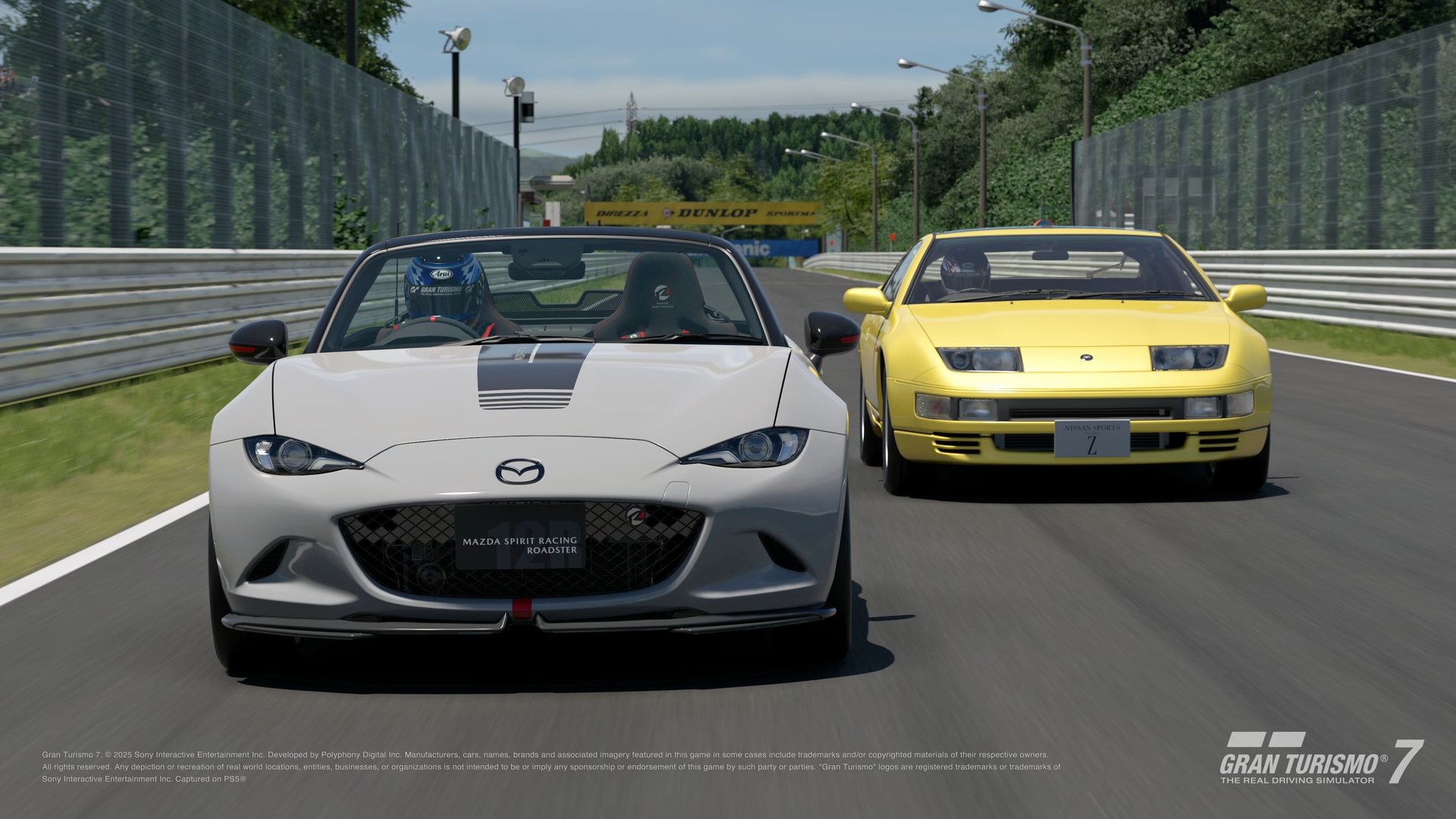
The Mazda MX-5 (front) is an ideal car for learning the fundamentals of track driving due to its balanced handling and moderate power.
Its lower weight, slightly softer suspension, and incredibly direct feedback make it the ultimate classroom on wheels. It will teach you to be smooth and to manage weight transfer effectively, as it communicates everything it's doing so clearly. Mastering the MX-5 will give you skills that make you a better driver in any car you pilot later.
The sim racing community widely regards the MX-5 as one of the best training cars available, and the reasons apply just as well to Gran Turismo 7 as they do to other simulators.
Ultimate Beginners Guide To The Mazda MX5 - 12 Top Tips To Master The Miata On iRacing
This video, while made for the iRacing simulator, perfectly articulates why the MX-5 is such a revered learning tool. The principles are universal.
Watch the short introduction from the beginning where he calls it the "perfect training ground." Then, pay close attention to the section on car control. The concepts of it being "predictable at the limit" and using weight transfer ("lift off oversteer") to help turn the car are exactly what we will be exploring in our upcoming lessons.
Practical Steps: Acquiring Your Car
It's time to head to the in-game dealership.
- From the Gran Turismo 7 World Map, navigate to Brand Central.
- Select the Asia-Pacific region, then find and enter the Mazda dealership.
- Browse the available cars and purchase the Roadster S (ND) '15. This is the standard, road-going version of the latest generation MX-5 and costs a very reasonable 28,900 Credits.
If you have a strong preference for the Toyota, you can purchase the GR86 RZ '21 from the Toyota dealership instead. Both will serve you well. For the purposes of our lessons, I will assume you are using the Mazda MX-5.
Practice Drill: First Impressions (15-20 Minutes)
With the car in your garage, let's take it for a spin. The goal here is not speed, but simply to get acquainted with your new vehicle.
- Car: Mazda Roadster S (ND) '15
- Track: Tsukuba Circuit
- Mode: From the World Map, select
World Circuits, navigate toAsia-Oceania, and chooseTsukuba Circuit. SelectTime Trialto have the track to yourself. - Assist Settings: Ensure you are using the
Customprofile we created in the last lesson (TCS2, ABSDefault, etc.).
Instructions:
Drive 10-15 laps of the circuit. Don't worry about the racing line, braking points, or your lap time. Just focus on the feel of the car.
- How does it respond to your steering? Is it immediate?
- On the exit of the slow hairpins, can you feel the subtle intervention of the Traction Control if you apply the throttle too early?
- Under heavy braking for Turn 1, feel the stability provided by the ABS.
- Most importantly, just get comfortable. This car will be your partner as we dive into the core techniques of track driving.
Conclusion
You have now completed the foundational module of your training. Your physical and virtual environments are optimized, and you have selected an ideal car to begin your journey. You've chosen a vehicle celebrated for its ability to teach, and this choice will pay dividends as we move into more complex techniques.
Key Takeaways:
- A great starter car for learning track driving should have moderate power, a rear-wheel-drive layout, and predictable, communicative handling.
- The Mazda MX-5 and Toyota GR86 are perfect examples of this philosophy.
- You have selected the Mazda Roadster S (ND) '15 as your primary "school car" due to its exceptional ability to teach the fundamentals of car control.
Now that we have our car and our settings, we are ready to learn how to drive it. In our next lesson, we will begin the "Foundations of Vehicle Dynamics" module. We'll start with the single most important concept in performance driving: weight transfer. You'll learn how every input you make—braking, accelerating, and steering—shifts the car's weight, and how managing that shift is the key to unlocking grip and speed.