Hello! Welcome to the final lesson in our module on Decision Trees and Random Forests.
In our previous lessons, we've successfully built a complete Random Forest from scratch, including a prediction function that aggregates votes from all the individual trees. Now, a crucial question arises: how do we evaluate the performance of our model? So far, we've learned about using train-test or train-validation-test splits. But Random Forests offer a clever, built-in alternative.
This lesson addresses the learning outcome: Implement out-of-bag (OOB) error estimation as an alternative to a validation set. We will explore what OOB samples are, why they are a "free" by-product of the Random Forest training process, and how we can implement a robust evaluation metric using them.
Recap: The Role of Bootstrapping
Remember how we trained our Random Forest? For each of the n_trees in our forest, we didn't use the entire training dataset. Instead, we used bootstrapping: creating a new dataset of the same size by sampling from the original data with replacement.
This sampling method is the key to OOB estimation. Because we sample with replacement, some data points from the original set will be selected multiple times for a given tree's training set, and more importantly, some will not be selected at all.
What are Out-of-Bag (OOB) Samples?
The data points that are not included in the bootstrap sample used to train a specific tree are called the out-of-bag (OOB) samples for that tree.
Statistically, it can be shown that for a large dataset, about two-thirds (≈63.2%) of the original data points will be in any given bootstrap sample, leaving about one-third (≈36.8%) as OOB samples.
This means that every tree in our forest has been trained on a slightly different subset of the data, and for each tree, there's a portion of the original data it has never seen. We can use this "unseen" data as a validation set to test the performance of that tree.
To get a clear visual intuition for this concept, please watch the following video.
StatQuest: Random Forests Part 1 - Building, Using and Evaluating
The StatQuest video 'Random Forests Part 1 - Building, Using and Evaluating' provides an excellent and intuitive explanation of what OOB data is and how it's created.
Please watch from 05:53 to 06:53. This segment visually demonstrates how bootstrapping leads to an 'out-of-bag' dataset for each tree.
The OOB Error Estimation Procedure
Since each tree has its own set of OOB samples, we can't just test the whole forest on one OOB set. Instead, the OOB score is calculated on a sample-by-sample basis for the entire training set. The process is as follows:
- For each data point in the original training set, identify all the trees that did not use this data point in their training (i.e., the trees for which this point was OOB).
- Pass that single data point through all of those identified trees to get their predictions.
- Take a majority vote of these predictions to get a single, final OOB prediction for that data point.
- Repeat this for all data points in the original training set.
- The OOB score is the accuracy (or another metric) calculated by comparing these OOB predictions against the true labels. The OOB error is simply
1 - OOB score.
The following image provides a brilliant step-by-step walkthrough of this process.
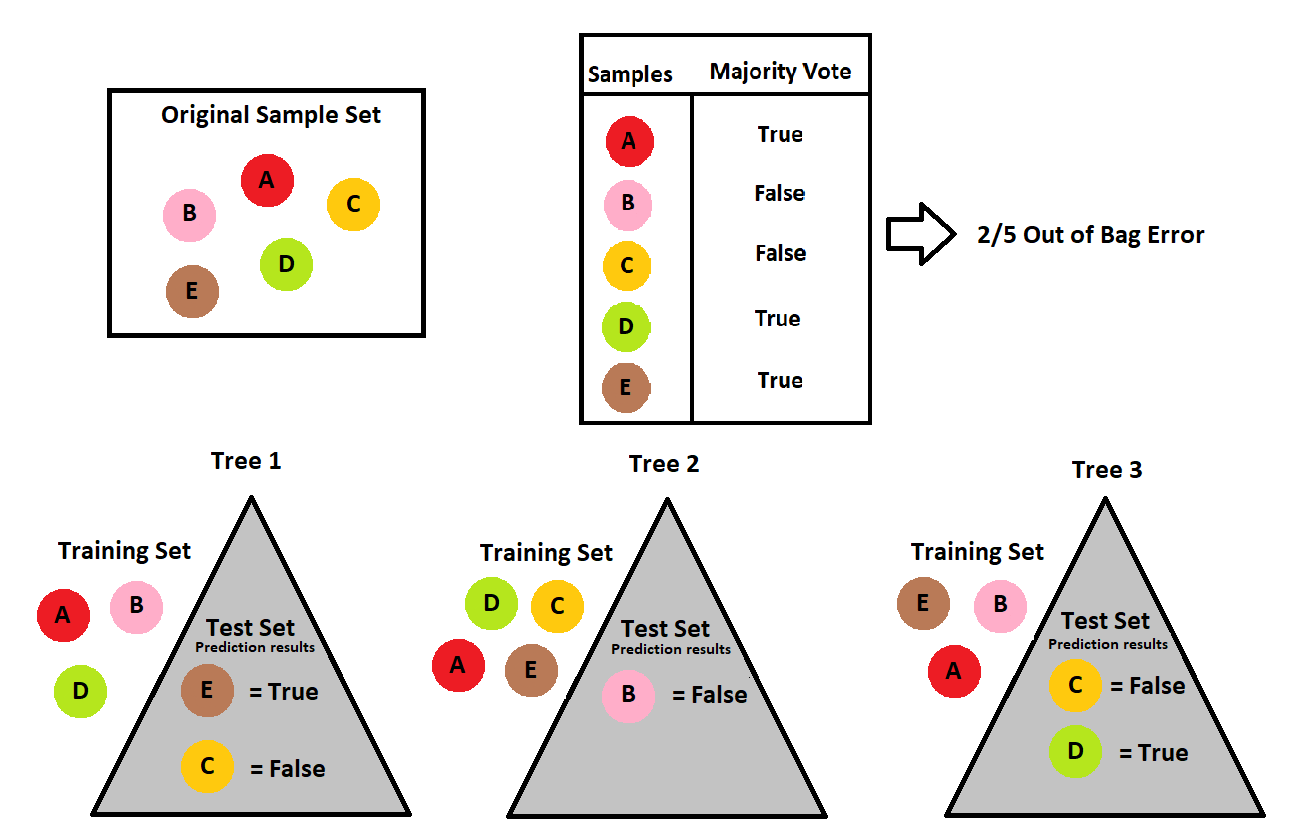
To solidify your understanding of how this process serves as a validation mechanism, let's watch another short video.
Out Of Bag Evaluation(OOB) And OOB Score Or Error In Random Forest
The video 'Out Of Bag Evaluation(OOB)' by Krish Naik clearly explains how this technique replaces the need for a separate validation set, which is one of its primary benefits.
Watch from 03:15 to 06:36. This section explains how OOB data acts as a validation set and discusses the ~1/3 split between OOB and training data.
Implementing OOB Error Estimation
Now, let's integrate this into the RandomForest class you've already built. We need to modify our fit method to keep track of OOB samples and calculate the final score.
Here is the high-level plan:
- Modify
fit: Inside the loop that builds each tree, we need to identify and store the indices of the OOB samples for that tree. - Store Predictions: We need a data structure to store the predictions for each sample, made only by the trees that held it out. A list of lists is a good choice, where
oob_predictions[i]will hold all predictions for samplei. - Calculate Final Score: After all trees are trained, we'll iterate through our stored OOB predictions, determine the final OOB prediction for each sample via majority vote, and compute the overall accuracy.
Let's look at the code. You will need to update your fit method to include this logic.
# You will need your helper function from the previous lesson
from collections import Counter
import numpy as np

def most_common_label(y):
    counter = Counter(y)
    if not counter:
        # Handle cases where there are no predictions (should be rare)
        return None
    return counter.most_common(1)[0][0]

class RandomForest:
    # Your __init__, _create_bootstrap, predict, etc. methods remain here
    # ...

    def fit(self, X, y):
        """
        Trains the Random Forest and calculates the OOB score.
        """
        self.trees = []
        n_samples = X.shape[0]

        # A list of lists to store OOB predictions for each sample.
        # oob_predictions[i] will be a list of votes for sample i.
        oob_predictions = [[] for _ in range(n_samples)]

        for _ in range(self.n_trees):
            # 1. Create a bootstrap sample and get OOB indices
            bootstrap_indices = np.random.choice(
                n_samples, size=n_samples, replace=True
            )
            # A set is much faster for checking membership (`in`)
            bootstrap_indices_set = set(bootstrap_indices)
            oob_indices = [i for i in range(n_samples) if i not in bootstrap_indices_set]

            X_bootstrap, y_bootstrap = X[bootstrap_indices], y[bootstrap_indices]

            # 2. Train a tree on the bootstrap sample
            tree = DecisionTree(
                min_samples_split=self.min_samples_split,
                max_depth=self.max_depth,
                n_features=self.n_features
            )
            tree.fit(X_bootstrap, y_bootstrap)
            self.trees.append(tree)

            # 3. Use the trained tree to predict its OOB samples
            if len(oob_indices) > 0:
                X_oob = X[oob_indices]
                oob_preds_for_tree = tree.predict(X_oob)

                # 4. Store these predictions
                for i, pred in zip(oob_indices, oob_preds_for_tree):
                    oob_predictions[i].append(pred)

        # 5. Calculate the final OOB score after all trees are trained
        oob_correct_predictions = 0
        total_oob_samples_evaluated = 0
        for i in range(n_samples):
            # Only evaluate samples that were OOB for at least one tree
            if len(oob_predictions[i]) > 0:
                total_oob_samples_evaluated += 1
                final_oob_pred = most_common_label(oob_predictions[i])
                if final_oob_pred == y[i]:
                    oob_correct_predictions += 1

        # Store the OOB score as an attribute of the model
        if total_oob_samples_evaluated > 0:
            self.oob_score_ = oob_correct_predictions / total_oob_samples_evaluated
        else:
            # This would happen only if n_trees is very small or dataset is tiny
            self.oob_score_ = 0.0
Code Walkthrough:
- Step 1 & 2: We initialize
oob_predictionsas a list of empty lists. Inside our main loop, after creatingbootstrap_indices, we efficiently findoob_indices. - Step 3 & 4: After a tree is trained, we immediately use it to predict its corresponding
X_oob. We then iterate through the OOB indices and their predictions, appending each prediction to the correct list inoob_predictions. For example, if samplei=5was OOB for this tree and the tree predicted1, we performoob_predictions[5].append(1). - Step 5: After the loop finishes,
oob_predictionsis fully populated. We iterate through it one last time. For each sampleithat has received at least one OOB vote, we calculate the majority vote (final_oob_pred) and check if it's correct. We sum up the correct predictions and divide by the number of samples we were able to evaluate. self.oob_score_: We store the final score as a class attribute. The trailing underscore is a common convention (used by Scikit-learn) for attributes that are learned or derived from the training data during thefitprocess.
The following resource provides code examples for a similar implementation strategy. While the structure is slightly different, it reinforces the core ideas of identifying OOB samples and using them for evaluation.
The article 'Random Forests From Scratch' by Mattia Carbonati provides concise Python functions that show the logic for OOB implementation.
Review the Python functions draw_bootstrap, oob_score, and random_forest. Note how draw_bootstrap returns both the bootstrap and OOB samples. The oob_score function calculates error for a single tree, and random_forest calls it in a loop. This is a slightly different approach (averaging per-tree errors) than our per-sample aggregation, but the underlying principle of using OOB data is the same.
Test your understanding!
Why is it generally better to calculate the OOB score by taking a majority vote for each sample across the relevant trees, rather than calculating an error score for each tree on its OOB set and then averaging those scores?
Show answer
The method of taking a majority vote for each sample more closely mimics how the Random Forest makes predictions on new, unseen data. The final prediction of the forest is based on the collective vote of all trees. Therefore, evaluating the collective vote of the OOB trees for a given sample gives a more accurate estimate of the entire forest's generalization error.
Averaging the individual error scores of each tree can be misleading. Some trees might be weak and have high OOB errors, while others are strong with low OOB errors. A simple average of these errors doesn't fully capture the corrective power of the ensemble's majority vote.
Conclusion
Congratulations on completing this module! You have now implemented a full-fledged Random Forest from scratch, complete with sophisticated prediction aggregation and a built-in, data-efficient evaluation mechanism.
Key Takeaways:
- Out-of-Bag (OOB) samples are the data points not selected during the bootstrapping process for a specific tree.
- These samples act as a "free" validation set for the forest, allowing for reliable performance estimation without sacrificing training data for a separate validation split.
- The OOB score is calculated by generating an aggregate prediction for each sample using only the trees that did not train on it.
- The implementation involves tracking which samples are OOB for each tree, collecting their predictions, and then performing a final majority vote for each sample.
Preview of the Next Lesson:
We have now mastered bagging (Bootstrap Aggregating), an ensemble technique where models are built in parallel. In the next module, we will explore a different, powerful family of ensemble methods: boosting. We'll start by implementing a decision stump (a one-level decision tree) to act as a "weak learner" and then use it to build our first boosting algorithm, AdaBoost, where trees are built sequentially, with each new tree focusing on the mistakes of the previous one.