Welcome to our third lesson. In our previous session, we explored the three fundamental machine learning paradigms: supervised, unsupervised, and reinforcement learning. You now have a framework for mapping business problems to the appropriate learning approach. Today, we zoom out to examine the entire journey of a machine learning model, from a business idea to a live, value-generating asset in your enterprise ecosystem.
This lesson addresses the end-to-end ML model lifecycle. We will break down the process into its core stages: data preparation, training, validation, deployment, and monitoring. For you as a solution architect, this is not about learning to perform each step, but about understanding the flow, the dependencies, and the architectural requirements needed to support this process at scale. Just as you architect CI/CD pipelines for software, you will learn to think about the "factory" for building and operating ML models.
From SDLC to MDLC: A Familiar Framework
As an experienced architect, you are intimately familiar with the Software Development Lifecycle (SDLC)—the structured process for building software. The Machine Learning Development Lifecycle (MDLC) shares a similar spirit but has unique complexities because it involves three moving parts: code, models, and data.
To frame this concept, the following video provides an excellent comparison between SDLC and MDLC, setting the stage for the machine learning-specific steps we will cover.
What is machine learning lifecycle? | What is Model Development Life Cycle (MDLC)? MDLC vs SDLC
Watch this introductory segment comparing the familiar SDLC with the emerging MDLC.
Please watch the first two minutes of the video, from the beginning to the point where the speaker starts detailing the steps of an ML project. This will help you connect the new concepts to your existing knowledge of software development. Watch the comparison between SDLC and MDLC.
The key takeaway is that while SDLC is primarily code-driven, the MDLC is an iterative, research-centric process where data and models are just as important as the code that processes them.
An Overview of the ML Model Lifecycle
The ML lifecycle is a series of iterative stages that guide a model from conception to production and beyond. While different organizations may label the stages differently, the core process remains consistent.
The diagram below presents a clean, high-level view of the end-to-end lifecycle, showing how code, model, and data artifacts evolve through each stage.
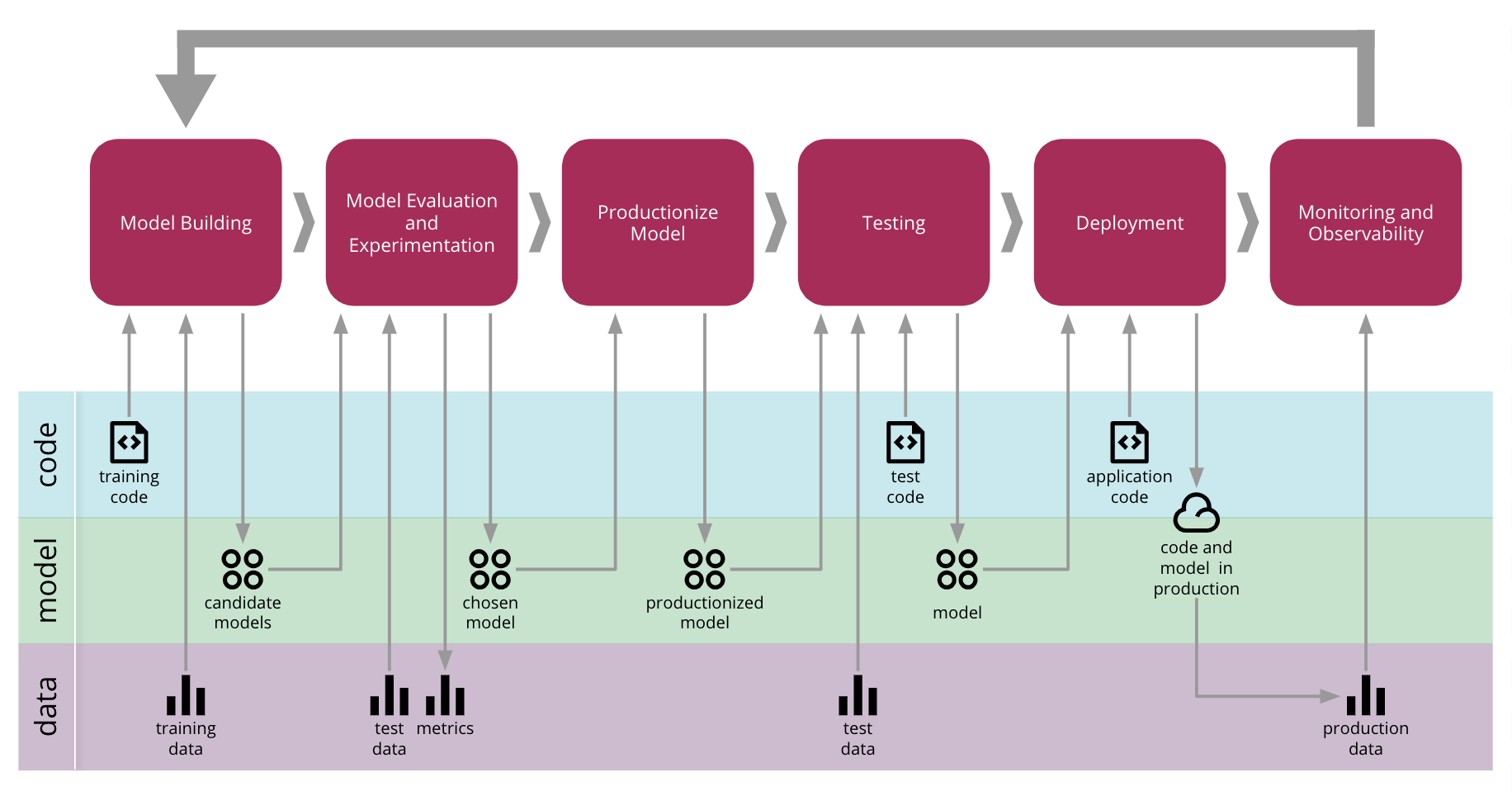
Let's now walk through these stages in more detail, always keeping an architect's perspective in mind. The Fiddler.ai article, "Guide to Machine Learning Model Lifecycle Management," provides a solid textual overview of this process. We will refer to it as we explore each phase.
Guide to Machine Learning Model Lifecycle Management
This article provides a comprehensive breakdown of the seven key stages of the ML lifecycle, from data collection to monitoring.
For now, you can skim the article to get a sense of the overall flow. We will be focusing on specific stages as we proceed through the lesson. Pay particular attention to the headings that define each stage, such as Data Collection and Preparation and Deployment and Integration.
Phase 1: Business & Data Understanding
Every ML project begins not with an algorithm, but with a business problem. The first phase involves defining the problem, assessing its feasibility, and understanding the data required to solve it.
- Business Problem Framing: Translating a business goal (e.g., "reduce customer churn") into a specific ML task (e.g., "build a binary classification model to predict which customers are likely to churn in the next 30 days").
- Data Collection & Preparation: This is arguably the most critical and time-consuming phase. As an architect, your focus here is on the data infrastructure.
- Sourcing: Where will the data come from? Internal databases, data lakes, third-party APIs, event streams?
- Pipelines: How will you build robust, repeatable pipelines to ingest, clean, and transform this data into a usable format for model training? This connects directly to your expertise in systems integration and cloud data services.
- Quality & Governance: How will you ensure data quality, privacy (e.g., GDPR), and security?
The initial steps of the lifecycle, from problem definition to data collection, are foundational. The following video segment explains these early-stage considerations.
What is machine learning lifecycle? | What is Model Development Life Cycle (MDLC)? MDLC vs SDLC
This part of the "What is machine learning lifecycle?" video covers the critical initial phases of problem definition, design, and data collection.
Watch the section from problem statement to data collection. Notice the key questions an architect must consider: Is ML necessary? Can we use a pre-built solution? What are the data sourcing and privacy implications?
Phase 2: Model Experimentation (Train, Validate, Select)
Once a prepared dataset is available, the process moves into a highly iterative phase of experimentation. This is the primary domain of data scientists, but they rely on the infrastructure and tools you architect.
This phase typically includes:
- Feature Engineering: Creating predictive signals from the raw data.
- Model Training: Using an algorithm and the training data to learn patterns.
- Model Validation & Selection: Evaluating different models against a validation dataset to see how well they perform on unseen data and selecting the best one based on performance metrics and business goals.
From an architect's viewpoint, your responsibility is to enable this experimentation loop by providing:
- Scalable compute environments (e.g., cloud VMs with GPUs).
- Tools for experiment tracking to log parameters, code versions, and results for reproducibility.
- Versioning systems that can handle not just code (like Git) but also large datasets and model files.
This short video segment provides a clear overview of the training and evaluation process.
What is machine learning lifecycle? | What is Model Development Life Cycle (MDLC)? MDLC vs SDLC
This segment explains the core activities of the model training phase.
Watch the clip from the model training phase. This covers the iterative process of trying different models, tuning them, and evaluating their performance to select a candidate for deployment.
Phase 3 & 4: Deployment & Monitoring (Operationalization)
Getting a model into production and keeping it there is where the discipline of MLOps (Machine Learning Operations) becomes critical. This is where your role as a solution architect is paramount, drawing heavily on your background in cloud platforms and DevOps practices.
A model is not a piece of static software; its performance can degrade over time as the real world changes. This phenomenon is known as model drift or concept drift. Therefore, the lifecycle doesn't end at deployment; it enters a continuous loop of monitoring and maintenance.
The following AWS Summit talk, designed specifically for architects, provides an excellent overview of the challenges in operationalizing ML and presents a practical MLOps architecture.
AWS Summit ANZ 2022 - End-to-end MLOps for architects (ARCH3)
This video from an AWS Summit provides a practitioner's view on building an end-to-end MLOps architecture.
This is a key resource for you. Please watch the following sections carefully: The ML Process: A quick recap of the lifecycle, emphasizing the importance of monitoring. Challenges and What is MLOps: This section highlights the common failure points in taking models to production and defines MLOps as the solution. Minimal MLOps Setup: This is the most important part. The speaker walks through an architecture diagram showing how to automate the deployment and retraining process using version control, a model registry, and CI/CD principles.
As you saw in the video, a robust MLOps setup involves several key architectural components:
- Source Control: For code, but also for tracking data and model artifacts.
- Automation Pipelines (CI/CD/CT):
- Continuous Integration (CI): Automating the testing of data, code, and models.
- Continuous Delivery (CD): Automatically deploying a new model or the pipeline that trains it.
- Continuous Training (CT): Automatically retraining models when new data is available or performance degrades.
- Model Registry: A central, versioned repository to store, manage, and govern trained models.
- Monitoring: Continuously tracking model performance, data drift, and operational metrics in production. This system provides the "feedback" that can trigger a retraining pipeline, thus closing the lifecycle loop.
Putting It All Together: The MLOps View
The entire lifecycle, with its various pipelines and feedback loops, can be visualized as a comprehensive engineering system.
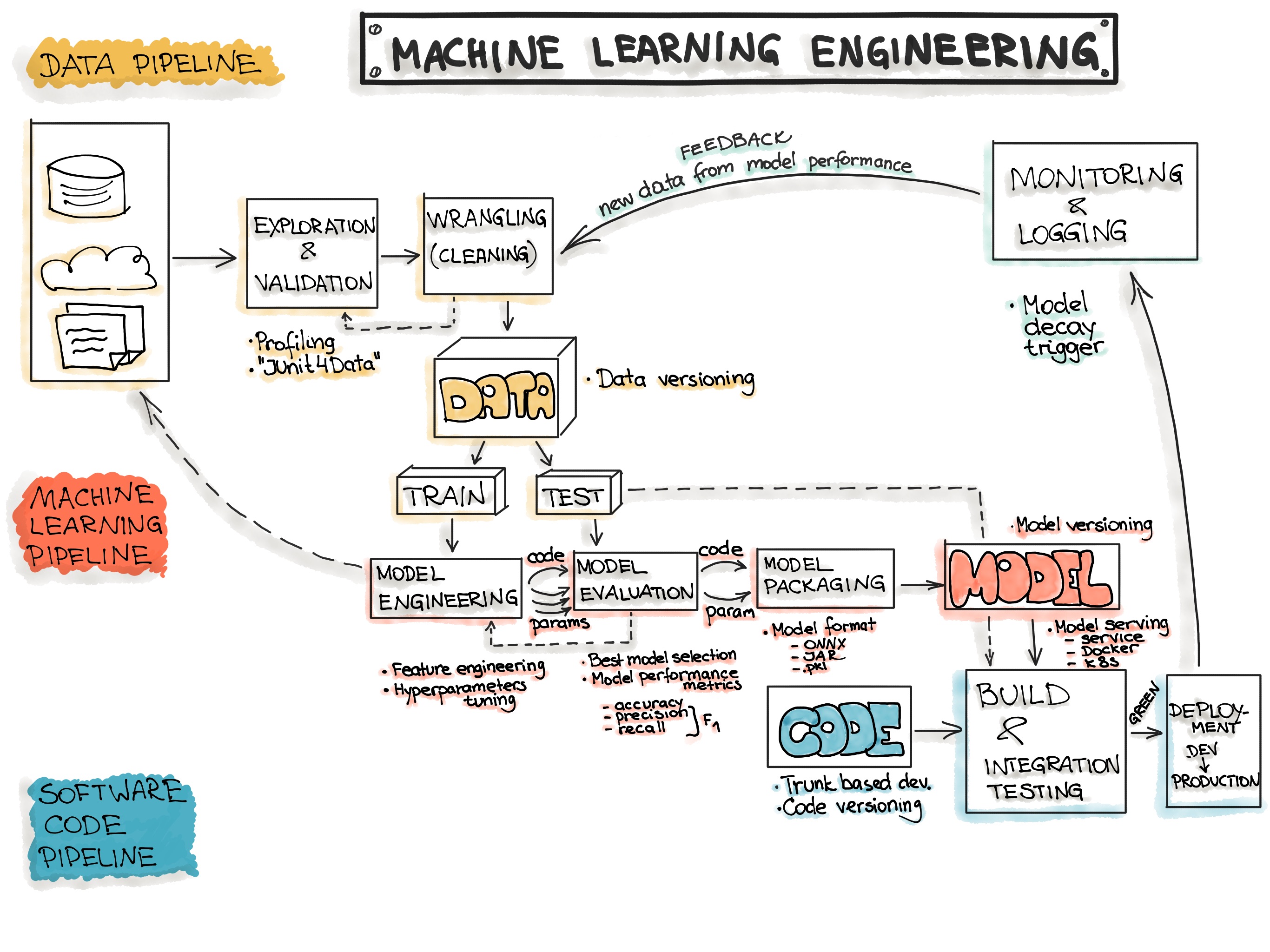
To give you a structured reference for your architectural work, the "MLOps Principles" article provides a detailed breakdown of testing, monitoring, and other key practices. The summary table is particularly useful.
This article provides deep, actionable principles for building and operating ML systems.
Please focus on these sections to understand the architect's responsibilities in ensuring a robust lifecycle: Read the definitions of Continuous X to solidify your understanding of CI/CD/CT/CM in the ML context. Skim the sections on Testing and Monitoring. You don't need to memorize the details, but appreciate the scope of testing and monitoring required for an ML system compared to traditional software. Finally, study the Summary Table. This is an excellent checklist that maps principles like Versioning, Testing, and Automation across Data, Model, and Code.
Conclusion
In this lesson, we have journeyed through the entire machine learning model lifecycle. We saw that it is an iterative, multi-faceted process that goes far beyond simply training a model.
Key Takeaways:
- The ML Development Lifecycle (MDLC) is analogous to the SDLC but is complicated by the interplay of code, data, and models.
- The core stages are Data Preparation, Model Training & Validation, Deployment, and Monitoring.
- Experimentation is central to the development phase, requiring infrastructure for iterative training and evaluation.
- Models are not static; they degrade in production. This necessitates a continuous loop of monitoring and retraining.
- MLOps is the application of DevOps principles to automate and manage this lifecycle, ensuring that ML models can be deployed and maintained in a reliable, repeatable, and scalable way.
- As a solution architect, your role is to design the "factory"—the integrated pipelines, platforms, and governance frameworks—that enables this entire lifecycle.
You now understand the path a model takes from an idea to a production service. In our next lesson, we will zoom in on a critical step in this process: model evaluation. We will learn how to interpret key metrics like accuracy, precision, and recall, and, more importantly, how to assess their direct impact on business outcomes.