Welcome to the final lesson of our first module, "AI and ML Foundations for Solution Architects." Over the past four lessons, we've journeyed from distinguishing between different AI concepts and learning paradigms to understanding the end-to-end ML lifecycle and, most recently, interpreting key model evaluation metrics. You now have the foundational vocabulary to understand what AI/ML is and how its performance is measured.
This lesson brings all those concepts home by addressing a crucial question for your role: what are the distinct responsibilities of a solution architect versus a data scientist in an AI project? As a seasoned solution architect, you are accustomed to being the bridge between business needs and technical implementation. This lesson will clarify how that bridging role is adapted, amplified, and focused in the context of AI, allowing you to define your position and maximize your impact on these transformative initiatives.
The Core Distinction: System Builder vs. Insight Discoverer
The most fundamental way to understand the difference between a solution architect and a data scientist is by their primary objective. A data scientist is an insight discoverer. Their main goal is to explore data, run experiments, and build, train, and validate models to uncover patterns and make predictions. They answer the question, "What can the data tell us?"
In contrast, as a solution architect, you are the system builder. Your focus is on designing the end-to-end enterprise solution that contains the model and delivers its insights as a scalable, secure, and reliable service. You answer the question, "How do we integrate this capability into the business to create value?"
The following video, while framed as "Data Scientist vs. AI Engineer," provides an excellent breakdown of these two worlds. For our purposes, think of the "AI Engineer" role described here as the system-building function you, the architect, will be designing for.
Data Scientist vs. AI Engineer
This IBM Technology video provides a clear and concise comparison of the two roles across four key dimensions. As you watch, focus on the contrast between the "data storyteller" and the "AI system builder."
Please watch the segments covering the four key differences: Use Cases: Note the distinction between descriptive/predictive analytics (data science) and prescriptive/generative systems (architecture/engineering). Data: Understand the typical data types each role focuses on—structured for traditional data science vs. unstructured for modern generative AI systems. Models: Grasp the difference between the many specialized models in a data scientist's toolkit and the large, general-purpose foundation models that architects now integrate. Process & Techniques: This is a crucial distinction. Contrast the data scientist's process of training a model from data with the architect/engineer's process of leveraging pre-trained models via techniques like prompt engineering and Retrieval-Augmented Generation (RAG).
As the video highlights, the data scientist's world is one of statistical analysis, feature engineering, and model training. The architect's world is increasingly about leveraging powerful, pre-existing components (like foundation models) and designing the complex systems that surround them—a task that perfectly aligns with your background in cloud platforms and systems integration.
A Framework for Your Architectural Responsibilities
Now that we have a high-level distinction, let's put a more formal structure around the architect's specific duties in an AI project. The following article provides an excellent breakdown of the key domains an ML Solution Architect covers.
ML Solution Architect - Introduction
This article from LinkedIn by Mediboyina Rupesh Kumar Yadav clearly defines the scope of an ML Solution Architect. It moves beyond a simple comparison and offers a practical list of responsibilities that will form the core of your work.
Please read the entire article. As you read, pay close attention to the five divisions of coverage. These provide a robust framework for your role: Business Understanding: This is your traditional starting point, but now includes identifying where ML can specifically address inefficiencies. Identification and Verification of ML Techniques: You don't need to invent algorithms, but you do need to validate that a chosen approach is feasible, often through a Proof of Concept (POC). System Architecture Design: This is your core territory, designing the platform that supports the entire ML lifecycle for all personas involved. MLOps: Designing the automation for CI/CD, a topic we will cover in-depth in a later module. Security and Compliance: Applying your architectural governance skills to the unique challenges of ML platforms and models.
This framework makes it clear that while data scientists are deep in the "model building" and "experimentation" phases, the architect owns the overarching platform and operationalization strategy. Your job is to create the environment where data scientists can be effective and to ensure their work translates into a functional, secure, and valuable enterprise asset.
The View from the Trenches: A Real AI Architect's Perspective
To move from the theoretical to the practical, let's hear from a senior AI architect at a large enterprise. This interview reveals where an architect actually spends their time and which skills are most critical.
What Does an AI Architect Actually Do? Interview With a Real AI Architect
This interview from the Go Cloud Architects channel features Praveen Dwivedi, a Senior VP and AI Architect at JPMorgan Chase. His experience provides a real-world validation of the principles we've discussed.
Please watch the following key clips from the interview: What an AI Architect Actually Does: Listen to Praveen's breakdown of his time. He states that 70% of his time is spent understanding business problems and coordinating with stakeholders, not on hands-on engineering. The Scope of the Team: Note the sheer number of stakeholders an architect must align, dealing with at least 30 other architects from security, FinOps, and other domains. Ranking Critical Skills: This is a powerful segment. Pay attention as he ranks skills like Communication, Leadership, and Emotional Intelligence as 10/10 in importance, while rating deep Technical Knowledge a 6/10—necessary, but not the primary differentiator. The Un-automatable Job: Listen to his description of asking probing "why" questions to the business. This critical thinking and business context is something AI itself cannot replace.
Praveen's testimony underscores a vital point: your success as an AI architect will be determined less by your ability to code in Python and more by your ability to communicate, lead, and apply business acumen to a technical domain. Your existing skills in stakeholder management and systems thinking are not just relevant; they are your primary assets.
Visualizing the Team and the System
Finally, let's use two visuals to summarize the division of labor and the architectural output.
First, this matrix illustrates the different skill concentrations within a data team.

As you can see, the Data Scientist is the specialist in quantitative methods. The architect's strength lies in broad technical and system knowledge, enabling them to design the complete solution.
So, what does that complete solution look like? The following diagram shows a typical architecture for a modern application using a Large Language Model (LLM).
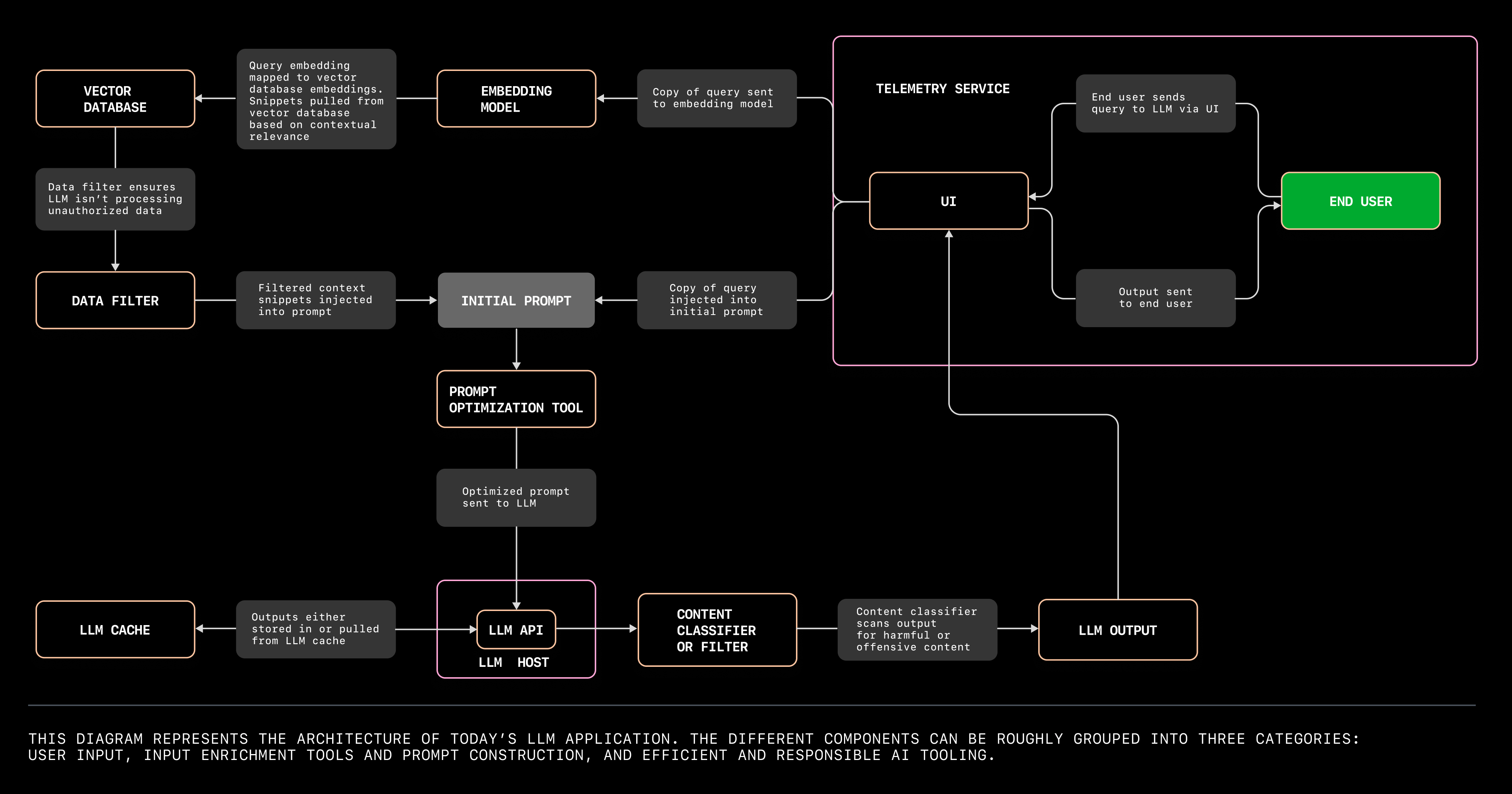
This diagram is your blueprint. It demonstrates that the model is just one piece of a much larger puzzle that you, as the architect, are responsible for designing and assembling.
Conclusion
This lesson marks a pivotal point in the course, clarifying your specific role in the AI landscape. You are not expected to be a data scientist, but you are expected to be their most important partner.
Key Takeaways:
- Data Scientists discover insights; Solution Architects build systems. The former focuses on experimentation and model creation, the latter on integration, operationalization, and delivering business value.
- Your responsibilities as an architect span the entire lifecycle from a systems perspective: business understanding, technology verification, platform architecture, MLOps, and governance.
- The essential, non-negotiable skills for an AI architect are communication, leadership, business acumen, and stakeholder management. Deep technical knowledge is a foundation, but these "soft" skills deliver architectural success.
- Your output is the end-to-end system design that orchestrates data, models, APIs, and security controls to meet an enterprise need.
You have now completed the foundational module of this course. You have a solid grasp of the core concepts, the development lifecycle, evaluation criteria, and your own role within an AI team.
In the next module, we will dive into the single most important prerequisite for any successful AI initiative: data. Our first lesson in "Data Architecture for AI Readiness" will introduce the concept of a data maturity model, providing you with a framework to assess an organization's readiness to even begin its AI journey.