Hello! Welcome to the start of your course on industrial product design. I'm excited to guide you through this journey.
Given your hands-on role in managing the entire product lifecycle—from concept to manufacturing—you already possess a wealth of practical experience. Our goal in this first module is to build on that foundation by introducing structured frameworks that can help formalize your process, making it more efficient, predictable, and ultimately, more successful.
This first lesson addresses a fundamental question: Why bother with a structured process at all? We'll explore the rationale behind systematic product development and see how it transforms a potentially chaotic and risky endeavor into a manageable and value-driven one. This will lay the groundwork for the more specific methodologies and techniques we'll cover later.
What is Product Development?
Before we dive into the "why," let's establish a clear definition of "product development." It's a term that's used often, but its scope can be broad.
To get a concise overview, please watch the first two minutes of the following video. It defines product development, explains why it matters, and clarifies the distinction between improving an existing product and creating something entirely new (New Product Development or NPD).
Product Development Explained in 9 minutes
This segment from Leaders Talk - ThinkEduca provides a clear and quick introduction to the concept of product development.
Please watch from 00:41 to 02:06. Focus on the core definition of product development and the difference between 'product development' and 'new product development' (NPD).
As the video highlights, every NPD effort is a form of product development, but not all product development involves creating a brand-new product. In your work with AV mounting equipment, you likely engage in both: making incremental improvements to existing mounts (product development) and designing entirely new mounting solutions (NPD). A structured process is valuable for both.
The Rationale for a Structured Process
In a small firm, it's common for the development process to be fluid or "ad-hoc," driven by immediate needs and the team's intuition. While this can be fast and flexible, it often leads to common pitfalls:
- Misalignment between the final product and what customers actually need.
- Unexpected manufacturing problems discovered late in the process.
- Cost and schedule overruns.
- Key project knowledge being lost when a team member leaves.
A structured process is the antidote to these problems. It's not about rigid bureaucracy; it's about creating a roadmap that helps you navigate complexity and make better decisions.
To understand the core benefits, please read the following article excerpt.
New product development process: Key stages, frameworks, and ...
This article from CleverX, titled 'New product development process: Key stages, frameworks, and best practices', clearly outlines why structured processes are so effective.
Please read the section titled 'Why structured development processes improve outcomes'. It begins right after the main introduction. Focus on the four key benefits described: preventing common failures, enforcing decision gates, coordinating activities, and facilitating learning.
Key Benefits Explained
The article you just read provides a great summary. Let's break down those benefits with your context as a mechanical engineer in mind.
1. Manages Risk and Investment
Structured processes use stage-gates or decision gates. At the end of each stage, the team must pause and present evidence that the project is still on track and deserves further investment of time and money.
As an engineer, this means you get clear go/no-go decisions before committing to expensive detailed design, tooling, or prototyping. It prevents the classic scenario of pouring resources into a flawed concept that should have been shelved earlier.
2. Coordinates Cross-Functional Collaboration
Even in a small firm, product development involves different functions: design (you), manufacturing, and likely someone handling sales or customer feedback. A structured process defines how these roles intersect.
Please read the following excerpt from a paper written for engineers about NPD. It perfectly describes how different functional groups work together.
[PDF] New Product Development for Engineers
This paper, 'New Product Development for Engineers', frames the NPD process from a technical perspective.
Read the subsection 'A. NPD Process' (it starts just after Table I). Pay close attention to the description of the cross-functional team (program manager, engineering, marketing, operations) and how they interact. The overall purpose mentioned—achieving target cost, schedule, and performance—is a key takeaway.
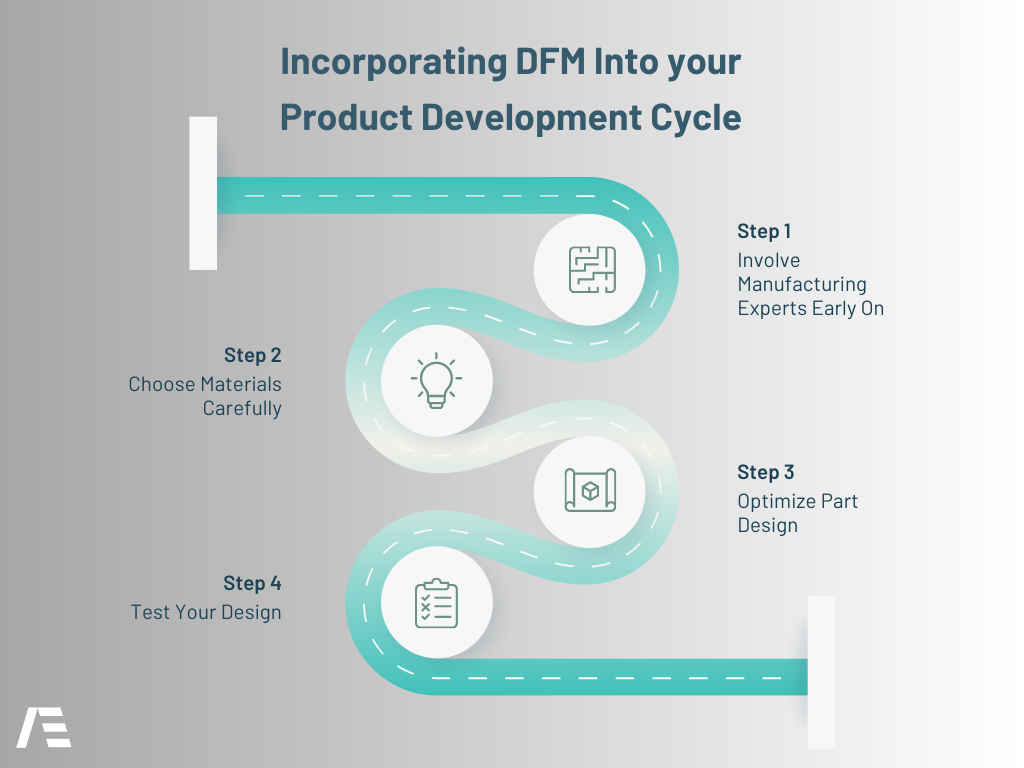
This coordination ensures that downstream considerations, like manufacturability, are addressed early. For example, instead of finishing a design and then "throwing it over the wall" to the manufacturing team, a structured process brings manufacturing expertise into the design phase. This practice is a core tenet of Design for Manufacturability (DFM).
3. Ensures Market Fit
The most elegant engineering solution is a failure if no one wants to buy it. Structured processes force you to start with and continually return to the user's needs. You define the problem before you start designing the solution. This customer-centricity is the heart of modern product development.
4. Facilitates Learning and Consistency
By documenting the process and key decisions at each stage, you create a "design history file." This is invaluable for:
- Bringing new team members up to speed.
- Revisiting past decisions to understand the trade-offs that were made.
- Analyzing what worked and what didn't to improve your process for the next project.
A Structured Process in Action: A Case Study
Theory is helpful, but seeing a process in action makes it concrete. Let's look at a real-world example. The following video documents the creation of a physical product—a desk accessory—using a popular framework called the Double Diamond.

Watch how the designer, Matthew Encina, and his collaborators move through distinct phases of divergent (exploratory) and convergent (focused) thinking.
How I Brought My First Product to Market – Idea to Launch
In 'How I Brought My First Product to Market', designer Matthew Encina provides a fantastic, practical walkthrough of a structured design process.
Watch the video from 00:52 to 05:33. Notice how the process is broken down into four distinct phases: Discover (01:20): Exploring the problem broadly (interviews, observation). Define (02:32): Narrowing down to a specific problem to solve. Develop (03:18): Exploring potential solutions (sketching, prototyping). Deliver (04:33): Refining a single solution and preparing it for manufacturing.
This case study beautifully demonstrates the rationale we've been discussing. The team didn't just jump to sketching products. They started by deeply understanding the user's problem ("Discover"), articulating a clear design challenge ("Define"), and only then did they start exploring solutions ("Develop"). This structured approach ensured they were solving the right problem and that their final design was thoughtful and well-considered.
Conclusion
In this lesson, we established the fundamental "why" behind structured product development. It's not about adding unnecessary steps but about instilling a discipline that leads to better outcomes.
Key Takeaways:
- A structured product development process provides a roadmap to transform an idea into a successful product.
- It improves design outcomes by reducing risk, ensuring customer focus, coordinating cross-functional teams, and building a foundation for continuous improvement.
- Frameworks like the Double Diamond provide a practical way to move from understanding a problem to delivering a refined solution.
- Integrating considerations like manufacturing and material selection early in the process—a natural result of a structured approach—prevents costly errors and delays.
Now that you understand the rationale for having a structured process, our next lesson will compare some of the most widely used methodologies: Stage-Gate, Design Thinking, and Lean Startup. We'll examine their different strengths and see how you might select the right one for a given project.