Hello! Welcome to the final lesson in our module on Testing in Django.
So far, you've gained practical experience writing tests for your models, views, and DRF API endpoints. The tests we've written have been crucial for verifying that different parts of our application work together. For instance, when testing a view, we checked everything from the URL routing to the database query and the final rendered response. These are examples of integration tests.
Today, we'll formalize this concept and explore the fundamental difference between the two primary types of automated tests. Our goal is to differentiate between unit tests and integration tests in a Django context. Understanding this distinction is key to building a test suite that is fast, reliable, and easy to maintain, giving you the confidence to make changes and deploy your application.
1. An Introduction to Test Types
At a high level, automated tests are pieces of code that check if other pieces of code are working correctly. However, not all tests are created equal. They differ in scope, speed, and purpose. The two most common types you'll encounter are unit tests and integration tests.
Django Testing Tutorial - What Is Testing? #1
To start, let's get a clear, high-level definition of these concepts. The video 'Django Testing Tutorial - What Is Testing?' provides a concise explanation.
Watch from 02:42 to 03:46. Pay attention to the core idea of each test type: Unit tests: Focus on a single piece of code independently. Integration tests: Focus on how multiple pieces of code work together.
As the video explained, unit tests are about isolation, while integration tests are about interaction. Let's dive deeper into what this means within a Django project.
2. Unit Tests vs. Integration Tests in Django
The best way to understand the difference is to see how each applies to the components of a Django application.
Django Testing Complete Guide: Unit Tests vs Integration ...
The article 'Django Testing Complete Guide' by Sizan Mahmud gives excellent, Django-specific definitions and examples for both unit and integration tests. It also lists the pros and cons of each.
Please read the sections titled '1. Unit Tests' and '2. Integration Tests'. As you read, focus on: What each test type typically covers in Django (e.g., model methods vs. view logic). The pros and cons, especially regarding speed and scope. The code examples provided for each.
Unit Tests: Testing in Isolation
As the article highlighted, a unit test verifies a single, small piece of functionality in isolation from the rest of the system.
- Scope: A single function, a method on a class, or a specific piece of logic.
- Key Characteristic: They do not interact with external systems like a database, the file system, or network services. This makes them extremely fast.
- In Django, this means testing things like:
- A custom method on a model that performs a calculation.
- A utility function that formats data.
- The validation logic within a
ModelForm. - The transformation logic in a DRF
Serializer.
Because they don't use the database, unit tests in Django should inherit from django.test.SimpleTestCase, not django.test.TestCase.
Integration Tests: Testing the Connections
An integration test verifies that several components ("units") work together as expected.
- Scope: A user workflow or a feature that involves multiple parts of your application.
- Key Characteristic: They do interact with other components and external systems (like a test database). This is what you've been doing in the previous lessons!
- In Django, this means testing things like:
- The full request-response cycle of a view.
- An API endpoint, from routing to serialization to database access.
- A form submission that creates or updates a model instance.
A dead giveaway for an integration test in Django is the use of the test client (self.client.get(), self.client.post(), etc.), as this simulates a request that goes through many layers of the framework. Because they need a database, these tests inherit from django.test.TestCase or rest_framework.test.APITestCase.
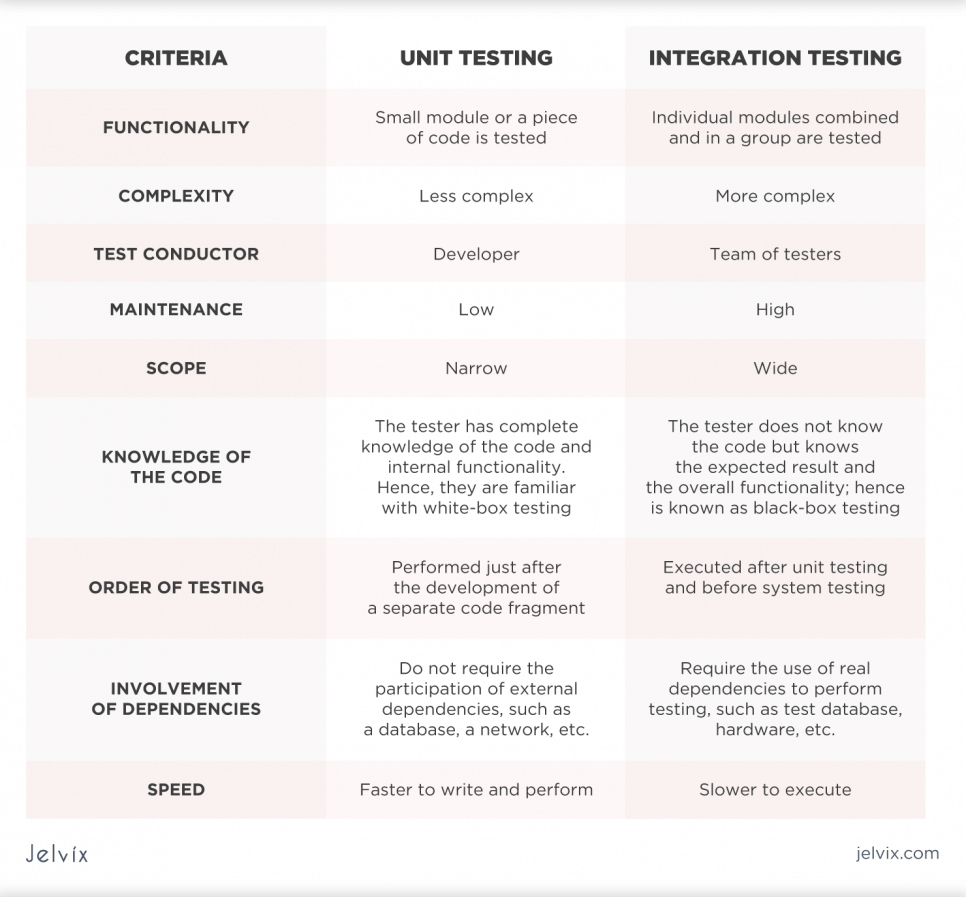
3. A Side-by-Side Comparison
Let's consolidate the differences into a clear comparison.
Unit and Integration testing COMPARED
The video 'Unit and Integration testing COMPARED' provides a great verbal walkthrough of these differences, reinforcing the points in the table.
Watch the comparison segment from 02:20 to 03:43. Notice the discussion on complexity, developer involvement, and dependency management.
4. A Practical Django Example
Let's make this concrete. Imagine we have a Product model with a method to calculate a sale price.
# models.py
from django.db import models

class Product(models.Model):
    name = models.CharField(max_length=100)
    price = models.DecimalField(max_digits=6, decimal_places=2)

    def get_sale_price(self, discount_percent):
        """Calculates the price after a percentage discount."""
        if not 0 <= discount_percent <= 100:
            raise ValueError("Discount must be between 0 and 100.")

        discount_amount = self.price * (discount_percent / 100)
        return self.price - discount_amount
The Unit Test
We want to test the get_sale_price logic by itself. We don't need a database for this; we just need a Product object in memory.
# tests.py
from django.test import SimpleTestCase
from .models import Product

class ProductMethodTests(SimpleTestCase):
    def test_get_sale_price_logic(self):
        """
        Unit test for the get_sale_price method's calculation.
        This test does not touch the database.
        """
        # Arrange: Create a Product instance in memory
        product = Product(name="Test Product", price=100.00)

        # Act & Assert
        self.assertEqual(product.get_sale_price(20), 80.00)
        self.assertEqual(product.get_sale_price(50), 50.00)

        # Assert that it handles edge cases
        with self.assertRaises(ValueError):
            product.get_sale_price(110) # Invalid discount
This is a unit test: It's fast, isolated, and tests only the calculation logic of one method.
The Integration Test
Now, let's say we have an API endpoint that displays the product's sale price. A test for this endpoint would be an integration test.
# tests.py
from rest_framework.test import APITestCase
from rest_framework import status
from django.urls import reverse
from .models import Product

class ProductAPITests(APITestCase):
    def test_product_sale_endpoint(self):
        """
        Integration test for the product sale API endpoint.
        This test involves the URL router, view, model, and serializer.
        """
        # Arrange: Create a real product in the test database
        product = Product.objects.create(name="Live Product", price=200.00)
        url = reverse('product-sale', kwargs={'pk': product.pk}) + '?discount=25' # e.g., /api/products/1/sale/?discount=25

        # Act: Make a request to the API
        response = self.client.get(url, format='json')

        # Assert
        self.assertEqual(response.status_code, status.HTTP_200_OK)
        # Asserts that the final JSON response contains the correct, calculated value
        self.assertEqual(response.data['sale_price'], 150.00)
This is an integration test: It verifies that the URL, view, model method, and serializer all work together correctly to produce the final result.
Test your understanding!
Consider the following test. Is it a unit test or an integration test? Why?
from django.test import TestCase
from django.contrib.auth.models import User

class UserModelTests(TestCase):
    def test_user_creation(self):
        """
        Ensures a user can be created in the database.
        """
        User.objects.create_user(username='test', email='test@test.com')
        self.assertEqual(User.objects.count(), 1)
Show answer
This is an integration test. Although it seems to be testing a small piece of functionality (user creation), it directly interacts with an external system: the database. It inherits from TestCase, which sets up a test database, and it uses User.objects.create_user() and User.objects.count() which execute real SQL queries. A pure unit test would use mocks to avoid touching the database entirely.
5. The Testing Pyramid: A Strategy for Success
So, which type of test should you write? The answer is both! A robust testing strategy uses a mix of tests, guided by a concept called the Testing Pyramid.
The Testing Pyramid model. Credit: Martin Fowler's blog, originally by Mike Cohn.
The pyramid illustrates the ideal distribution of tests:
- Unit Tests (Base): Write lots of these. They are fast to run, easy to write, and precisely pinpoint failures in your core business logic.
- Integration Tests (Middle): Write a good number of these. They are slower but give you confidence that the different parts of your application are wired together correctly. The view and API tests you've written fall here.
- End-to-End (E2E) Tests (Top): Write very few of these. They test the entire application from a user's perspective (e.g., automating a web browser). They are slow, brittle, and expensive to maintain, so they should be reserved for only the most critical user workflows.
By following this model, you create a test suite that is both comprehensive and fast enough to run frequently.
Conclusion
Congratulations on completing the testing module! You now understand not just how to write tests in Django, but also the strategy behind what to test and how to test it.
Key Takeaways:
- Unit Tests are fast, isolated tests for a single piece of code (like a function or method) that do not touch external systems like the database. Use
SimpleTestCase. - Integration Tests are slower tests that verify multiple components work together correctly. They often use a test database and the test client. Use
TestCaseorAPITestCase. - The tests you wrote for views and APIs are classic examples of integration tests.
- The Testing Pyramid is a strategic guide: build a large base of fast unit tests, a smaller layer of integration tests, and a tiny cap of end-to-end tests.
Next Up
Having a solid, well-structured test suite is a prerequisite for confidently deploying an application to the real world. In our next module, "Deployment Fundamentals," we will begin exploring that process. The first lesson will focus on how to manage project settings for different environments (development vs. production), a critical step in preparing your Django project for launch.