Hello! Welcome to the first lesson of our new module, "The Solid Earth: Plate Tectonics and Associated Hazards."
In our last module, we explored the hydrosphere, culminating in our study of the powerful ocean-atmosphere interactions of ENSO. We now shift our focus from the fluids that cover our planet to the solid ground beneath our feet. This module will explore the dynamic forces that shape continents, build mountains, and trigger earthquakes and volcanic eruptions.
Today's lesson addresses the first, most fundamental question: What is the Earth made of? We will work towards the learning outcome: Describe the layered internal structure of the Earth (crust, mantle, core). We will embark on a virtual journey to the center of the Earth to understand its composition and physical state. This knowledge is the bedrock upon which the entire theory of plate tectonics is built.
1. How Do We Know What's Inside the Earth?
Humans have never drilled deeper than a few kilometers, a mere scratch on the Earth's 6,370 km radius. So, how do we know what lies deep within?
Our primary evidence comes not from direct observation, but indirectly, from studying the energy waves released by earthquakes. These are called seismic waves.
To begin, let's explore the sources of information we use to understand Earth's interior, with a special focus on these crucial seismic waves.
Internal Structure of the Earth | World Physical Geography | Geomorphology| Dr. Krishnanand
This video from Dr. Krishnanand provides a great overview of the direct and indirect sources of information about Earth's interior. It then clearly explains the two main types of seismic waves and the concept of 'shadow zones,' which are key to our understanding.
Please watch two segments from this video: 00:11 - 03:44: Focus on the distinction between direct sources (like mining) and indirect sources (like seismic waves). 09:06 - 13:45: This is the most important part. Pay close attention to the characteristics of P-waves and S-waves and how their different behaviors create shadow zones. Understand why the S-wave shadow zone is so significant.
As the video explained, our most powerful tool is seismology. Here’s a summary of the key concepts:
- Primary Waves (P-waves): These are compression waves, like a push through a Slinky. They are faster and can travel through both solid rock and liquid material.
- Secondary Waves (S-waves): These are shear waves, moving material up and down or side-to-side. They are slower and, crucially, cannot travel through liquids. A liquid cannot sustain a shear force.
- Shadow Zones: The fact that S-waves are not detected on the opposite side of the Earth from an earthquake creates a large S-wave shadow zone. This is the definitive evidence that a large part of the Earth's core is liquid. The more complex P-wave shadow zone, caused by waves bending (refracting) at the core boundary, allows scientists to calculate the precise size of the core.
2. Two Ways to Layer the Earth
Based on the evidence from seismic waves, along with studies of gravity and Earth's magnetic field, scientists have determined that the Earth is not uniform. It is arranged in a series of concentric layers.
A common point of confusion is that there are two different, equally valid ways to define these layers:
- By Chemical Composition: Based on what the layers are made of (rock vs. metal).
- By Mechanical Properties: Based on how the layers behave physically (e.g., solid, liquid, weak, or strong).
This distinction is vital for understanding plate tectonics.
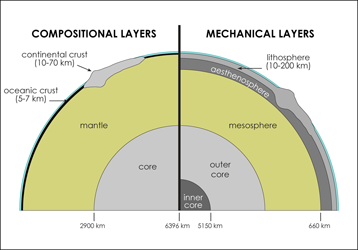
To get a clear overview of both classification systems, let's watch a short, focused video.
Geomorphology Intro and Earth Structure
This video by Susan Mahoney provides a very clear, side-by-side explanation of the two classification systems. It's an excellent way to build a mental model of these concepts.
Watch from 02:41 to the end (11:49). The first part covers the three compositional layers (crust, mantle, core), and the second part covers the five mechanical layers. Focus on the reason for the differences, particularly the interplay of temperature and pressure.
Now that you have a solid overview from the video, let's organize and reinforce these concepts.
3. The Compositional Layers: What It's Made Of
This is the simpler classification, dividing the Earth into three layers based on their chemical makeup.

-
Crust: The outermost, thinnest layer, composed of relatively light rock. It makes up less than 1% of Earth's mass. There are two types:
- Continental Crust: Thicker (average 25 miles/40 km), less dense, and primarily granitic in composition. This is the rock that makes up the landmasses.
- Oceanic Crust: Thinner (average 5 miles/8 km), denser, and composed of basalt. This is the rock that forms the ocean floors.
-
Mantle: The thickest layer, extending down about 1,800 miles (2,900 km). It makes up about 84% of Earth's volume. It is composed of dense, iron- and magnesium-rich rock, most notably a type called peridotite.
-
Core: The innermost layer, with a radius of about 2,200 miles (3,500 km). It is composed of a very dense mixture of metals, primarily iron and nickel.
4. The Mechanical Layers: How It Behaves
This classification is based on physical properties and is more important for understanding plate tectonics. It divides the Earth into five layers.
Let's refer back to the right side of the "Earth Structure" diagram (LINK).
-
Lithosphere ("rocky sphere"): This is the rigid, brittle outer shell of the Earth. Crucially, it consists of the entire crust PLUS the very top, rigid part of the mantle. The "plates" in plate tectonics are pieces of the lithosphere.
-
Asthenosphere ("weak sphere"): Located entirely within the upper mantle, just below the lithosphere. This layer is not fully liquid, but it is so hot that it becomes "plastic" or ductile—it can flow very slowly over geologic time, like extremely thick tar. The rigid lithospheric plates float and move upon this weak, flowing layer.
-
Mesosphere (or Lower Mantle): Below the asthenosphere, the mantle becomes solid and rigid again. Although the temperature is even higher, the immense pressure keeps the rock from flowing, making it much stronger than the asthenosphere.
-
Outer Core: This layer is liquid. The temperatures are high enough to melt the iron-nickel alloy. The constant churning and convection of this liquid metal generates Earth's magnetic field. This is the layer that stops S-waves.
-
Inner Core: Despite being the hottest layer, the pressure at the very center of the Earth is so extreme that it forces the iron-nickel alloy into a solid state.
To consolidate these details, let's do a final reading.
The article 'Earth Structure' from Visionlearning provides an excellent written summary of everything we've covered, from seismic evidence to the two classification systems.
Please read the sections titled 'Compositional layers' and 'Mechanical layers'. As you read, compare the descriptions to the video you just watched and the diagrams in this lesson.
5. Discontinuities: The Boundaries
The boundaries between these layers are not perfectly smooth. They are transition zones known as discontinuities, identified by abrupt changes in the speed of seismic waves. You don't need to memorize them all, but it's good to know the names of the major ones:
- Mohorovičić Discontinuity (Moho): The boundary between the crust and the mantle.
- Gutenberg Discontinuity: The boundary between the mantle and the outer core.
- Lehmann Discontinuity: The boundary between the liquid outer core and the solid inner core.
Test your understanding!
Imagine you are tracing the path of a tectonic plate. According to the mechanical classification, which layer constitutes the plate itself? And which layer does it move upon? Now, using the compositional classification, what two different layers make up the tectonic plate?
Show answer
- Using the mechanical classification, the plate is the Lithosphere, and it moves upon the Asthenosphere.
- Using the compositional classification, the plate (the lithosphere) is made up of the Crust and the uppermost part of the Mantle. This shows why both classification systems are necessary to fully describe the Earth's structure and dynamics.
Conclusion
In this lesson, we have journeyed to the center of the Earth and back. We've seen how scientists use indirect evidence, primarily from seismic waves, to map out our planet's interior. You are now equipped to describe this complex structure using two complementary classification systems.
Key Takeaways:
- Our knowledge of Earth's interior comes from indirect evidence, mainly the behavior of P-waves and S-waves from earthquakes.
- The S-wave shadow zone provides definitive proof of a liquid outer core.
- Earth's layers can be classified by composition: the rocky Crust, the denser Mantle, and the metallic Core.
- They can also be classified by mechanical properties: the rigid Lithosphere (crust + upper mantle), the plastic Asthenosphere, the solid Mesosphere, the liquid Outer Core, and the solid Inner Core.
- The concept of a rigid lithosphere floating on a flowing asthenosphere is the physical basis for plate tectonics.
Preview of the Next Lesson:
Now that we understand the fundamental layered structure of the Earth, we are ready to explore how this structure allows for the movement of continents. In our next lesson, we will trace the development of plate tectonic theory from the early ideas of continental drift to the revolutionary discovery of seafloor spreading. We will see how accumulating evidence gradually transformed a radical hypothesis into the central organizing theory of modern geology.