Hello! Welcome to the next stage of our journey into climatology.
In our last lesson, we learned how to interpret temperature patterns on a map using isotherms. We saw that the Earth is heated unevenly, creating warm and cold regions. This fundamental fact is the starting point for everything that happens next in the atmosphere. The differences in temperature are the primary engine driving global weather.
Today, we will explore the direct consequence of this uneven heating: variations in atmospheric pressure. This lesson addresses the learning outcome: Explain the concept of atmospheric pressure and the factors that affect it. Understanding pressure is the key that unlocks why winds blow, why storms form, and how weather systems move.
We will proceed systematically:
- Define atmospheric pressure and its vertical changes.
- Investigate the primary factors that cause pressure to differ from place to place, focusing on temperature, humidity, and air movement.
1. What is Atmospheric Pressure?
At the most basic level, atmospheric pressure is simply the weight of the air in the atmosphere pressing down on the Earth's surface. The air may feel weightless, but the column of air stretching hundreds of kilometers above you has mass and is pulled down by gravity.
To begin, let's watch a short segment from Crash Course Geography that introduces this idea.
Where Does Wind Come From? Crash Course Geography #8
This video, 'Where Does Wind Come From?', offers a clear and engaging introduction to the concept of atmospheric pressure.
Please watch from 01:39 to 02:26. Focus on how the video defines atmospheric pressure as the weight of air and why we don't feel this pressure.
As the video explains, we aren't crushed by this pressure because the air and fluids inside our bodies exert an equal pressure outward.
For a more formal definition, we can turn to our textbook resources.
ATMOSPHERIC CIRCULATION AND WEATHER SYSTEMS
This excerpt from the NCERT textbook 'ATMOSPHERIC CIRCULATION AND WEATHER SYSTEMS' provides a precise definition of atmospheric pressure and introduces the units used to measure it.
Please read the two short paragraphs under the heading 'ATMOSPHERIC PRESSURE'. Focus on the definition, the standard units (milibar), the average sea-level pressure, and the instruments used for measurement.
From this reading, let's establish a few key points:
- Definition: Atmospheric pressure is the weight of a column of air above a unit area.
- Measurement: It is measured using a barometer (mercury or aneroid).
- Units: The standard unit in meteorology is the milibar (mb). The average pressure at sea level is 1,013.2 mb. You may also see pressure reported in inches of mercury (used in US weather reports) or hectopascals (hPa), which are equivalent to millibars (1 mb = 1 hPa).
2. Vertical Variation of Pressure: The Role of Altitude
The single biggest factor determining pressure at a location is its altitude. As you go higher, there is less air above you, so the weight of the air column is less, and therefore the pressure is lower.
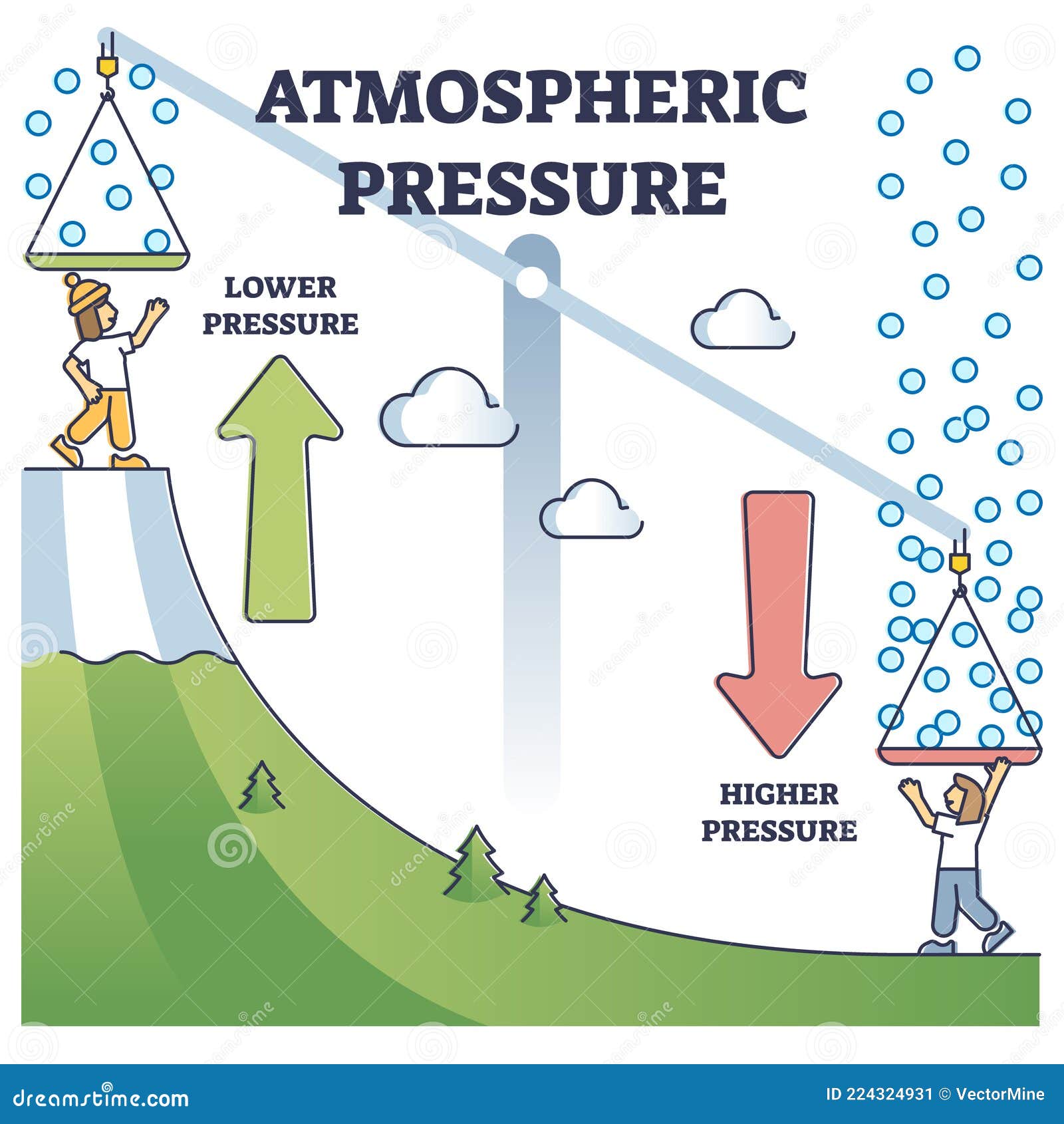
Let's watch a detailed explanation of this effect.
Factors Affecting Air Pressure
The video 'Factors Affecting Air Pressure' provides excellent, intuitive examples of how altitude affects pressure, including the relatable experience of 'ear-popping' in an airplane.
Please watch from 03:58 to 07:10. Pay close attention to the examples of the mountain climber and the airplane journey to understand this relationship.
The key takeaway is simple: As altitude increases, atmospheric pressure decreases.
This decrease is quite rapid near the surface. The NCERT textbook (LINK) notes that in the lower atmosphere, pressure decreases by about 1 mb for every 10 meters of elevation gained. This is why mountaineers need supplemental oxygen at extreme heights—the pressure is so low that the air is too thin to breathe effectively.
3. Horizontal Variation of Pressure: What Creates Highs and Lows?
While altitude causes the largest changes in pressure, meteorologists are most interested in the horizontal differences in pressure at the surface. These differences, though small, are what drive the wind. We correct for altitude by converting all pressure readings to what they would be at sea level.
So, what causes these crucial horizontal variations? There are three main factors.
Factor 1: Temperature
This is the most direct link to our previous lessons. The temperature of the air has a profound effect on the pressure it exerts.

Let's explore the mechanism behind this relationship.
Factors Affecting Air Pressure
We'll return to the 'Factors Affecting Air Pressure' video, which provides a clear explanation of how temperature influences air density and pressure.
Please watch from 01:09 to 02:08. Focus on the concept of air molecules expanding when heated and contracting when cooled.
To summarize this critical point:
- When air is heated, it expands, becomes less dense, and tends to rise. This results in less weight pressing on the surface, creating an area of lower pressure.
- When air is cooled, it contracts, becomes denser, and tends to sink. This results in more weight pressing on the surface, creating an area of higher pressure.
This is why, generally speaking, warm equatorial regions are associated with low pressure, and cold polar regions are associated with high pressure.
One important detail for a deeper understanding is that this inverse relationship works because the atmosphere is an open system. As explained in the "Pressure" resource from weather.gov (LINK), if you heat air in a sealed box, the pressure increases. But in the open atmosphere, the heated air is free to expand upwards, which reduces its density at the surface, thereby lowering the pressure.
Factor 2: Humidity (Water Vapor)
This factor is often counter-intuitive. Many people assume that humid, moisture-laden air is "heavier" than dry air. The opposite is true.
The video you watched earlier explains this concept brilliantly.
Factors Affecting Air Pressure
Let's revisit the 'Factors Affecting Air Pressure' video one last time to understand the surprising effect of humidity.
Please watch from 02:08 to 03:58. The key is understanding which molecules are being displaced when water vapor enters the air.
The science is as follows: The Earth's atmosphere is mostly made of nitrogen molecules (N₂) and oxygen molecules (O₂). When water evaporates, water molecules (H₂O) enter the air. A molecule of water has less mass than a molecule of either nitrogen or oxygen. Therefore, when water vapor displaces the heavier nitrogen and oxygen molecules, the overall air mass in that volume becomes lighter and less dense.
So, the rule is: As humidity increases, air pressure decreases.
Factor 3: Air Circulation (Convergence and Divergence)
Temperature and humidity create thermal pressure differences. However, pressure is also strongly affected by the large-scale movement of air, known as dynamic factors.
This text from weather.gov provides clear definitions for the key circulation patterns that influence surface pressure.
Please read section 'VI. Circulations - definitions'. Focus on the definitions for 'Divergence', 'Convergence', 'High pressure (anticyclone)', and 'Low pressure (cyclone)'.
Let's simplify these concepts:
- Convergence: When air flows together horizontally, it "piles up" and has nowhere to go but up. This upward motion is called ascent. Rising air means less weight on the surface, creating Low Pressure.
- Divergence: When air flows apart horizontally, a void is created. Air from above sinks down to fill this void. This downward motion is called subsidence. Sinking air adds weight to the surface, creating High Pressure.
These dynamic factors can be even more important than thermal factors in creating the powerful high and low-pressure systems you see on a weather map. The weather associated with these systems is a direct result of the air's vertical motion. Rising air in a low-pressure system cools, forms clouds, and often leads to precipitation. Sinking air in a high-pressure system warms and dries out, leading to clear, sunny skies.
Test your understanding!
Imagine two coastal locations, both at sea level.
- Location A is in the tropics. The air is warm (30°C) and very humid.
- Location B is in the arctic. The air is frigid (-10°C) and very dry.
Which location would you expect to have lower atmospheric pressure, and why? Justify your answer based on the factors of temperature and humidity.
Show answer
Location A would have significantly lower atmospheric pressure.
- Temperature Effect: The air at Location A is very warm, causing it to be expanded and less dense. This leads to lower pressure. The air at Location B is very cold, making it contracted and dense, which leads to higher pressure.
- Humidity Effect: The air at Location A is very humid. The lighter water vapor molecules displace heavier nitrogen and oxygen molecules, further reducing the air's density and pressure. The air at Location B is very dry, meaning it is composed almost entirely of the heavier nitrogen and oxygen, contributing to higher pressure.
Both factors work together to make the pressure at Location A much lower than at Location B.
Conclusion
Today, we established the fundamental concept of atmospheric pressure and explored the factors that cause it to vary. This knowledge is the bedrock for understanding atmospheric motion.
Key Takeaways:
- Atmospheric pressure is the weight of the air column above a surface, typically measured in milibars (mb).
- Pressure decreases rapidly with increasing altitude because the column of air above gets shorter and less dense.
- Horizontally, pressure is influenced by three main factors:
- Temperature: Warm air is less dense and exerts lower pressure. Cold air is denser and exerts higher pressure.
- Humidity: Moist air is less dense (lighter) than dry air and therefore exerts lower pressure.
- Circulation: Rising air (convergence) creates low pressure, while sinking air (divergence) creates high pressure.
Preview of the Next Lesson:
Now that you understand why pressure varies, our next step is to learn how to visualize these variations on a map. In the next lesson, we will focus on the learning outcome: Interpret isobars and pressure patterns (highs, lows) on weather maps. Just as we used isotherms to map temperature, we will use isobars to map pressure and begin to see the direct relationship between pressure patterns and the wind.