Hello! Welcome to our next lesson on atmospheric dynamics.
In our last session, we mapped out the Earth's global pressure belts—the semi-permanent bands of high and low pressure that circle the globe. We learned how they are formed by either direct solar heating (thermal) or the mechanics of air movement (dynamic), and how they shift with the seasons.
Today, we will connect those pressure belts to the winds that flow between them. This will allow us to build the master blueprint for global air movement: the three-cell model of atmospheric circulation. This model is fundamental to climatology as it explains the existence and patterns of our planet's most significant wind systems.
Your learning outcome for this lesson is to: Analyze the three-cell model of global circulation, including trade winds, westerlies, and polar easterlies.
We will take a systematic approach, starting with a simple thought experiment to understand the basic principles, before building the complete, more realistic model that accounts for the Earth's rotation.
1. From a Simple Idea to a Complex Reality
In the last lesson, we established a clear pattern of global pressure: low pressure at the equator and 60° latitudes, and high pressure at the poles and 30° latitudes. Since air flows from high to low pressure, what kind of circulation would this create on a simplified Earth?
Let's begin by reading about this simplified "single-cell model" and why it's not quite right for our planet.
Chapter 11: General Circulation
The following text from 'Atmospheric Processes and Phenomena' introduces the concept of a single-cell circulation model for a non-rotating Earth. Understanding this simple model is the first step to appreciating why the more complex three-cell model is necessary.
Please read the section titled 'Single-Cell Model'. Focus on how temperature differences would drive a single large circulation cell in each hemisphere and, crucially, why the Earth's rotation (and the Coriolis effect) makes this model incomplete.
As you've just read, on a non-rotating Earth, the circulation would be beautifully simple:
- Hot air would rise at the equator (low pressure).
- It would flow towards the poles in the upper atmosphere.
- It would cool, sink at the poles (high pressure), and then flow back towards the equator along the surface.
This single, thermally direct circulation is called a Hadley Cell. However, the Earth does rotate. As the poleward-moving air in the upper atmosphere travels, the Coriolis effect deflects it so strongly that it never reaches the poles. This "breaks" the single large cell into three smaller, distinct cells in each hemisphere.
2. The Three-Cell Model: Earth's Atmospheric Engine
We will now build the complete three-cell model, which includes the Hadley, Ferrel, and Polar cells. This model is the key to understanding the major wind belts that dominate our planet's surface.
Chapter 11: General Circulation
We will now return to the same resource, which provides an excellent, detailed breakdown of the three-cell model. This section is the core of today's lesson.
Please read the section titled 'Three-Cell Model'. As you read, focus on identifying the following for each of the three cells (Hadley, Ferrel, and Polar): The latitudes it operates between. Where the air rises and where it sinks. The name of the resulting surface wind belt and its general direction.
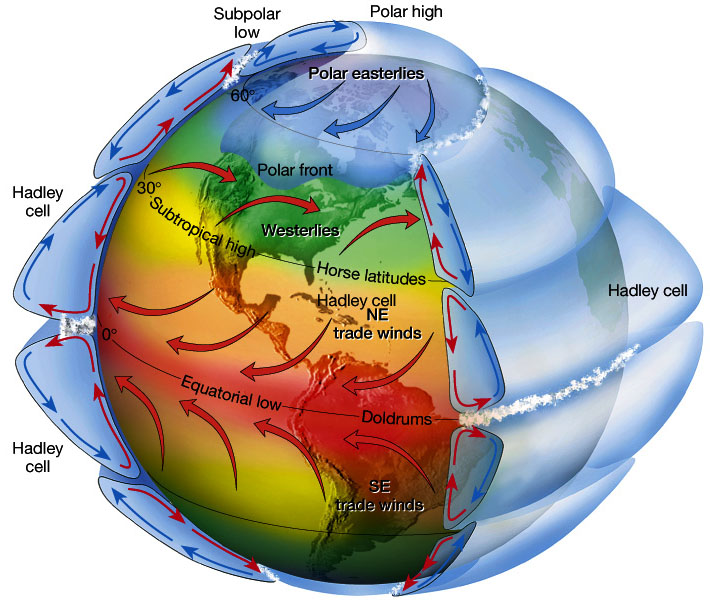
Let's break down and visualize what you've just read. The diagram below shows the complete model, which we will now unpack piece by piece.

a) The Hadley Cell (0° to 30° Latitude)
This is a powerful, thermally driven cell that functions much like the one in our simple model, but over a smaller area.
- Process: Warm, moist air rises at the Equatorial Low (ITCZ), moves poleward in the upper atmosphere, cools, and sinks over the Subtropical Highs around 30° N/S.
- Surface Winds: Air at the surface flows from the Subtropical High back toward the ITCZ to replace the rising air. The Coriolis effect deflects this flow, creating the steady and reliable Trade Winds.
- In the Northern Hemisphere, they are deflected to the right, becoming the Northeast Trades.
- In the Southern Hemisphere, they are deflected to the left, becoming the Southeast Trades.
b) The Polar Cell (60° to 90° Latitude)
This is another, smaller, thermally driven cell at the top of the world.
- Process: Extremely cold, dense air sinks at the Polar High, flows along the surface toward the equator, and is forced to rise at the Subpolar Low around 60° N/S where it meets warmer air.
- Surface Winds: The surface flow from the poles toward 60° latitude is deflected by the Coriolis effect, creating the Polar Easterlies.
c) The Ferrel Cell (30° to 60° Latitude)
This middle cell is different. It's not driven by temperature but is more like a gear caught between the powerful Hadley and Polar cells. It is a thermally indirect cell because it involves cool air rising and warm air sinking.
- Process: Air sinks at the warm Subtropical High (30°) and flows poleward at the surface. At around 60° latitude, it collides with the cold air from the Polar cell, is forced to rise over the Subpolar Low, and then returns toward the subtropics at high altitude to complete the loop.
- Surface Winds: The surface air moving from the Subtropical High (30°) toward the Subpolar Low (60°) is deflected by the Coriolis effect, creating the Prevailing Westerlies. These are the winds that bring weather systems across regions like the continental United States and most of Europe.
The image below gives a 3D perspective of these cells and wind belts on the globe itself.
Test your understanding!
Match the wind belt to the circulation cell that creates it.
| Wind Belt | Circulation Cell |
|---|---|
| 1. Trade Winds | A. Ferrel Cell |
| 2. Prevailing Westerlies | B. Polar Cell |
| 3. Polar Easterlies | C. Hadley Cell |
Show answer
- Trade Winds are created by the Hadley Cell (C).
- Prevailing Westerlies are created by the Ferrel Cell (A).
- Polar Easterlies are created by the Polar Cell (B).
3. Seeing the System in Motion
Now that we've built the model step-by-step, let's watch a video that puts it all together. This will help reinforce the connections between pressure, circulation, and the winds you've just learned about.
Global Pressures and Wind Belts
The video 'Global Pressures and Wind Belts' provides a clear, animated summary of how the pressure belts drive the formation of the wind systems within the three-cell model.
Please watch the video from 01:20 to 08:22. As you watch, pay attention to: How rising and sinking air create the pressure belts (01:20 - 05:30). How the flow of air between these belts, deflected by Coriolis, creates the trade winds, westerlies, and polar easterlies (05:30 - 08:22). The final part of the video (08:22 - 10:50) gives some interesting historical context for the names 'doldrums' and 'horse latitudes,' which you might find interesting.
The video provides a great dynamic summary of the entire system. Notice how winds are always named for the direction from which they come. The Northeast Trades come from the northeast, and the Westerlies come from the west.
Conclusion
Today, you have assembled one of the most important conceptual models in physical geography. By understanding the three-cell model, you can now explain the fundamental pattern of the planet's major winds, which are a critical component of global climate.
Key Takeaways:
- The uneven heating of Earth and its rotation cause the simple, single-cell circulation to break down into a three-cell model in each hemisphere.
- The Hadley Cell (0°-30°) is a strong, thermally direct cell that creates the Trade Winds.
- The Polar Cell (60°-90°) is a smaller, thermally direct cell that creates the Polar Easterlies.
- The Ferrel Cell (30°-60°) is a mechanically driven, thermally indirect cell that results in the Prevailing Westerlies.
- Together, these cells and their associated winds form a global system that transports heat from the equator toward the poles.
Preview of the Next Lesson:
The three-cell model describes circulation on a planetary scale. However, this global pattern is modified by smaller, more localized factors. In our next lesson, we will zoom in to examine local wind systems, such as the land and sea breezes you experience at the coast, and the mountain and valley winds that are common in rugged terrain.