Hello! Welcome to the first lesson in our new module, The Hydrosphere: Oceans and the Water Cycle.
In our previous module, we concluded by seeing how interconnected the atmosphere and oceans are in shaping global climates. You learned how ocean currents, driven by wind and density, transport enormous amounts of heat and are a critical piece of the climate puzzle. That was a perfect bridge to this module, where we will shift our focus from the air above to the water that covers our planet.
Today's lesson addresses the learning outcome: Describe the distribution of water on Earth and the concept of the global water budget. We'll start by taking a complete inventory of Earth's water—where it is, and in what form. Then, we'll introduce a fundamental concept for understanding how this water moves: the water budget. This will lay the groundwork for our next lesson on the processes of the water cycle.
1. Earth's Water: A Global Inventory
When we view Earth from space, its most defining feature is the vast expanse of blue ocean. But that's only part of the story. Water exists all over the planet, from frozen glaciers to underground reservoirs. Let's start with a quick and engaging overview.
This short video from NASA's Jet Propulsion Laboratory provides an excellent introduction to Earth's water budget. It uses a helpful analogy to explain how water is distributed across different 'accounts' like oceans, glaciers, and groundwater.
Please watch from the beginning until the 2:33 mark. Pay close attention to the percentages given for different types of water and how accessible each type is for human use.
As the video highlighted, while there is a massive amount of water on Earth, only a tiny fraction of it is freshwater, and even less is easily accessible to us.
Let's visualize this breakdown. The following chart clearly illustrates the hierarchy of Earth's water distribution.
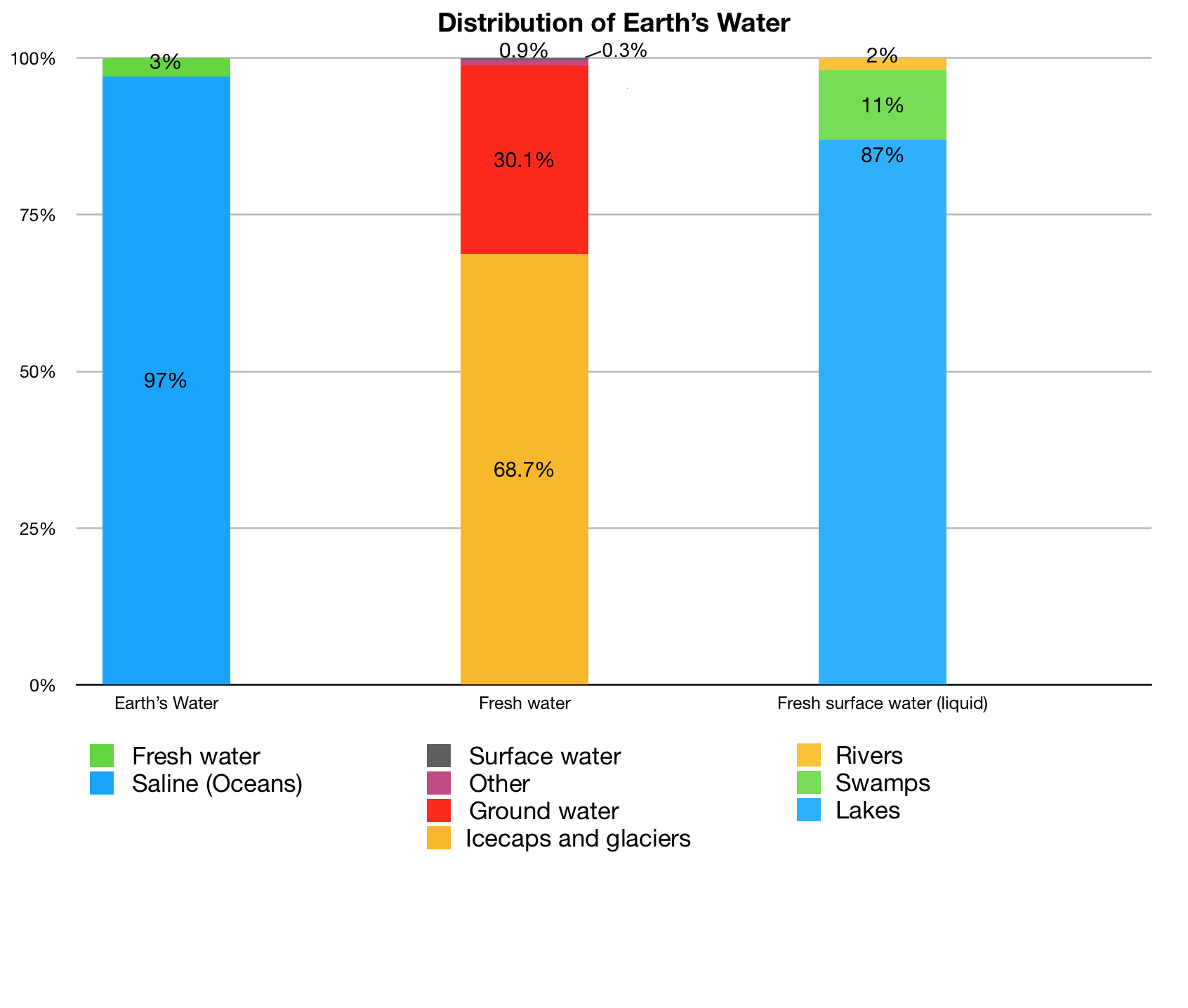
The chart makes a crucial point very clear:
- Total Water: Almost all of it (97%) is saline ocean water. Only 3% is fresh.
- Freshwater: Of that small 3%, the vast majority (over two-thirds) is locked away as ice. Most of the rest is groundwater.
- Surface Freshwater: The water we see in lakes and rivers, which is most accessible for life, makes up an incredibly small fraction of the total.
Now, let's examine these numbers in more detail. The table below, from NASA, provides a comprehensive estimate of global water distribution.
Earth Observatory Water Cycle Overview
This resource from the NASA Earth Observatory provides a detailed table quantifying the Earth's water reservoirs. It gives you the precise numbers behind the charts and percentages we've just seen.
Please carefully study the table titled 'Estimate of Global Water Distribution'. You don't need to memorize the exact volumes, but focus on understanding the relative percentages. Compare the 'Percent of Total Water' column for different reservoirs like oceans, ice caps, and groundwater.
Studying this table reveals a few key insights:
- Oceans are dominant: With 96.5% of all water, the oceans are by far the largest reservoir.
- Freshwater is scarce: All freshwater sources combined (ice, groundwater, lakes, etc.) make up only about 2.5% of the total.
- Most freshwater is frozen: Ice caps and glaciers hold about 68.7% of all freshwater.
- Groundwater is the largest unfrozen freshwater source: It accounts for about 30.1% of all freshwater, far exceeding the amount in lakes and rivers.
- Surface water is a tiny fraction: Rivers, which are so vital to civilization, hold only 0.006% of the world's freshwater.
This static inventory gives us the "where" and "how much." Next, we'll introduce a concept to help us understand how water moves between these reservoirs.
2. The Water Budget: An Accounting System for Water
The total amount of water on Earth is essentially constant. However, it is continuously moving from one reservoir to another—from the atmosphere to the land, from rivers to the ocean, from the ocean back to the atmosphere. To track this movement, hydrologists use a concept called the water budget.
Think of it like a bank account. You have money coming in (inflow), money going out (outflow), and the amount currently in your account (storage). A water budget does the same thing for a specific area, whether it's a small lake, a vast river basin, or the entire planet.
The Water Budget - by Ritchie Cunningham
This article provides a clear definition of the water budget, its core components, and its fundamental equation. It will give you the formal structure for this concept.
Please read the first two sections of the article, from the top down to just before the heading 'Importance of the Water Budget'. Focus on understanding the general equation and the definitions of Inflow, Outflow, and Changes in Storage (ΔS).
As the article explains, the water budget for any given area can be expressed by the simple equation:
Inflow = Outflow ± Change in Storage
Let's break down these components for a typical land area:
- Inflow (Inputs): The primary inflow is Precipitation (rain, snow, hail). In some cases, it can also include water flowing in from rivers or groundwater.
- Outflow (Outputs): Water leaves the system in several ways:
- Evapotranspiration (ET): The combined process of evaporation from surfaces (like soil and lakes) and transpiration from plants.
- Runoff: Water flowing over the land surface into streams and rivers.
- Groundwater Outflow: Water that percolates deep into the ground and flows away underground.
- Change in Storage (ΔS): This is the net change in the amount of water held within the area. If inflow is greater than outflow, storage increases (e.g., soil gets wetter, lake levels rise). If outflow is greater than inflow, storage decreases (e.g., soil dries out, aquifers are depleted).
Over a long period, the global water budget is balanced: the total amount of evaporation equals the total amount of precipitation. However, on regional and local scales, budgets can be in surplus (leading to floods) or deficit (leading to droughts).
Test your understanding!
Imagine a small, forested watershed over the course of a hot summer week. It receives one heavy thunderstorm. The trees release water vapor from their leaves, and the ground, still damp from the rain, dries out. A stream at the bottom of the watershed continues to flow, fed by water from the soil.
Identify one example for each component of the water budget in this scenario:
- Inflow
- Outflow
- Change in Storage
Show answer
- Inflow: The heavy thunderstorm (Precipitation).
- Outflow: Water vapor from trees (Transpiration), water drying from the ground (Evaporation), and water leaving via the stream (Runoff/Outflow).
- Change in Storage: The soil first becomes wetter (positive change in storage) after the rain, then dries out over the week (negative change in storage). The net change over the week depends on whether the inflow was greater or less than the total outflow.
3. Why the Water Budget Matters
This concept of a water budget isn't just an academic exercise; it is a critical tool for managing one of our most precious resources. Understanding the inflows, outflows, and storage changes in a region is fundamental to modern life.
The Water Budget - by Ritchie Cunningham
Let's return to the same article to explore the real-world applications and importance of calculating water budgets.
Now read the sections 'Importance of the Water Budget' and 'Applications of Water Budgets'. As you read, think about how a farmer, a city planner, and a climate scientist might all use water budget information differently.
Understanding the water budget is essential for:
- Water Resource Management: It helps cities and farmers determine how much water is available for use and whether current usage is sustainable.
- Drought and Flood Prediction: A sustained deficit in the water budget warns of a coming drought, while a sudden, large surplus can help predict floods.
- Climate Change Assessment: Long-term changes in budget components, like less rainfall or more evaporation, are key indicators of a changing climate.
- Land Use Planning: Building a city drastically changes the water budget (less infiltration, more runoff). Planners use this knowledge to design drainage systems and manage water quality.
Conclusion
In this lesson, you have taken the first crucial step into the hydrosphere. You've established a clear picture of where Earth's water is located and learned about the profound scarcity of easily accessible freshwater. You were also introduced to the water budget, a powerful conceptual tool for accounting for the movement of water through a system.
Key Takeaways:
- About 97% of Earth's water is saline and found in the oceans.
- Of the ~3% that is freshwater, the vast majority is frozen in glaciers and ice caps. The largest source of liquid freshwater is groundwater.
- Accessible surface water in lakes and rivers constitutes a tiny fraction of the global total.
- The water budget is an accounting system that balances inflows (like precipitation), outflows (like evapotranspiration and runoff), and changes in storage.
- Understanding the water budget is vital for sustainable water management, hazard prediction, and assessing the impacts of climate change.
Preview of the Next Lesson:
Now that we have our inventory (distribution) and our accounting framework (budget), we are ready to explore the engine that drives it all. In the next lesson, we will examine the global hydrological cycle. We will trace the journey of a water molecule as it evaporates, condenses, precipitates, and flows, connecting all the reservoirs we've discussed today.